Austria shows a growing urgency to regain control over data, infrastructure, and digital collaboration. The Austrian Ministry of Economy and the University of Innsbruck are two strong examples of open source adoption in the country’s public sector and education.
TU Wien is another excellent example. Back at the Nextcloud Enterprise Day Vienna, we talked to Jan Vales, System Administrator for the TUcloud at TU Wien. Founded in 1815, it was the first university of technology in present-day German-speaking Europe. The scale makes this story especially interesting: one of the bigger universities in Vienna, it employs around 5,500 staff and enrols around 30,000 students.
In this personal conversation, Jan tells us how a search for phone contact sync 10 years ago led to running Nextcloud for a university of 30,000 people, how share links solved TU Wien’s external collaboration problems, and why he thinks open source should win over closed source.
Hi Jan, could you please introduce yourself and your organization?
Hi, I’m Jan from TU Wien. We’re one of Vienna’s bigger universities, with around 5,500 staff and 30,000 students, and we’re running a new Nextcloud instance migrated from ownCloud.
What first drew you to open source and Nextcloud, and what keeps you engaged today?
I first came into contact with open source through Fedora Core 3 in middle school, so that’s where I first saw Linux. A few years later, I decided to start using it productively, and by now I’ve been Linux-only for 10 years, with no Windows except in a VM for debugging purposes. So I’ve been around for a while now. I like the openness, the idea that people help each other with problems and with source code.
As for how I came to Nextcloud: I needed something to synchronize my contacts and my calendar on my mobile phone. I tried basically all the solutions that were out there, and Nextcloud was the one that actually worked. That was about 10 years ago now. Since then, I’ve been running a few Nextcloud instances. Currently I’m at five or six, mostly for friends, family, the student council, and a few other non-profits.
Later, I joined TU Wien, the central campus IT. There was an ownCloud instance to be run, so I was put there, and that’s how I came to professional Nextcloud operations.
The usage comes from trying it out and seeing that it works. That’s my experience with Nextcloud everywhere: it usually just works. And that’s why people use it, because other systems don’t always work reliably.
Jan Vales
System Administrator for the TUcloud at TU Wien
So you and Nextcloud go way back, even before your current projects. That’s very interesting. Can you share a few ways you use Nextcloud in practice in your organization, and what impact it has had for your team and organization?
I don’t really have a team. But in the organization, at TU Wien, we basically only use the core Nextcloud Files component. This is going to be in my talk too: we’ve solved quite a lot of collaboration problems with it, mainly with people outside TU Wien, because the solutions that existed, and still exist, are inflexible when it comes to working with non-TU people. So share links are the most valuable feature we have.
What lessons from your own experience could be valuable for other organizations considering Nextcloud? Do you have any advice?
I would say: just set it up. I’d expect people to start using it, depending on what the organization already has implemented. For us, for example, the freedom the client gives us, not needing a permanent online connection, is a key feature that draws people in. Suddenly they can work on the train while they’re traveling, and once they’re back on stable internet, the file is synchronized back. That’s a really interesting thing.
I think Nextcloud in general is a great product, and people should be able to experience it and try it out. In my opinion, that by itself draws people in. The usage comes from trying it out and seeing that it works. That’s my experience with Nextcloud everywhere: it usually just works. And that’s why people use it, because other systems don’t always work reliably.
I think that’s because the features Nextcloud offers tend not to have such hard consistency requirements. They’re easier to satisfy, and so it feels better for everyone.
Great. You’ve listed quite a few ways Nextcloud stands out. What role do you think open source plays in that?
Open source in general is a great thing for debugging. You have something running, and then you run into an issue. As we all know, documentation is almost never that great, but that’s true for closed-source products too. The great part about open source is that you can ignore the documentation and start reading the source code to see what the real issue is. At TU Wien, I’ve actually read quite a lot of Nextcloud source code by now, because people come up with unusual issues, and you have to look into what they did wrong, what we did wrong, or what the issue is. So I think it’s a great thing for debugging.
It’s also great that you can fairly easily improve or adapt the product. If you have your Nextcloud, you can change some aspects. Especially now that everything is AI, you can just use AI to create small adaptations quite easily. I’ve actually done that, just for testing purposes, so nothing in production, to explore whether some adaptations could make sense. Mostly it was in database code. So: it’s open, you can read the code, and I think that’s the important part.
Just take debugging: you can debug open source software, while with closed source you can’t. Even if it’s just that, I think it’s a key point that should make open source win over closed source.
Jan Vales
System Administrator for the TUcloud at TU Wien
Thanks. Speaking of open source more generally: do you think interest in open source has evolved in the past year? If so, how, and what trends have you noticed?
I’m not sure how you would measure that. What has definitely increased since Trump took office is that the danger of everything running in the USA has turned up as a real risk, and people are looking for alternatives. Whether those are open source or not isn’t as important, I think. So I have no real way to quantify whether open source solutions are now more popular.
I really hope so, because I’m an open source guy with my whole heart, and because it would at least reduce the risk of just switching from one monolithic big company to another, more ethical big company. With open source, you’re not locked in as much anymore. It’s not a switch from A to B that ends up being the same thing in a different form; it’s actually different.
So I really hope that, in the long term, open source solutions win over closed-source solutions. Just take debugging: you can debug open source software, while with closed source you can’t. Even if it’s just that, I think it’s a key point that should make open source win over closed source.
At the second Nextcloud Enterprise Day Copenhagen, municipalities, universities and other public organisations discussed how they can reduce their dependency on US Big Tech. Read our recap of the event.
Created in a joint effort of our team, community, and partners, Nextcloud Hub 26 Summer learns from real people using our tools every day. Create your team's own space with Nextcloud Teams, organize your memories in new Nextcloud Photos, and enjoy the updates you asked for across all apps. Read on for a full rundown of our latest release!
We are introducing the Nextcloud ISV Partner Program to support independent app developers through the Nextcloud app store. Read more in this article and get in touch with our team if you want to join the program.
We explore challenges Nextcloud Talk solves that Microsoft Teams can't, uncovering a stronger alternative for organizations that that prioritize digital sovereignty, compliance, and control.
Following two successful Nextcloud Enterprise Days in The Hague in 2025, we brought the event to Utrecht this year, where a massive 750 registrations brought a big crowd to the Jaarbeurs venue. The kickoff in the morning pre-announced the launch of the book “Sovereignty! But how?“ by well-known Dutch IT security journalist and author Brenno […]
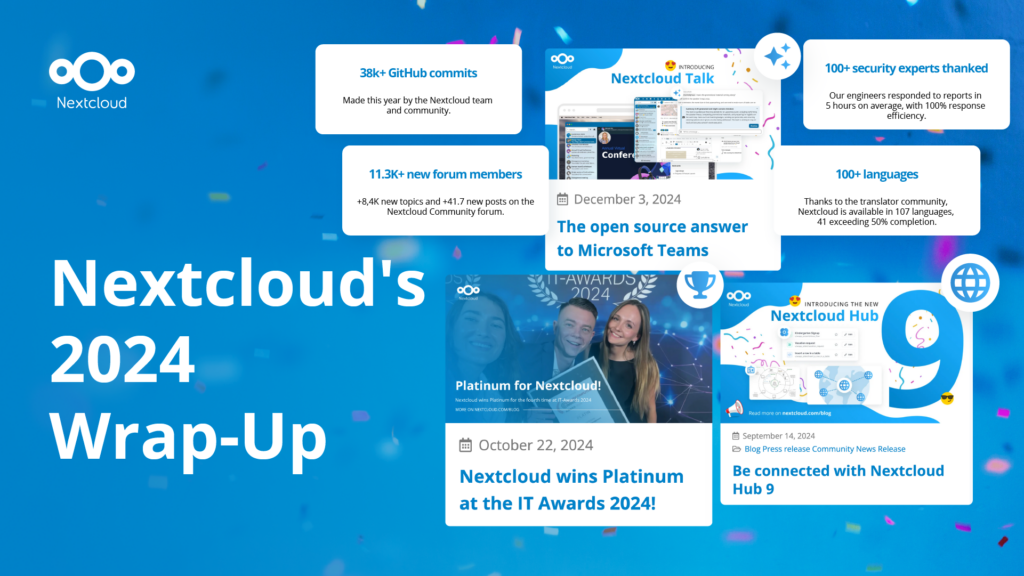
In the Nextcloud 2024 wrap-up, we want to take a moment to celebrate this year's achievements. Join us as we continue to reimagine what’s possible - shaping a world where open source, privacy and connection come together and drive progress for the greater good.
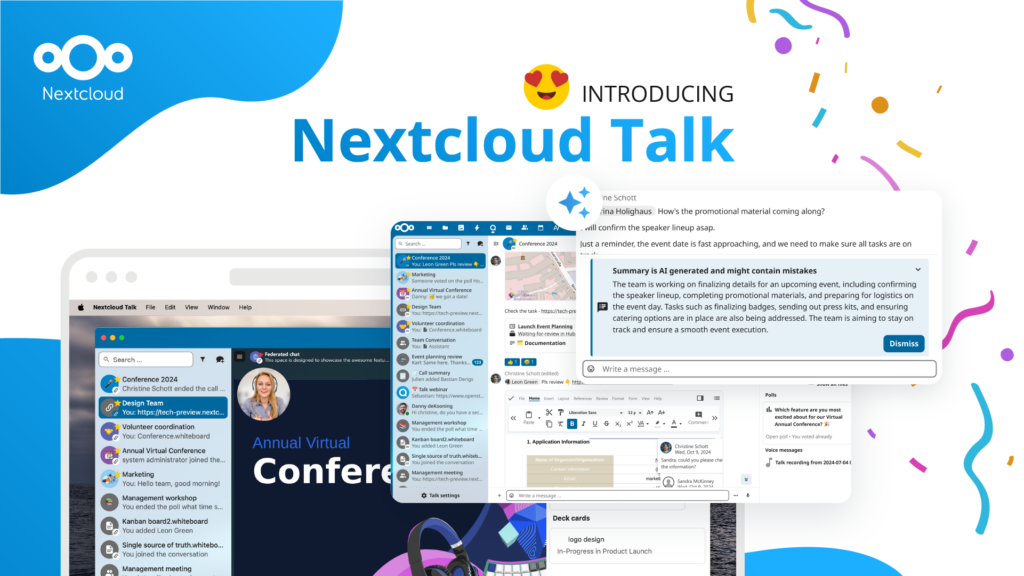
Organisations, small and large, need a way to ensure the resiliency and digital sovereignty of their operations – an open-source, privacy-respecting alternative to Teams. And today, we present that solution - Nextcloud Talk.
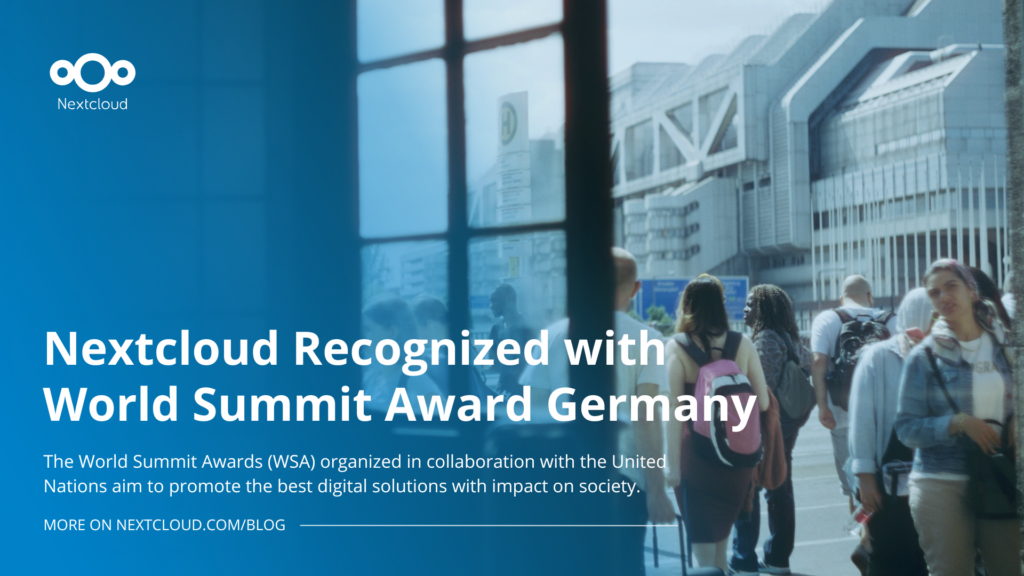
Nextcloud has been recognized with the World Summit Award Germany that selects and promotes local digital innovation improving society, aiming to contribute to the United Nations' agenda of sustainable development goals.
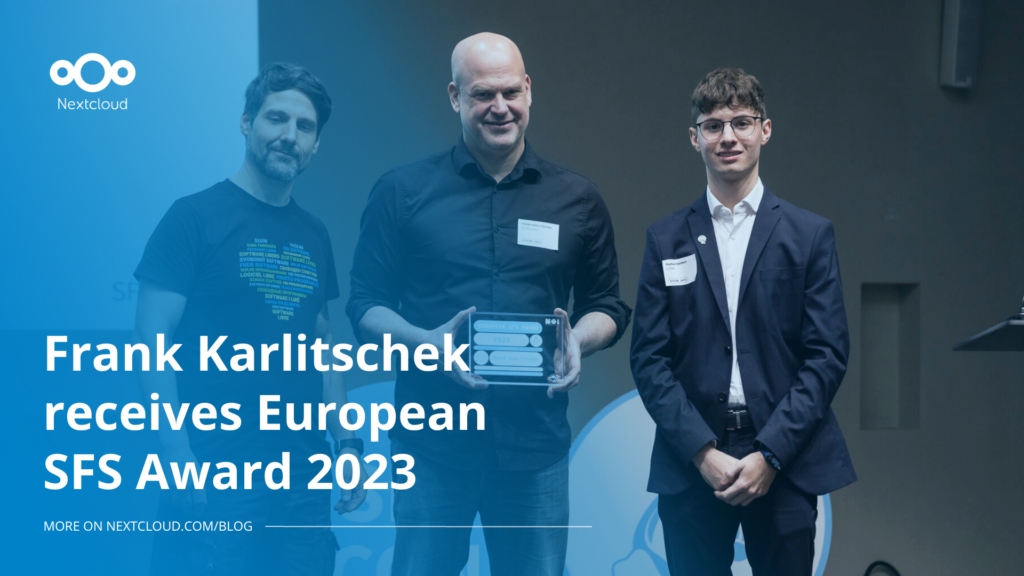
DIE ZEIT, a prominent German outlet, interviewed Nextcloud’s founder Frank Karlitschek for an article on Microsoft’s anti-competitive behaviour on the European office software market. Read for a recap of the article and the key takeaways.
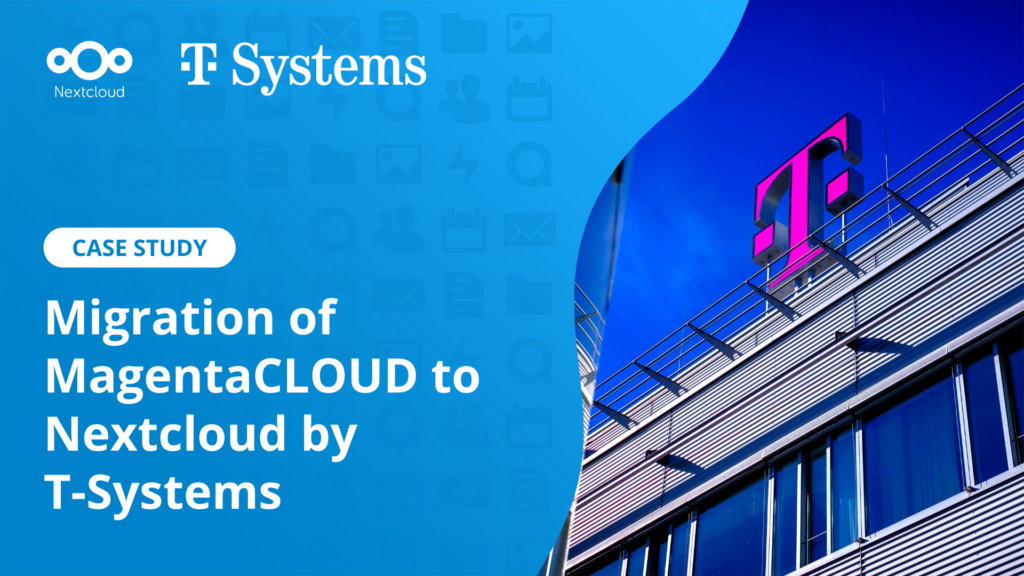
MagentaCLOUD’s migration to Nextcloud in 2021 resulted in a fully equipped Online Storage with an integrated online office suite that further improves the user experience, flexibility and security for customers.
We bring you a major update to the Nextcloud AI Assistant, plus the news we work with several big hosting providers like IONOS and OVHcloud to bring AI-as-a-Service options to you!
Bechtle and Nextcloud announce today a complete managed collaboration platform for the public sector that requires no tender and can be deployed immediately.
Discover how to make the switch from ownCloud to Nextcloud. Our quick guide provides insights into the migration process, helping you make the transition smoothly.
Today, US-based file sync & share vendor Kiteworks announced their acquisition of ownCloud and Dracoon. Kiteworks points out that their customers now have access to their file-sharing application. It is to be expected they will not maintain 3 similar products, but customers will have to migrate to the US firms’ platform or look for another […]
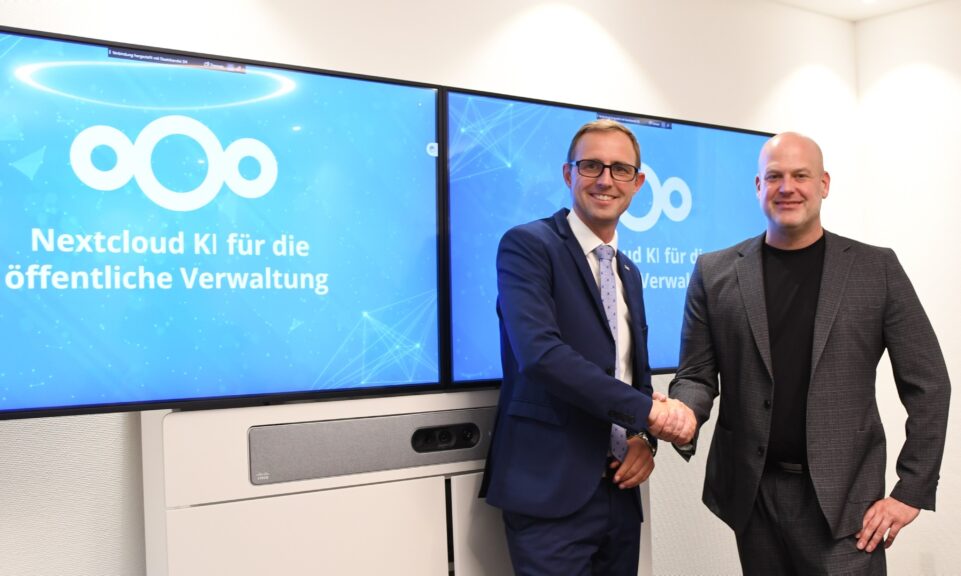
As part of Schleswig-Holstein's state digitization strategy, the state chancellery has announced they will work with Nextcloud to develop AI for working with government documents. This comes just after we announced the first private AI assistant last weekend with Hub 6. The German state already uses Nextcloud and their AI strategy aligns with our work on ethical, local AI technologies.
New maintenance updates are available for Nextcloud Hub. Read more in this post or access the full changelog on our website. Keep your server up-to-date!
Switch, the foundation of the Swiss universities, moved 39,500 students, teachers and researchers at 65 organizations to Nextcloud over a single weekend. That was 585 TB of data in 32 hours. As criticism of Big Tech licensing in education grows, Switzerland joins a growing list of universities choosing digital sovereignty. Their migration also shows that switching is a manageable process, not an impossible challenge.
We save some cookies to count visitors and make the site easier to use. This doesn't leave our server and isn't to track you personally!
See our Privacy Policy for more information. Customize
Statistics cookies collect information anonymously and help us understand how our visitors use our website. We use cloud-hosted Matomo
Service:Matomo
Cookies description:
_pk_ses*: Counts the first visit of the user
_pk_id*: Helps not to double count the visits.
mtm_cookie_consent: Remembers that consent for storing and using cookies was given by the user.
Cookies expiry:_pk_ses*: 30 minutes
_pk_id*: 13 months
mtm_cookie_consent: 30 days