In Austria, organizations are witnessing a strong shift towards digital sovereignty. The public sector, educational institutions, and enterprises are increasingly replacing legacy Big Tech software with sovereign, self-hosted tools that put the data of people — customers, citizens, students — under their own control.
And we, of course, want to tell the stories of the organizations who are pioneering the movement. Following up on the public sector examples, like the developing success story of the Austrian Ministry of Economy, this time we want to hear one from academia.
University of Innsbruck, the third-largest university in Austria and the largest one in the region of Tyrol, uses Nextcloud Hub to provide an integrated collaboration platform to its students and professors. We met Michael Redinger, the Head of the Central IT Service (ZID) at the University of Innsbruck, to ask him a few questions about how the University uses Nextcloud.
University campus. Image source: University of Innsbruck website
Hello, Michael. Could you first introduce yourself and your organization?
With approximately 28,000 students and 6,000 staff members, the University of Innsbruck is Western Austria’s largest research and educational institution. As a comprehensive university, we offer research and study opportunities in a wide variety of fields — from theology, the humanities, and law to the economic sciences and technical and natural sciences. The range of IT users is correspondingly broad.
My name is Michael Redinger. I am the head of the Central IT Service (ZID) — the university’s central IT service provider. We support this broad spectrum of users in the IT sector and provide the University of Innsbruck’s central IT services — ranging from IT infrastructure (data centers, networks) and server systems to storage, as well as teaching- and research-specific IT services, application development for university administration, and support for client systems.
Traditionally, we have a very strong focus on open source: While the client systems themselves run on Windows and are supported by Windows server systems (e.g., AD, SCCM), the majority of the services we offer run on Linux. Traditionally in virtualization environments (formerly RHEV, now Proxmox), now increasingly on a “cloud-native platform” based on Kubernetes (and GitOps processes).
Given the breadth of our responsibilities, the IT department at the University of Innsbruck is staffed accordingly: we currently have approximately 140 employees across a wide range of areas (from first-level support to developers).
I began working at the University of Innsbruck in 1997. Initially as a Linux system administrator (setting up both server and client environments on Linux), later as a network and security administrator — followed by management roles (Head of the Network Department and Deputy Head of IT starting in 2009; then Head of the entire IT department starting in 2016).
What first drew you to open source and Nextcloud, and what keeps you engaged today?
I actually entered the workforce through open source systems: My first assignment was to set up a “dual-boot (Linux) system” for the university’s computer labs (“student computer rooms”). After that, I began managing the university’s Linux server infrastructure — as a replacement for various Unix environments.
So open source has always been part of my work and a major reason why I ended up in IT in the first place.
I’ve actually been following Nextcloud since its inception. I’ve watched it evolve into an increasingly robust and stable platform that’s also suitable for large-scale environments.
Up until now, we’ve used other, standalone products that offered some of Nextcloud’s features (chat, sync & share, etc.). With the COVID-19 pandemic, however, users have increasingly voiced a desire for a unified platform. And the pressure to move toward Microsoft 365 was already very high. Ultimately, though, we were able to convince the key stakeholders at the university that the path toward Nextcloud is the right one — especially with regard to digital sovereignty.
Can you share a few ways you use Nextcloud in practice and what impact it has had for your team or organization?
When we implemented Nextcloud, we made a conscious decision not to emphasize individual features, but rather to focus on its role as an integrated collaboration platform. I therefore mostly use Nextcloud precisely from this perspective: Nextcloud Collectives often serves as an integration point, for example, to organize and document meetings and to link elements from Nextcloud Files and Deck. This makes it possible to keep track of all aspects of a topic (or a meeting).
The value of open source here is that it has produced a range of open possibilities and “best-of-breed” solutions to choose from, and because of their openness, they can then be integrated into a comprehensive solution. This is hardly conceivable with commercial offerings.
Michael Redinger
Head of the Central IT Service (ZID), University of Innsbruck
Which Nextcloud feature or product has been most valuable in helping you achieve your goals, and why?
One of my favorite features is Nextcloud Deck. It makes it really easy for me to organize and coordinate my tasks.
If I had to pick a second feature, it would be the ability to edit documents directly in Collabora/Nextcloud Office. This feature has become extremely powerful. I hardly ever use the local Office program anymore.
What lessons from your experience could be valuable for other organizations considering Nextcloud?
On the positive side:
This approach of referring to Nextcloud as a platform has been very helpful. It sets a direction for how we talk to customers about Nextcloud and how we communicate its value.
On the not-so-positive side:
It takes a lot of time to migrate users and their data from different platforms. We took our time with this — but it often takes much longer. We mustn’t underestimate the fact that, ultimately, this isn’t just about data, but fundamentally about work processes.
In your view, what makes Nextcloud stand out compared to other solutions, and what role does open source play in that?
Part of Nextcloud’s value as a “platform” stems from the fact that it integrates with existing open source solutions or creates interfaces to them.
Open source solutions sometimes have the drawback that while there are excellent standalone solutions for specific tasks, there is no common goal or unifying element. Nextcloud aims to “address” exactly that.
We are still in the process of utilizing these interfaces with third-party programs. But we are (hopefully) succeeding in creating a “cohesive” platform of collaboration systems. Together with products such as Xwiki, OpenProject, or Zammad.
The value of open source here is that it has produced a range of open possibilities and “best-of-breed” solutions to choose from, and because of their openness, they can then be integrated into a comprehensive solution. This is hardly conceivable with commercial offerings.
How has interest in open source evolved over the past year, and what trends have you noticed?
We’ve always had a very strong focus on open source systems. However, we’ve found that the COVID-19 pandemic has certainly put us under pressure: commercial solutions (Teams, Zoom, and the like) promised quick fixes. And suddenly, everyone was telling us how simple the world had become: all you had to do was switch to Microsoft Teams/M365 — and then everything would be a breeze. At that point, we occasionally felt quite alone in our emphasis on open source and digital sovereignty.
The shift in public discourse in Austria (which happened significantly later than, for example, in Germany) has only really been noticeable for the past year: Now (finally) people are talking about digital sovereignty — it is the main driver of current developments. This pleases us and confirms that we are on the right path (which is not limited to the client side; digital sovereignty in IT goes much further for us).
Discover Nextcloud success stories
Find out how public sector, business and educational organizations use Nextcloud around the world.
You don't need to run Nextcloud to enjoy the Nextcloud Community Conference and take a great deal of value home with you. Let's answer the question: who is the Nextcloud Community Conference for?
We are introducing the Nextcloud ISV Partner Program to support independent app developers through the Nextcloud app store. Read more in this article and get in touch with our team if you want to join the program.
We explore challenges Nextcloud Talk solves that Microsoft Teams can't, uncovering a stronger alternative for organizations that that prioritize digital sovereignty, compliance, and control.
Following two successful Nextcloud Enterprise Days in The Hague in 2025, we brought the event to Utrecht this year, where a massive 750 registrations brought a big crowd to the Jaarbeurs venue. The kickoff in the morning pre-announced the launch of the book “Sovereignty! But how?“ by well-known Dutch IT security journalist and author Brenno […]
In the Nextcloud 2024 wrap-up, we want to take a moment to celebrate this year's achievements. Join us as we continue to reimagine what’s possible - shaping a world where open source, privacy and connection come together and drive progress for the greater good.
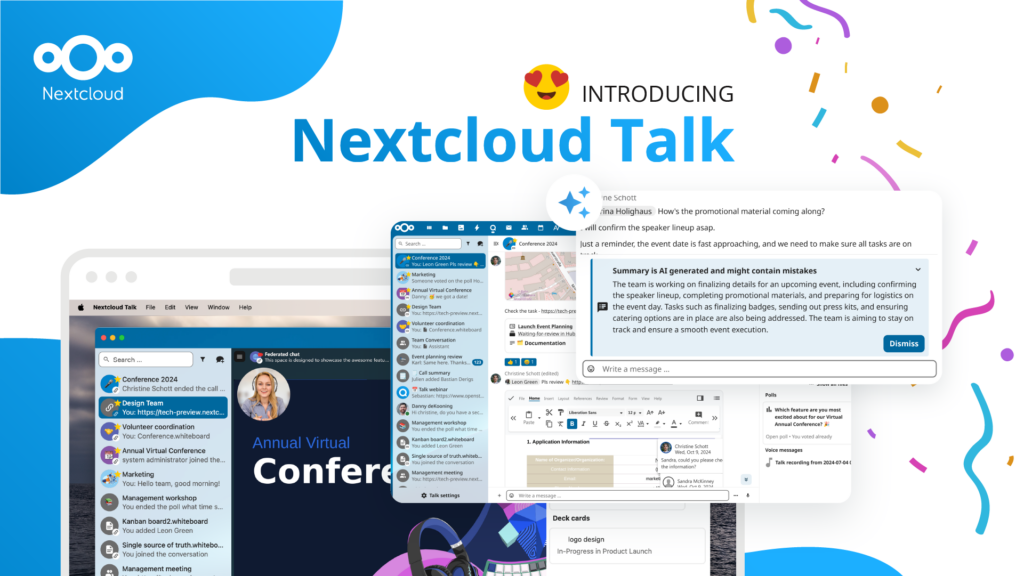
Organisations, small and large, need a way to ensure the resiliency and digital sovereignty of their operations – an open-source, privacy-respecting alternative to Teams. And today, we present that solution - Nextcloud Talk.
Nextcloud has been recognized with the World Summit Award Germany that selects and promotes local digital innovation improving society, aiming to contribute to the United Nations' agenda of sustainable development goals.
DIE ZEIT, a prominent German outlet, interviewed Nextcloud’s founder Frank Karlitschek for an article on Microsoft’s anti-competitive behaviour on the European office software market. Read for a recap of the article and the key takeaways.
MagentaCLOUD’s migration to Nextcloud in 2021 resulted in a fully equipped Online Storage with an integrated online office suite that further improves the user experience, flexibility and security for customers.
We bring you a major update to the Nextcloud AI Assistant, plus the news we work with several big hosting providers like IONOS and OVHcloud to bring AI-as-a-Service options to you!
Bechtle and Nextcloud announce today a complete managed collaboration platform for the public sector that requires no tender and can be deployed immediately.
Discover how to make the switch from ownCloud to Nextcloud. Our quick guide provides insights into the migration process, helping you make the transition smoothly.
Today, US-based file sync & share vendor Kiteworks announced their acquisition of ownCloud and Dracoon. Kiteworks points out that their customers now have access to their file-sharing application. It is to be expected they will not maintain 3 similar products, but customers will have to migrate to the US firms’ platform or look for another […]
As part of Schleswig-Holstein's state digitization strategy, the state chancellery has announced they will work with Nextcloud to develop AI for working with government documents. This comes just after we announced the first private AI assistant last weekend with Hub 6. The German state already uses Nextcloud and their AI strategy aligns with our work on ethical, local AI technologies.
Fancy names, same lock-in: here's why Microsoft’s digital sovereignty promises don’t protect European data from US law and why its “sovereign” cloud still leaves you dependent.
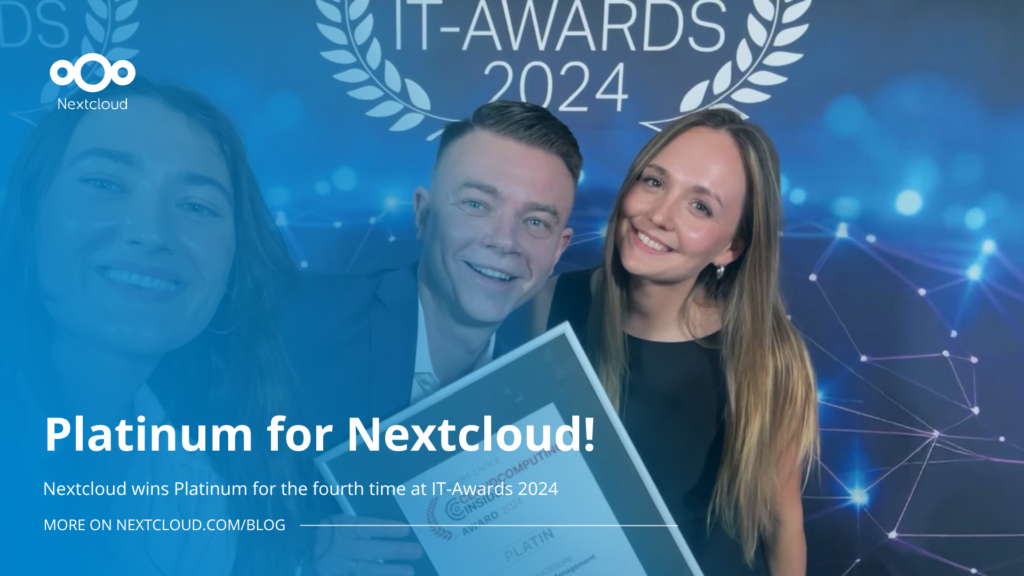
Once again, Nextcloud takes home Platinum at the CloudComputing-Insider IT-Awards. For this award, we want to thank everyone who supported us this year and took a minute to put it into a vote! Read more details about the awards in this post.
At the second Nextcloud Enterprise Day Copenhagen, municipalities, universities and other public organisations discussed how they can reduce their dependency on US Big Tech. Read our recap of the event.
We save some cookies to count visitors and make the site easier to use. This doesn't leave our server and isn't to track you personally!
See our Privacy Policy for more information. Customize
Statistics cookies collect information anonymously and help us understand how our visitors use our website. We use cloud-hosted Matomo
Service:Matomo
Cookies description:
_pk_ses*: Counts the first visit of the user
_pk_id*: Helps not to double count the visits.
mtm_cookie_consent: Remembers that consent for storing and using cookies was given by the user.
Cookies expiry:_pk_ses*: 30 minutes
_pk_id*: 13 months
mtm_cookie_consent: 30 days