The adoption of AI is growing rapidly, but so are concerns around data privacy, bias, and control. That’s because many AI systems today are developed and operated in centralized environments, where transparency into training data, model behavior, and data usage is limited.
With new regulations, like the EU AI Act, organizations are more and more under pressure to adopt AI safely. So, how can you ensure that your organization can integrate AI into its everyday workflows while also maintaining full data control and transparency?
At Nextcloud, we have asked ourselves the same question, leading us to the development of the Ethical AI Rating: a simple way to evaluate how transparent, open, and trustworthy an AI solution really is.
The problem with Big Tech AI platforms, as well as the challenges of open source AI technologies
The development of AI is moving fast, and many of the new capabilities face ethical and even legal challenges. As we explored in our article on Big Tech AI privacy concerns, many of these tools rely on large-scale data collection, often without clear transparency or user control.
This can lead to issues with:
Use of data without permission
Discrimination and biases
Data theft and leakage
What’s more, the mere use of open source code is no longer enough to be able to say you are in control over your data or that the software is safe or ethical.
This is particularly true for neural network-based AI technologies.
The set of data and the software used in the training, as well as the availability of the final model, are all factors that determine the amount of freedom and control a user has.
Your guide to privacy-first AI: Nextcloud’s Ethical AI Rating
Not all AI models are equal, because some prioritize openness and user control, while others rely on opaque models and centralized data processing.
To help users and administrators make informed decisions, we developed the Nextcloud Ethical AI Rating: a rating system designed to give a quick insight into the ethical implications of a particular integration of AI in Nextcloud.
This rating aims to provide a quick, transparent review of how much control and insight you have over these tools.
This is especially important as organizations evaluate AI tools not just for performance, but for compliance, privacy, and long-term data sovereignty.
Users can still evaluate solutions in more detail, but the Nextcloud Ethical AI rating can simplify the choice for the majority of users and customers.
The Nextcloud Ethical AI rating in practice: What you need to know
The rating is based on points from these factors:
Open source licensing
Is the software open source for both inference and training?
Self-hosting options
Is the trained model freely available for self-hosting?
Availability of training data
Is the training data available and free to use?
And has four levels:
Red 🔴
Orange 🟠
Yellow 🟡
Green 🟢
This leads us to the following ranking system:
If all of these conditions are met, we give the AI solution a green label 🟢
If one condition is met, it receives an orange label 🟠
If two conditions are met, the label is yellow 🟡
If none of the conditions are met, it gets a red label 🔴
In other words, if you have full control over the AI tool you’re using, you’ll see a green label. If you have no control and a lot of dependency, the label will be red.
These colors give an immediate overview of the AI solution for factors such as sovereignty, transparency, and data control.
Caveat: Why critical thinking is still important to ensure ethical AI
We add one additional note to the rating: bias.
Bias remains a known challenge in AI systems. While it is difficult to guarantee complete neutrality, the rating highlights known issues where they exist, helping users make informed decisions.
So when we discover major biases in the data set or in the expression of the model at the time of our last check, you will see this mentioned in the rating. This includes discrimination on the basis of race or gender for a face recognition technology, for example.
There are other ethical considerations for AI, of course.
Think of legal challenges related to the use of datasets, in particular copyright issues, as well as the significant energy consumption of deep neural networks, which is of great concern.
Unfortunately, those concerns are extremely hard to quantify in an objective manner, and while we intend to try to warn users of any open issues, we can not (yet) include them in our rating.
For that reason, we recommend users to investigate for themselves what the consequences of the use of AI are for their individual case using the Nextcloud Ethical AI Rating.
Ethical AI in Nextcloud Assistant
Of course, we try to practice what we preach: this approach is not just theoretical, but also shapes how AI is implemented in Nextcloud.
At the core of Nextcloud’s AI approach is the principle that it should never be locked into any single provider. In other words, the administrators can choose between different providers, including self-hosted options.
What’s more, organizations can decide where their models run, which models are used, and what happens to their data.
By doing so, your organization can benefit from AI-supported collaboration without giving up responsibility for its data and stay in control.
AI is still optional and configurable, instead of a mandatory layer imposed on all users or workflows. This allows organizations to adopt AI at their own pace, align it with internal policies, and decide which use cases make sense in their environment.
When AI is enabled, it becomes part of the collaboration environment instead of an external dependency. It integrates into existing workflows without breaking governance or compliance frameworks.
Summarize meetings and conversations in Nextcloud Talk
Provide live transcription and translation for multilingual collaboration
Integrate AI capabilities directly into email, chat, meetings, and file workflows
Nextcloud Hub 26 Winter also makes compliance easier: You can generate images and documents in various apps and automatically label content with watermarks. This ensures your organization is in line with the latest regulations, such as the EU AI Act.
In short: privacy-first AI solutions such as the Nextcloud Assistant give organizations the efficiency and convenience of AI, while keeping governance, compliance, and data ownership exactly where they belong: under their control.
Regain your digital autonomy with Nextcloud Hub 26 Winter
Our latest release of Nextcloud Hub 26 Winter is here! Discover the latest Nextcloud features.
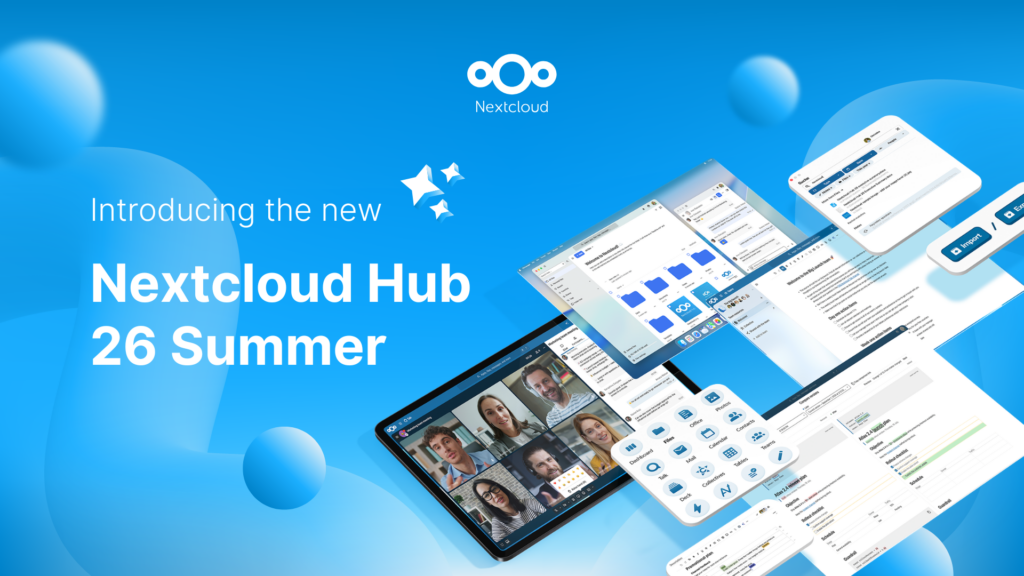
Created in a joint effort of our team, community, and partners, Nextcloud Hub 26 Summer learns from real people using our tools every day. Create your team's own space with Nextcloud Teams, organize your memories in new Nextcloud Photos, and enjoy the updates you asked for across all apps. Read on for a full rundown of our latest release!
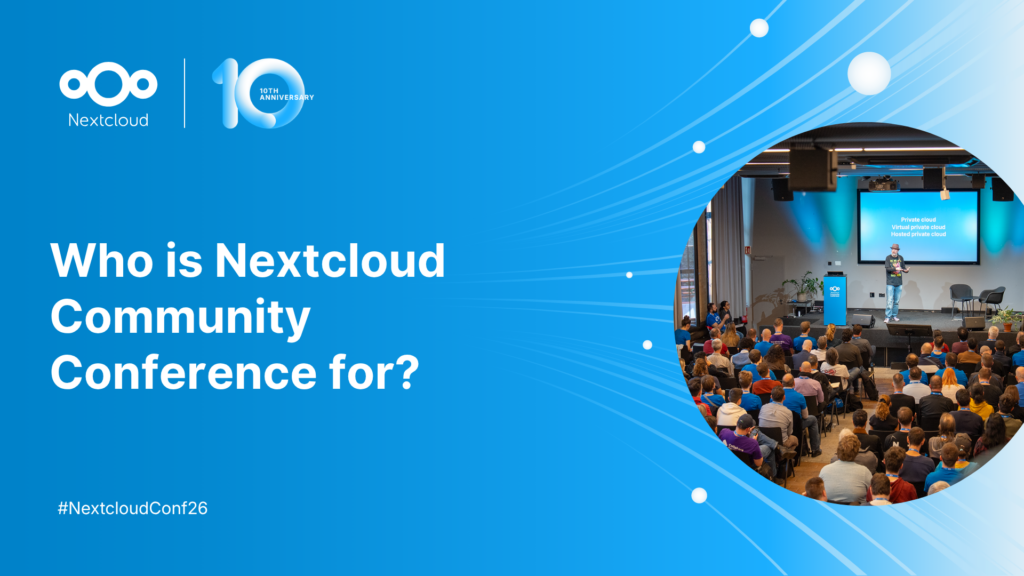
You don't need to run Nextcloud to enjoy the Nextcloud Community Conference and take a great deal of value home with you. Let's answer the question: who is the Nextcloud Community Conference for?
We are introducing the Nextcloud ISV Partner Program to support independent app developers through the Nextcloud app store. Read more in this article and get in touch with our team if you want to join the program.
We explore challenges Nextcloud Talk solves that Microsoft Teams can't, uncovering a stronger alternative for organizations that that prioritize digital sovereignty, compliance, and control.
Following two successful Nextcloud Enterprise Days in The Hague in 2025, we brought the event to Utrecht this year, where a massive 750 registrations brought a big crowd to the Jaarbeurs venue. The kickoff in the morning pre-announced the launch of the book “Sovereignty! But how?“ by well-known Dutch IT security journalist and author Brenno […]
Nextcloud Hub 25 Autumn makes it easier to get started with powerful collaboration while fully in control of your data. From global design updates to improved usability and performance, discover our latest release in this blog.
In the Nextcloud 2024 wrap-up, we want to take a moment to celebrate this year's achievements. Join us as we continue to reimagine what’s possible - shaping a world where open source, privacy and connection come together and drive progress for the greater good.
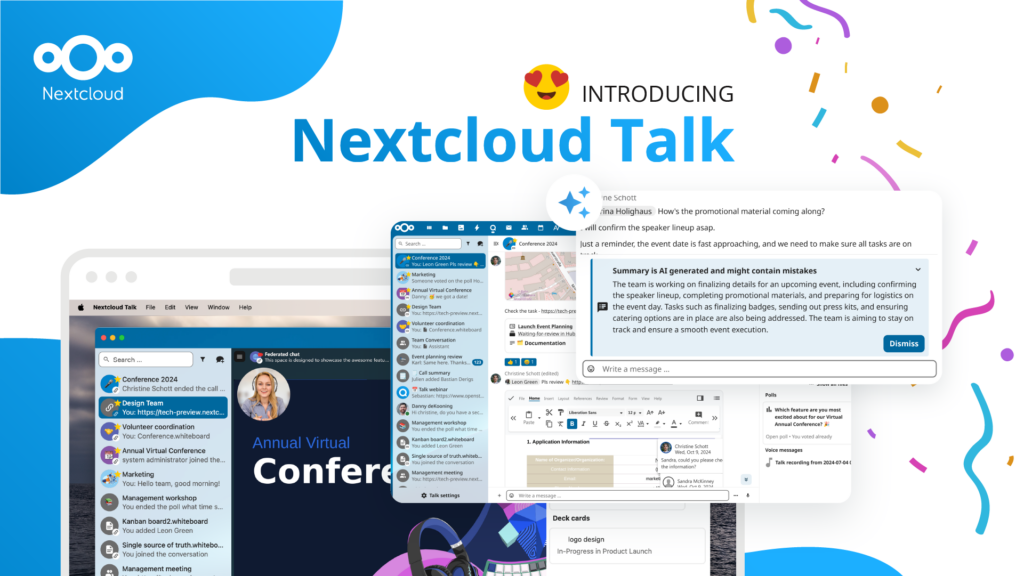
Organisations, small and large, need a way to ensure the resiliency and digital sovereignty of their operations – an open-source, privacy-respecting alternative to Teams. And today, we present that solution - Nextcloud Talk.
Nextcloud has been recognized with the World Summit Award Germany that selects and promotes local digital innovation improving society, aiming to contribute to the United Nations' agenda of sustainable development goals.
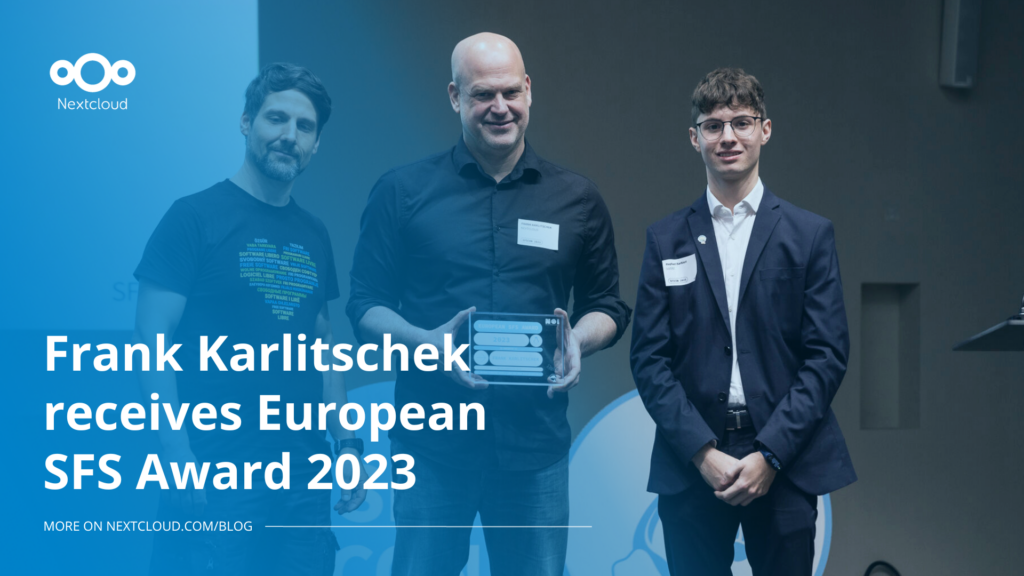
DIE ZEIT, a prominent German outlet, interviewed Nextcloud’s founder Frank Karlitschek for an article on Microsoft’s anti-competitive behaviour on the European office software market. Read for a recap of the article and the key takeaways.
MagentaCLOUD’s migration to Nextcloud in 2021 resulted in a fully equipped Online Storage with an integrated online office suite that further improves the user experience, flexibility and security for customers.
We bring you a major update to the Nextcloud AI Assistant, plus the news we work with several big hosting providers like IONOS and OVHcloud to bring AI-as-a-Service options to you!
Bechtle and Nextcloud announce today a complete managed collaboration platform for the public sector that requires no tender and can be deployed immediately.
Discover how to make the switch from ownCloud to Nextcloud. Our quick guide provides insights into the migration process, helping you make the transition smoothly.
Today, US-based file sync & share vendor Kiteworks announced their acquisition of ownCloud and Dracoon. Kiteworks points out that their customers now have access to their file-sharing application. It is to be expected they will not maintain 3 similar products, but customers will have to migrate to the US firms’ platform or look for another […]
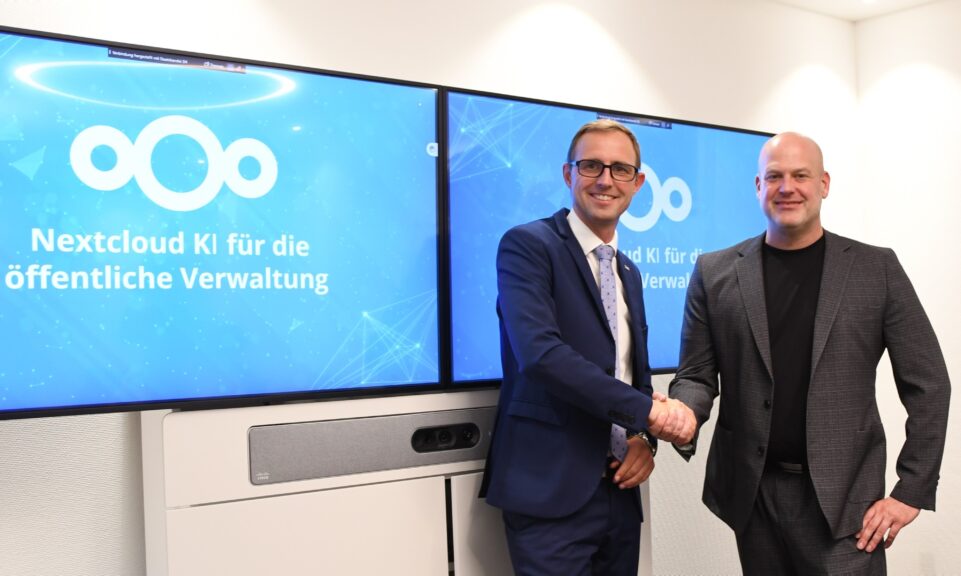
As part of Schleswig-Holstein's state digitization strategy, the state chancellery has announced they will work with Nextcloud to develop AI for working with government documents. This comes just after we announced the first private AI assistant last weekend with Hub 6. The German state already uses Nextcloud and their AI strategy aligns with our work on ethical, local AI technologies.
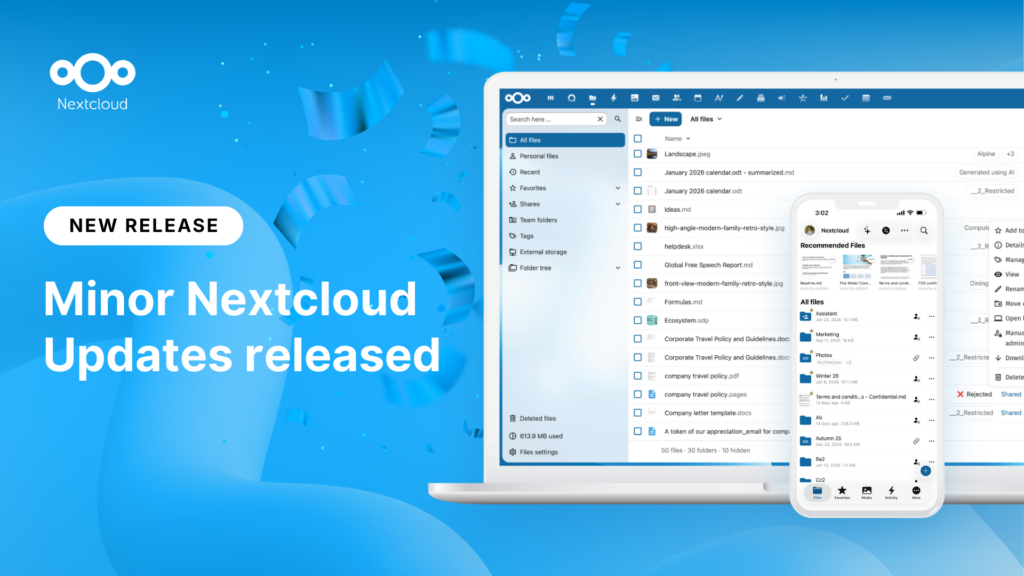
New maintenance updates are available for Nextcloud Hub. Nextcloud Hub 25 Autumn reaches End of Life. Read more in this post or access the full changelog on our website. Keep your server up-to-date!
A new evolutionary step for Nextcloud Circles, Nextcloud Teams app is a hidden gem that amplifies your team sharing. Read this blog to learn everything about the app.
We save some cookies to count visitors and make the site easier to use. This doesn't leave our server and isn't to track you personally!
See our Privacy Policy for more information. Customize
Statistics cookies collect information anonymously and help us understand how our visitors use our website. We use cloud-hosted Matomo
Service:Matomo
Cookies description:
_pk_ses*: Counts the first visit of the user
_pk_id*: Helps not to double count the visits.
mtm_cookie_consent: Remembers that consent for storing and using cookies was given by the user.
Cookies expiry:_pk_ses*: 30 minutes
_pk_id*: 13 months
mtm_cookie_consent: 30 days