Meet the winners of the Nextcloud Community Awards 2026!
Meet three winners of the Nextcloud Community Awards 2026 nominated for outstanding and unique contributions to the Nextcloud universe.
Read More

Explore what’s new in the release blog!
Read moreIt’s been three years since OpenAI shook the digital world with the launch of ChatGPT, with now 200 million people logging on to ChatGPT weekly. And those numbers get a lot higher if you also include other generative AI solutions, such as Gemini or Claude: smart large language models from Big Tech companies that can generate text or images, translate, or code.
But while AI assistants are everywhere and bring these big, productive promises, it’s getting hard to determine what has been discussed more: The opportunities that AI will create, or the privacy issues that come with it. Think of data exfiltration, unchecked surveillance, and biased profiling.
Let’s look at why and how Big Tech is collecting your data and what best practices you can implement to protect your data when using AI.
Any large language model is only as good as the data it’s trained on. That’s why AI models of Big Tech companies, such as Google, Microsoft, and Amazon, are actively using your conversations with their chatbots to improve their models.
A recent Stanford study compared the privacy policies of six Big Tech AI platforms. Their research revealed that:
These data-collecting mechanisms provide AI companies with a lot of control.
Lack of transparency due to cloud centralization makes building this control is easy for them. It’s expensive to run independent AI models. A lot of AI platforms are hosted in large, centralized cloud environments. The remote servers process the inputs and return an answer. While this is efficient, it also concentrates control: the data leaves the local environment, leading to a shift in governance from the user to the provider.
In other words, Big Tech is gaining a lot of power by collecting data while also keeping its data processing out of our sight.
A lot of AI tools have seemingly free or cheap versions, while in reality, users pay by giving up their data, as data is the currency of the AI platform. In other words: If it’s free, you are the product.
You might wonder, what are the issues with these AI data collection and processing mechanisms, as long as they provide you with a smart and efficient business tool?
First of all, there is the issue of unchecked surveillance and bias.
Data collection has been growing for years, and your AI model is only as good as the data that supports it. This can lead to unfair profiling and inequality, especially if the training data is biased.
A couple of real-life AI bias examples include:
Then there is the issue of data theft and leakage. AI systems can become attractive targets for hackers because they process large amounts of sensitive information in one place.
They can also leak data by showing parts of previous conversations or sensitive data when they generate responses. Or the AI system conflates information and produces fake news.
That happened, for example, when a journalist was falsely described as “a 54-year-old child molester” by Microsoft’s AI tool Copilot. As he had been reporting on criminal court cases on child abuse, the AI bot wrongly made him into a criminal.
That’s just the tip of the iceberg of privacy concerns. Other issues surrounding AI include the collection of data without consent, training on children’s data, and the use of data without permission.
At this point, you might be wondering: Isn’t regulation supposed to address these issues?
The EU’s AI Act was designed exactly for that purpose: to set guardrails around how AI systems are developed and used. Once fully applied in August 2026, it would introduce rules aimed at improving transparency, accountability, and risk management for AI providers.
But the tech industry, especially the Big Tech players, didn’t just stand by to let this happen. They argued that parts of the AI Act were too complex and burdensome for innovation, and they have been actively pushing for change.
(Digital industry lobbying in the EU has grown significantly from about €113 million annual spending in 2023 to roughly €151 million today, an increase of more than 30% in just two years.)
And their efforts paid off, as the EU introduced a new proposal, “the Digital Omnibus“, which aims to simplify compliance and reduce regulatory overhead under the AI Act in certain areas.
The debate on AI now continues.
Supporters say the changes could make it easier for companies to adopt AI while maintaining safeguards. Critics, however, warn that this new proposal could weaken some of the protections originally intended by the AI Act and other digital regulations.
For most organizations, the question is no longer whether AI is used, but under which conditions. In most cases today, using AI means sending data to external services.
And as this blog post shows, for organizations working with sensitive data, this can become a problem with legal, technical, and ethical consequences.
Does that mean you shouldn’t use AI at all?
The issue is that if you don’t provide AI you can trust, people will likely start using their favorite services like ChatGPT for work. And that means losing control of your sensitive data.
That’s why it might be better to look for responsible AI solutions that you can trust and that provide:
An AI tool like the Nextcloud Assistant ticks all of these boxes, making sure you can safeguard your online data without having to give up on the efficiency and comfort of an AI solution.
Nextcloud’s prime approach to AI is that it should never be fixed to any particular provider. In other words, the administrators can choose between different providers, including self-hosted options.
With our ethical AI rating, they can get specific guidance in this choice, based on a four-level, color-coded rating scale.
Apart from that foundation, we have specific tools for both admins and users to make the most of this privacy-first AI solution, ensuring governance, compliance, and data protection.
• We aim to ensure that for each AI function in Nextcloud, there exists at least one fully green-rated AI option, that is, an option that is fully open source in terms of model, training data & running code.
• We aim to give granular control over the various AI features so that different models/solutions can be employed for different functions.
• By default, all AI features are disabled. You can run the AI fully on-premises without sharing any data with providers, and our Ethical AI rating helps understand how data sharing works in provider-hosted models.
• You’ll find clear indicators showing when AI is being used and how data is processed.
• Features are opt-in whenever possible, or easily disabled. AI is also only introduced where it adds real value, avoiding unnecessary automation.
• The AI functionality is either available from our the Nextclout Assistant’s dedicated interface, or through deep integrations in the various applications, such as AI-generated subtitles during a video call.
As AI in Nextcloud is designed to be sovereign, organizations decide where their models run, which models are used, and what happens to their data. By doing so, your organization can benefit from AI-supported collaboration without giving up responsibility for its data and stay in control.
Our latest release of Nextcloud Hub 26 Winter continues to build on this foundation.
AI is still optional and configurable, instead of a mandatory layer imposed on all users or workflows. This allows organizations to adopt AI at their own pace, align it with internal policies, and decide which use cases make sense in their environment.
When AI is enabled, it becomes part of the collaboration environment instead of an external dependency. It integrates into existing workflows without breaking governance or compliance frameworks.
What can the Nextcloud Assistant do for you in practice?
Nextcloud Hub 26 Winter also makes compliance easier: You can generate images and documents in various apps and automatically label content with watermarks. This ensures your organization is in line with the latest regulations, such as the AI Act in the EU.
In short: privacy-first AI solutions such as the Nextcloud Assistant give organizations the efficiency and convenience of AI, while keeping governance, compliance, and data ownership exactly where they belong: under their control.
Our latest release of Nextcloud Hub 26 Winter is here! Discover the latest Nextcloud features.
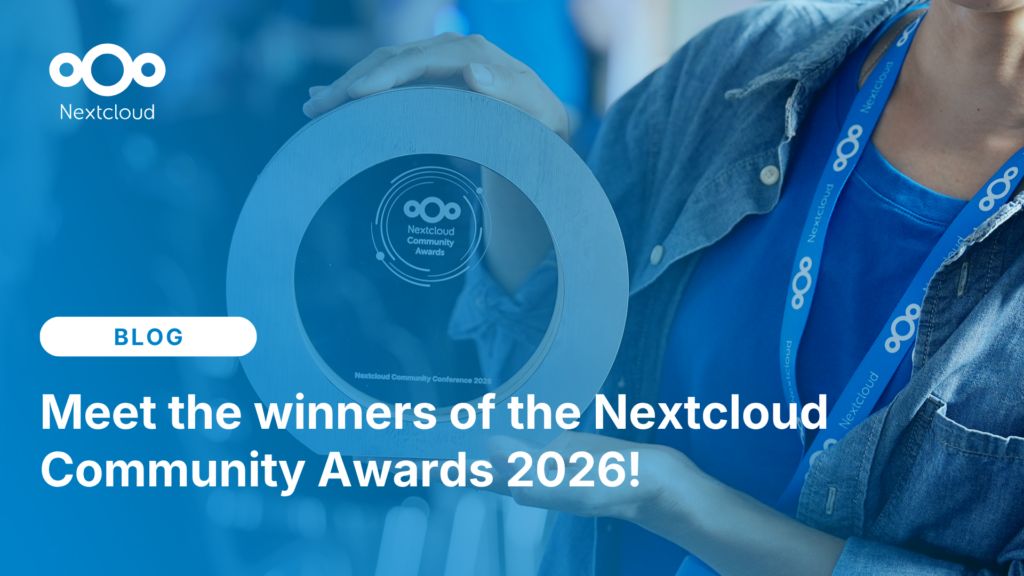
Meet three winners of the Nextcloud Community Awards 2026 nominated for outstanding and unique contributions to the Nextcloud universe.
Read More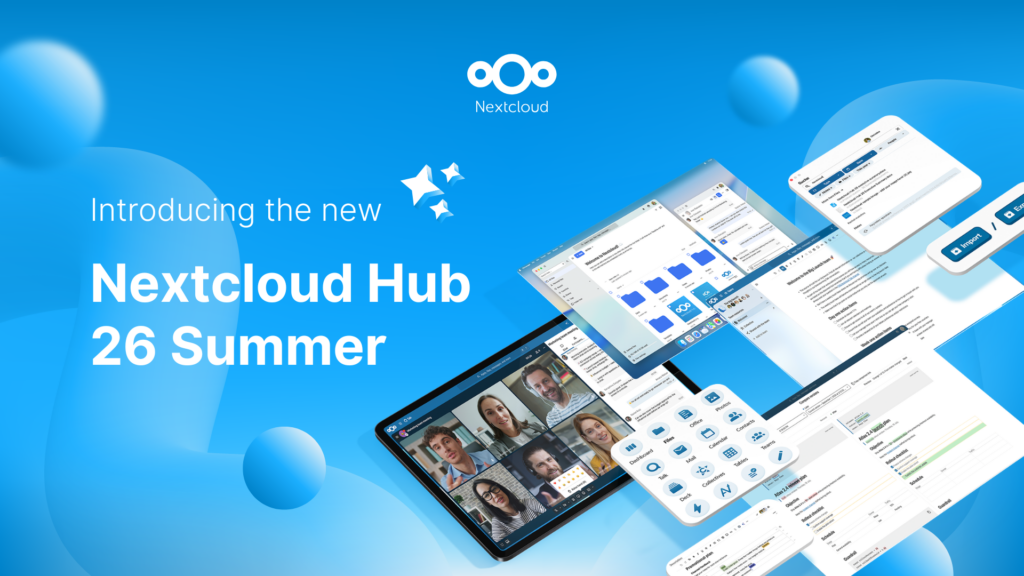
Created in a joint effort of our team, community, and partners, Nextcloud Hub 26 Summer learns from real people using our tools every day. Create your team's own space with Nextcloud Teams, organize your memories in new Nextcloud Photos, and enjoy the updates you asked for across all apps. Read on for a full rundown of our latest release!
Read More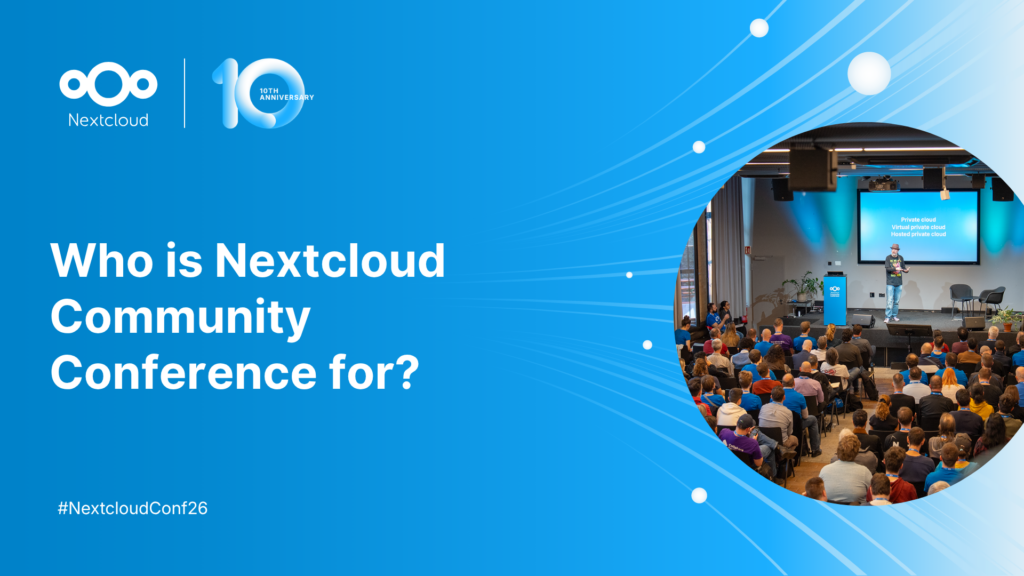
You don't need to run Nextcloud to enjoy the Nextcloud Community Conference and take a great deal of value home with you. Let's answer the question: who is the Nextcloud Community Conference for?
Read More
We are introducing the Nextcloud ISV Partner Program to support independent app developers through the Nextcloud app store. Read more in this article and get in touch with our team if you want to join the program.
Read More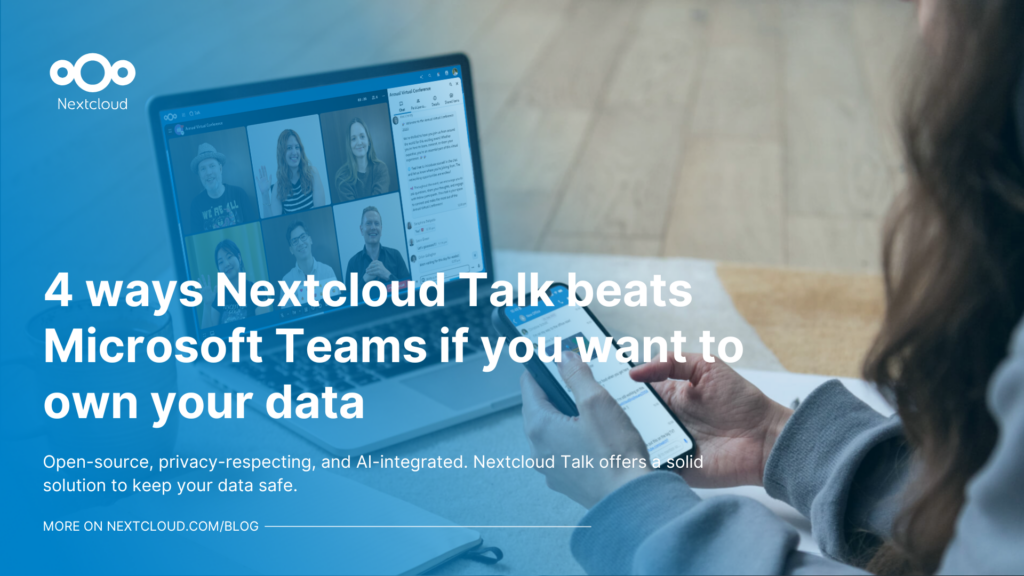
We explore challenges Nextcloud Talk solves that Microsoft Teams can't, uncovering a stronger alternative for organizations that that prioritize digital sovereignty, compliance, and control.
Read More
Is Nextcloud your top choice as cloud content management solution? Vote for us in the CloudComputing-Insider Award 2026 and show your support!
Read More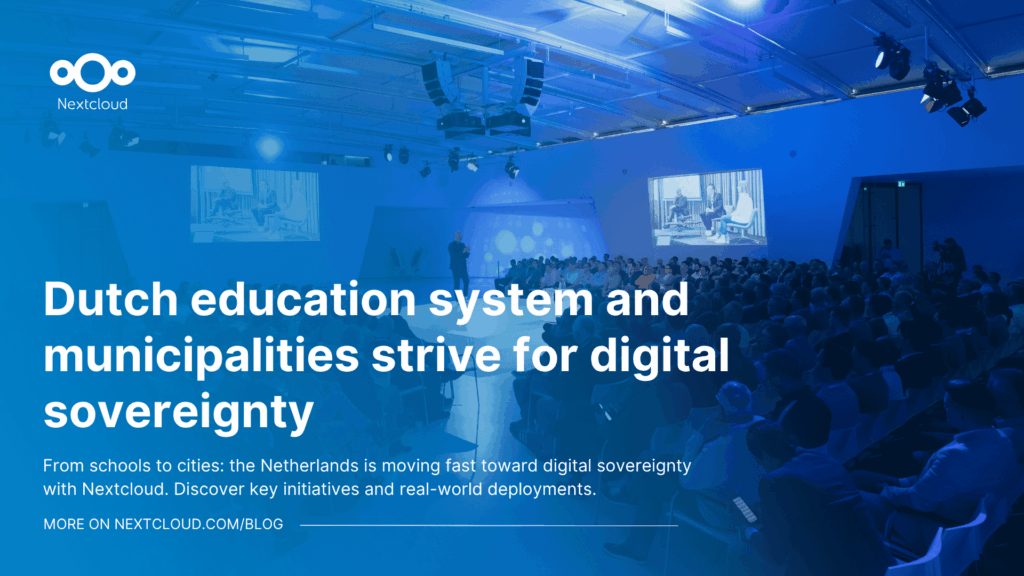
Following two successful Nextcloud Enterprise Days in The Hague in 2025, we brought the event to Utrecht this year, where a massive 750 registrations brought a big crowd to the Jaarbeurs venue. The kickoff in the morning pre-announced the launch of the book “Sovereignty! But how?“ by well-known Dutch IT security journalist and author Brenno […]
Read More
Looking for a sovereign Microsoft Office alternative? Learn how Nextcloud puts you back in control of your data and online collaboration.
Read More
Nextcloud Hub 25 Autumn makes it easier to get started with powerful collaboration while fully in control of your data. From global design updates to improved usability and performance, discover our latest release in this blog.
Read More
Nextcloud has published its first Digital Sovereignty Index (DSI) to showcase the status of digital sovereign infrastructure.
Read More
Discover the Microsoft 365 alternative by Nextcloud and IONOS: the Nextcloud Workspace office suite, launching in the course of 2025.
Read More
Nextcloud becomes the first cloud software platform to earn the Blauer Engel ecolabel, proving that digitally sovereign and green IT is possible.
Read More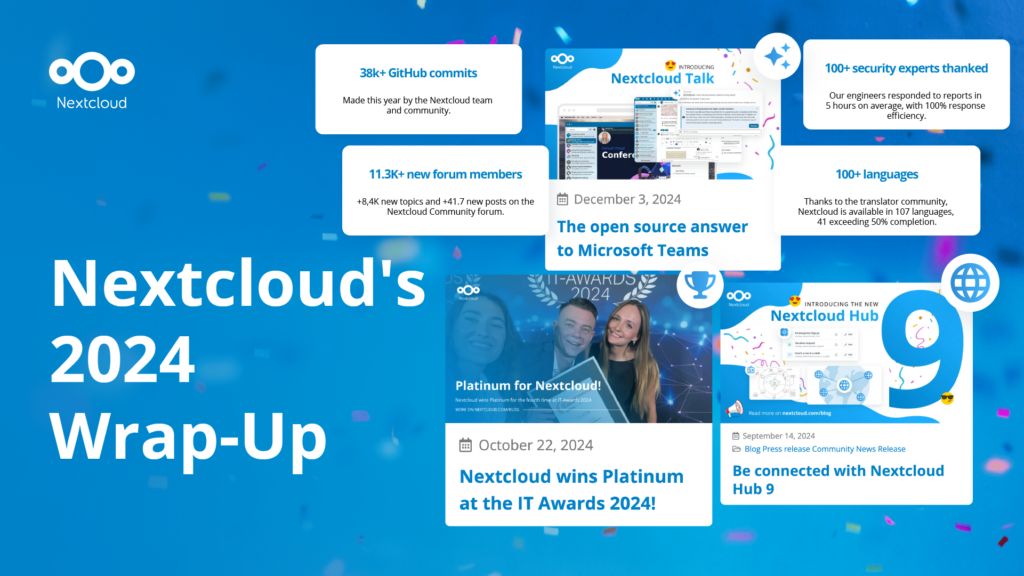
In the Nextcloud 2024 wrap-up, we want to take a moment to celebrate this year's achievements. Join us as we continue to reimagine what’s possible - shaping a world where open source, privacy and connection come together and drive progress for the greater good.
Read More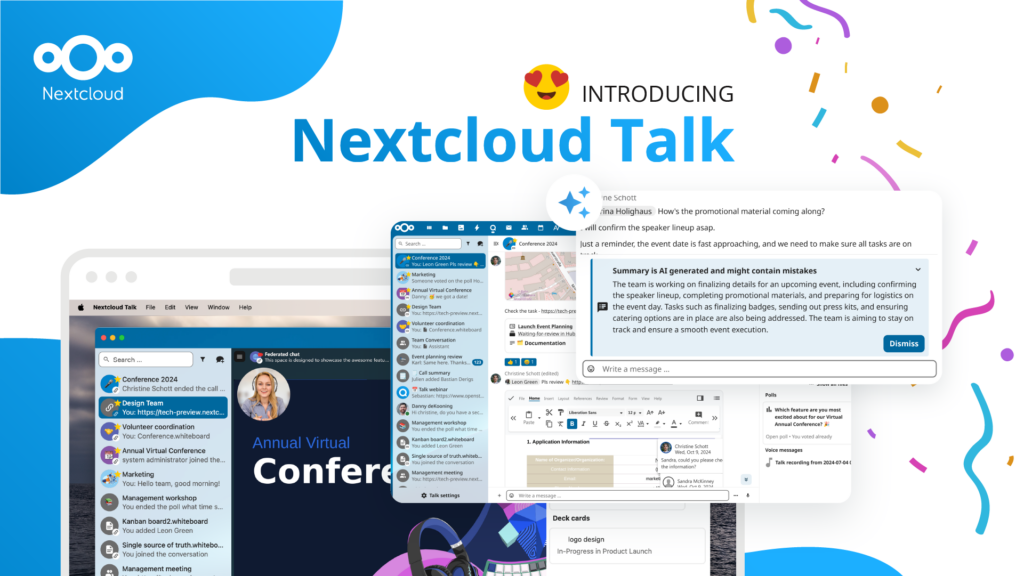
Organisations, small and large, need a way to ensure the resiliency and digital sovereignty of their operations – an open-source, privacy-respecting alternative to Teams. And today, we present that solution - Nextcloud Talk.
Read More
Nextcloud has been recognized with the World Summit Award Germany that selects and promotes local digital innovation improving society, aiming to contribute to the United Nations' agenda of sustainable development goals.
Read More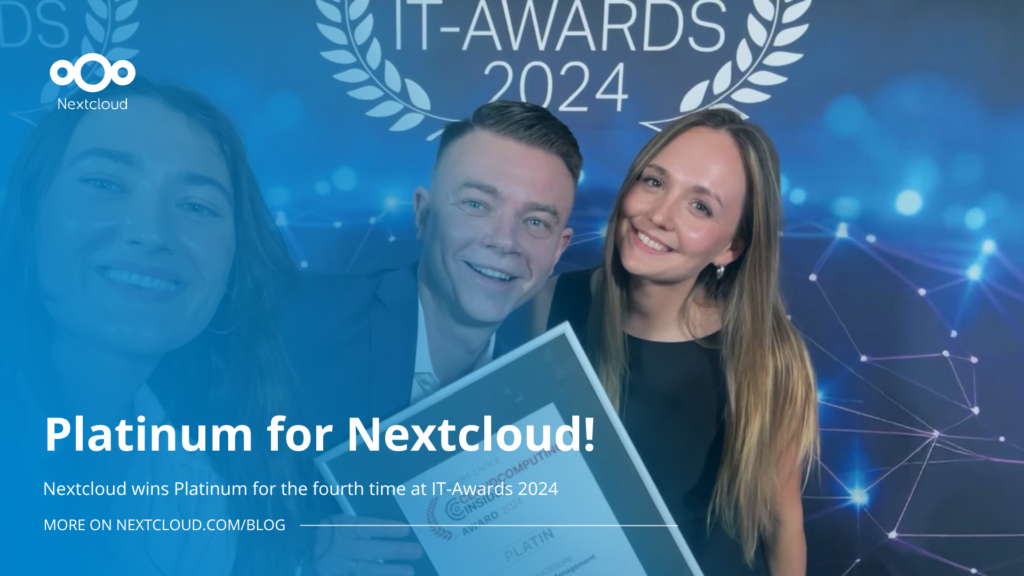
Nextcloud has been awarded Platinum at the IT Awards 2024. Today, we celebrate this win together!
Read More
DIE ZEIT, a prominent German outlet, interviewed Nextcloud’s founder Frank Karlitschek for an article on Microsoft’s anti-competitive behaviour on the European office software market. Read for a recap of the article and the key takeaways.
Read More
MagentaCLOUD’s migration to Nextcloud in 2021 resulted in a fully equipped Online Storage with an integrated online office suite that further improves the user experience, flexibility and security for customers.
Read More
We bring you a major update to the Nextcloud AI Assistant, plus the news we work with several big hosting providers like IONOS and OVHcloud to bring AI-as-a-Service options to you!
Read More
Bechtle and Nextcloud announce today a complete managed collaboration platform for the public sector that requires no tender and can be deployed immediately.
Read More
Discover how to make the switch from ownCloud to Nextcloud. Our quick guide provides insights into the migration process, helping you make the transition smoothly.
Read More
Today, US-based file sync & share vendor Kiteworks announced their acquisition of ownCloud and Dracoon. Kiteworks points out that their customers now have access to their file-sharing application. It is to be expected they will not maintain 3 similar products, but customers will have to migrate to the US firms’ platform or look for another […]
Read More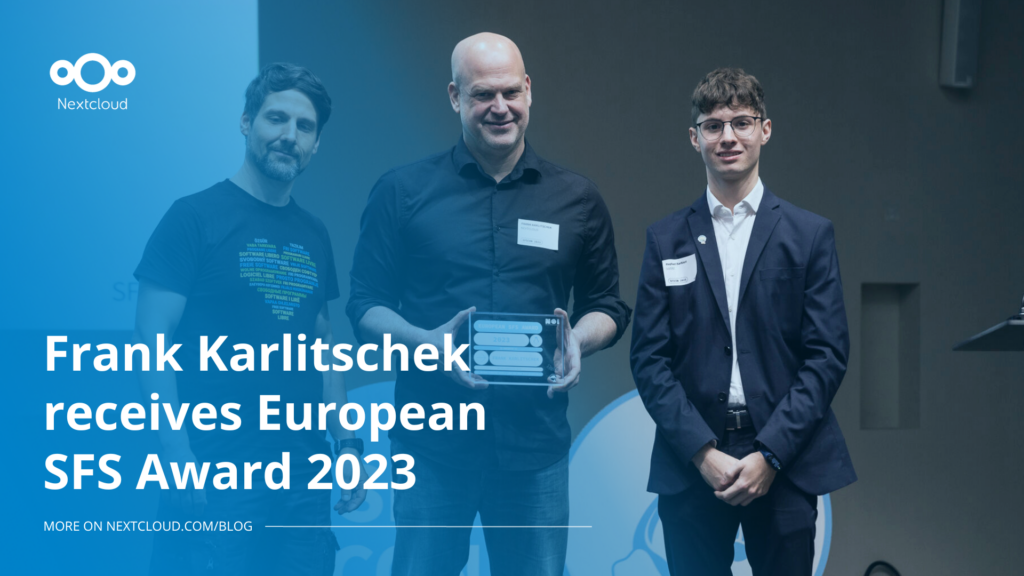
Nextcloud founder and CEO Frank Karlitschek earns the honorary SFS Award at the 20th annual SFSCON taking place in South Tyrol, Italy.
Read More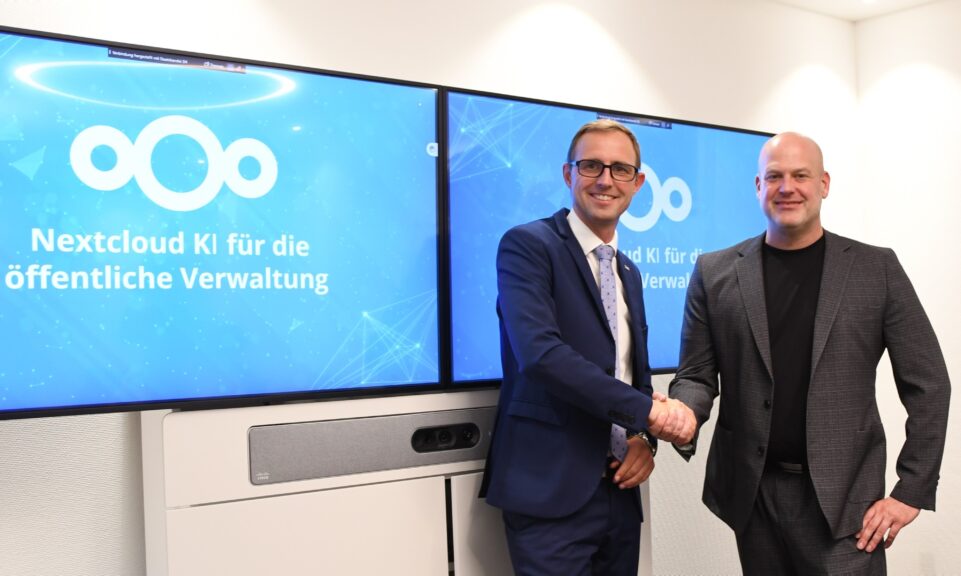
As part of Schleswig-Holstein's state digitization strategy, the state chancellery has announced they will work with Nextcloud to develop AI for working with government documents. This comes just after we announced the first private AI assistant last weekend with Hub 6. The German state already uses Nextcloud and their AI strategy aligns with our work on ethical, local AI technologies.
Read More
Your handy guide to the Nextcloud Community Conference 2026: Discover what to expect, what to bring, how to get there, and more!
Read More