You might have heard of vendor lock-in: the practice of being dependent on a closed ecosystem. It doesn’t only cause spiraling licensing fees, little to no app compatibility, but also frustrating difficulties in migrating platforms.
And in 2026, there’s an additional problem: organizations aren’t locked into one specific vendor, but instead rely on dozens of different disconnected platforms. Their digital information lives across various closed systems, each with its own setup. This is commonly called vendor sprawl.
You are questioning: is that happening to my team too? Just think of your team’s everyday workload. From project management to time tracking or editing documents, are they using a dozen SaaS tools to keep their tasks organized, often from various vendors? If yes, the result is fragmented systems, duplicated data, and inconsistent security models.
In short, by working with so many vendors, you get caught in vendor sprawl, ultimately leading to a loss of visibility and control of your digital infrastructure.
Break free from vendor lock-in risk. Regain control of your digital infrastructure!
Want to learn more about the real impact of vendor risk and how to escape it? Watch our on demand webinar.
When you lose control of your digital infrastructure, you don’t just lose money, but also transparency. As organizations often combine dozens of SaaS platforms to keep their workflows moving, they become aware of the “trio of hidden costs”:
Audit fatigue: The continuous cycle of manual compliance checks across multiple uncoordinated platforms. Each vendor is a new risk that requires a separate assessment, making GDPR or HIPAA audits increasingly difficult.
Data sprawl and shadow IT: The quiet fragmentation of company intelligence as employees bypass restrictive, locked-in tools to use personal, consumer services (ChatGPT, Google Drive). This creates data silos that the IT department can’t see (or protect).
Lack of transparency: The growing risk of “black box” algorithms and hidden data-harvesting practices that put your liability in the hands of a third party. Or, in that case, multiple third parties. This is especially the case with the rise of Big Tech AI platforms.
While we’ve previously discussed vendor lock-in at a macro level, we now want to take a look at the daily friction of this modern SaaS landscape, breaking down the issues with audit fatigue, data sprawl, and shadow IT, and the lack of transparency.
What is audit fatigue, and how is it hurting your organization?
According to the A-LIGN 2025 Compliance Benchmark Report, 58% of organizations now conduct 4 or more audits per year. 35% of enterprise organizations reported conducting six or more audits or assessments per year. While the number of audits goes up, 45% of organizations were not considering increasing staffing or resources.
In other words, businesses are doing more auditing with the same headcount.
This trap of continuous audits, with data spread across different vendors, is causing “audit fatigue”. As you might have guessed, the term refers to being tired of audits: The mental and operational exhaustion caused by the constant need to meet regulatory requirements, leading to oversight, reduced productivity, and increased burnout.
And with a growing tech stack, every new vendor added isn’t just a new platform. It means yet another compliance silo that requires its own check with a series of repetitive, high-friction tasks:
Constantly checking T&Cs: You aren’t just auditing your own security; you are auditing the security of all these different companies. If one vendor changes their Terms of Service or moves a data center to a different jurisdiction, your previous audit is instantly invalidated.
Trying to keep track of your employees: Proving „who accessed what“ becomes a scavenger hunt across different administrative consoles, each with its own logging format and retention policy.
Working in a “black box” of information: Proprietary vendors often provide „Standard Reports“ (like a generic SOC2). However, you’re missing the granular visibility required for high-security internal audits.
The danger of audit fatigue lies in complacency. As the burden of proof becomes too heavy, your teams might shift toward a „check-the-box“ mentality. They stop looking for real vulnerabilities and start focusing on simply surviving the next audit cycle.
Data sprawl and the rise of shadow IT: What you need to know
Data sprawl occurs when your organization’s information is fragmented across dozens of public and private clouds, SaaS tools, and local devices.
According to a 2025 report by Gartner, a “heterogeneous multivendor multistack environment will become the norm through the next two to three years”. As organizations use more than one cloud provider, their information is saved in proprietary silos that can be difficult (and expensive) to move.
So, because of the many vendors, your organization’s data starts sprawling or expanding and living in places where the IT teams can not access it clearly. This overuse of software is costing your organization a lot of time, but also money. From small companies to large enterprises: reportedly, the annual SaaS licensee waste ranges from $4.1 million to a staggering $127.3 million in 2025.
These many different software platforms can also cause friction with employees. That’s when they start looking for a workaround, using apps to bypass the corporate software, also called “shadow IT” tools.
Now, with the rise of AI, employees also turn to shadow AI platforms, using external, unmanaged AI agents to get a job done. The survey “Cyber Risk in 2026: From Today’s Pressures to Tomorrow’s Threats” showed that AI governance, such as shadow AI oversight, ranked among the top priorities for 2026.
The Big Tech black box: How a lack of transparency leads to extra risks
In an ideal IT setup, you have full visibility on the code, can view the logs, and understand how your data moves from A to B. Regretfully, in a lot of locked-in proprietary ecosystems, this is not the case.
The integration of generative AI into these platforms is now causing even more transparency issues. While many Big Tech vendors include AI features as standard, they are often not clear about:
Training data: Is your sensitive corporate data being used to train the vendor’s global models?
Data processing: Where does the prompt data go once the AI has processed it?
Model bias: How is the AI making decisions, and can you explain those decisions to a regulator?
This transparency gap means that you are essentially outsourcing your company’s ethical and legal liability to a third party. Proprietary vendors are asking their customers to just “trust them” when it comes to security features.
This approach marks a big contrast with open source technology, where anyone can audit the code, and data remains on infrastructure you control.
How to reclaim your data (while also cutting costs and risks)
The “hidden” costs of vendor risks aren’t that difficult to see. Audit fatigue, data sprawl, and a lack of transparency are clear realities for organizations worldwide. How can you fix these issues? By going to the core problem: the loss of digital sovereignty.
By moving toward a consolidated, transparent, and self-hosted ecosystem, your organization can stop paying the „complexity tax“. Instead, you can focus on what really matters: innovation, security, and growth.
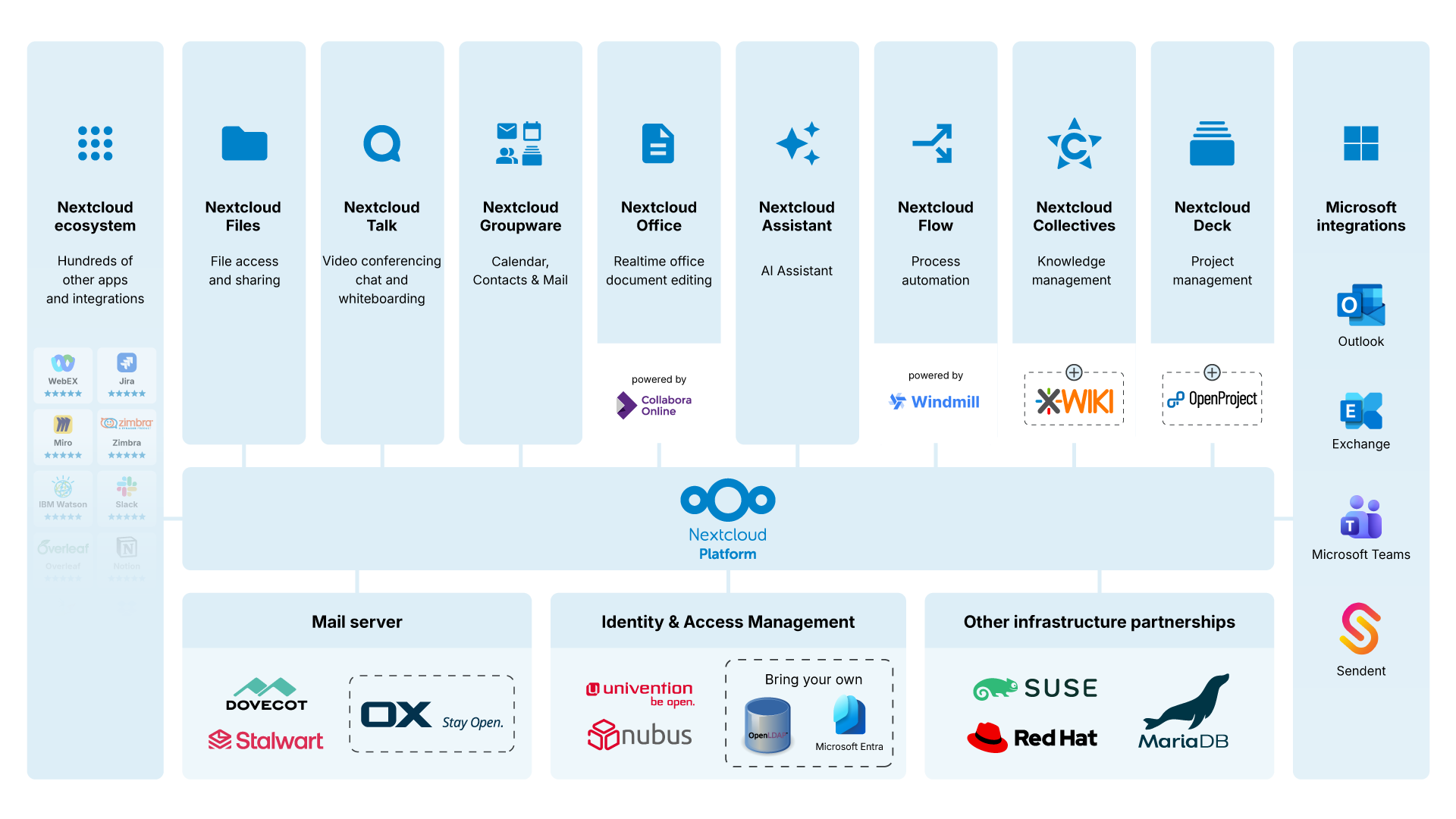
Nextcloud offers a single, integrated stack that simplifies compliance and control while providing a connected and scalable digital workspace. Its open, modular, and integrated approach allows you to pick and choose which apps you would like to add to your dashboard.
The stack is truly your own: Nextcloud Hub’s core apps, integrations like XWiki and OpenProject, popular apps you use may use like Notion, Miro, or Microsoft tools, or perhaps your very own apps and custom services. Nobody decides what you must use or what you can’t use.
And of course, as a leading open source private-cloud collaboration platform, you can rest assured of a strong focus on data protection, trusted by tens of thousands of organizations to stay in control of their sensitive data.
Regain your digital autonomy with Nextcloud Hub 26 Winter
Our latest release of Nextcloud Hub 26 Winter is here! Discover the latest Nextcloud features.
Nextcloud Hub 26 Summer ist eine Gemeinschaftsleistung des Nextcloud-Teams, unserer Community und unserer Partner und wird auf Grundlage davon weiterentwickelt, wie es tagtäglich genutzt wird. Erstellen Sie mit Nextcloud Teams einen eigenen Bereich für Ihr Team, organisieren Sie Ihre Erinnerungen mit der neuen Nextcloud Photos-App und nutzen Sie die von Ihnen gewünschten Features in allen Apps. Lesen Sie weiter, um einen vollständigen Überblick über den neuesten Release zu erhalten.
Nextcloud Hub 25 Autumn erleichtert Ihnen den Einstieg in eine leistungsstarke Zusammenarbeit, während Sie die vollständige Kontrolle über Ihre Daten behalten. Von globalen Design-Updates bis hin zu verbesserter Benutzerfreundlichkeit und Leistung – entdecken Sie unsere neueste Version in diesem Blog.
Nextcloud ist die erste Cloud-Plattform, die mit dem Umweltzeichen „Blauer Engel“ ausgezeichnet wurde und damit beweist, dass eine digital souveräne und grüne IT möglich ist.
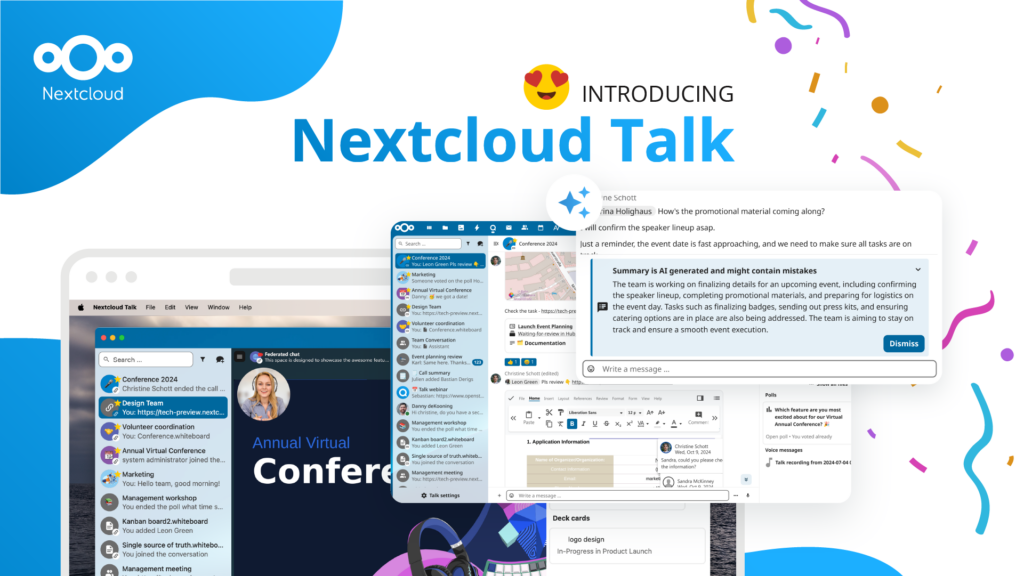
Unternehmen, ob klein oder groß, brauchen eine Möglichkeit, die Ausfallsicherheit und digitale Souveränität ihrer Abläufe zu gewährleisten - eine Open-Source-Alternative zu Teams, die die Privatsphäre respektiert. Und heute stellen wir diese Lösung vor - Nextcloud Talk.
Bechtle und Nextcloud kündigen heute eine vollständig verwaltete Kollaborationsplattform für den öffentlichen Sektor an, die keiner Ausschreibung bedarf und sofort bereitgestellt werden kann.
Our mission is to help individuals, businesses and organizations achieve digital sovereignty and regain control over their data. Nextcloud Hub 5 marks a massive step forward towards achieving this mission, putting the power of AI into your hands – in a way that keeps you in control. New release, new possibilities Hub 5 builds on […]
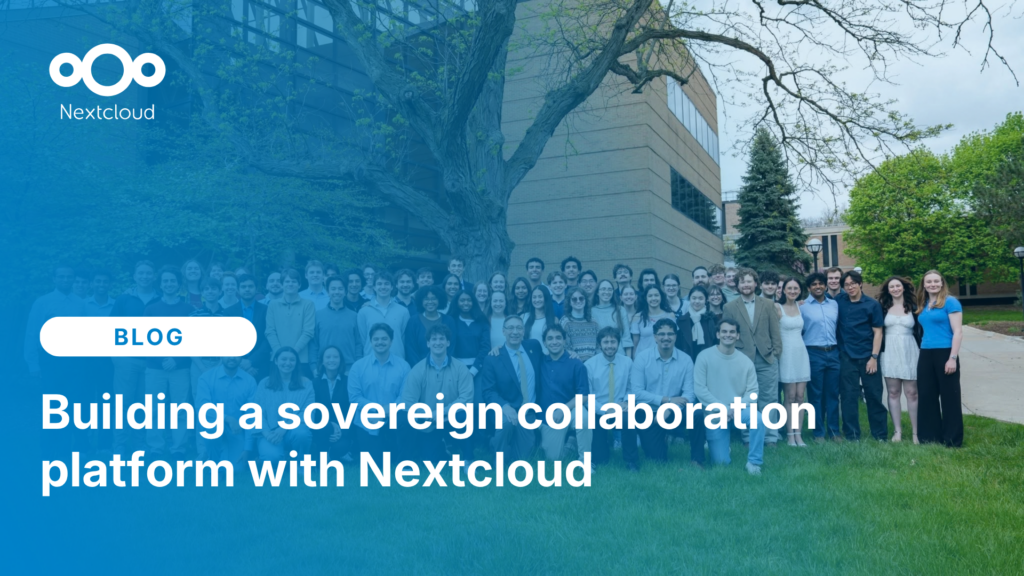
Michigan Tech Aerospace Enterprise migrated from Google Workspace and Microsoft SharePoint to Nextcloud, creating a unified, self-hosted collaboration platform that supports secure engineering workflows, mission coordination, and full control over data and infrastructure.
Wir speichern einige Cookies, um Besucher zu zählen und die Nutzung der Website zu erleichtern. Diese verlassen unseren Server nicht und dienen nicht der Verfolgung Ihrer online-Aktivitäten.
Weitere Informationen hierzu finden Sie in unserer Datenschutzrichtlinie. Anpassen
Statistik-Cookies sammeln anonym Informationen und helfen uns zu verstehen, wie unsere Besucher unsere Website nutzen. Wir verwenden cloud-gehostetes Matomo
Dienst:Matomo
Cookie-Beschreibung:
_pk_ses*: Zählt den ersten Besuch des Benutzers
_pk_id*: Hilft, die Besuche nicht doppelt zu zählen.
mtm_cookie_consent: Erinnert daran, dass der Nutzer seine Zustimmung zur Speicherung und Verwendung von Cookies gegeben hat.
Cookie-Ablauf:_pk_ses*: 30 Minuten
_pk_id*: 13 Monate
mtm_cookie_consent: 30 Tage