Digital sovereignty is becoming a defining issue for Europe’s future. Geopolitical tensions are reshaping alliances and forcing countries to reconsider how they cooperate and support one another. For Europe, this raises a critical question:
How can we pursue a more independent security policy that is less reliant on the United States, its long-standing Cold War partner?
Building a credible and independent defence system is no longer limited to traditional measures of military protection. It must expand into the digital world, where we host our communication, our data, and, increasingly, our democratic functions.
In other words, we cannot afford to rely solely on U.S. providers, whose systems can be cut off at their discretion.
Stronger dependencies mean less control
The case of the ICC, the International Criminal Court, has shown that such dependencies translate into a serious loss of control. Europe cannot expose its most sensitive data to external powers. Ensuring the security of our digital infrastructure must become a central pillar of our sovereignty and defence strategy.
Yet what is missing in Europe is not capability, talent, or technology. What it lacks is leadership and courage. In defence as in digital policy, the United States has historically taken the lead. Without the U.S., Europe’s military landscape would look very differently, and that dependence continues to shape transatlantic relations.
A pattern of reliance on U.S. tech, ready to be broken
A similar pattern exists in the digital world. Since the early days of the internet, Europeans have heavily relied on American technology. From Microsoft and Apple to Google and Meta, their solutions have become household names across Europe and enjoy immense popularity.
While Europe’s digital development began more slowly, it has gathered momentum.
Today, European alternatives exist across the stack, from cloud to operating systems and collaborative tools, and they are ready to compete.
Rising awareness of data protection and changes in U.S. regulations that allow for governmental access and, as such, higher surveillance, have only reinforced the need to keep data under European oversight. This is especially important for governments handling classified information.
Digital sovereignty in Europe: What does it take to champion European products and solutions?
So the real question is not whether Europe can create competitive digital solutions (spoiler: it already did!) but whether it will adopt them.
This is not a question about protectionism or capacity. It is a question of political will and confidence. After all, did Steve Jobs have a detailed master plan when Apple began? Hardly.
Apple’s success was driven by vision, allowing for some uncertainties, and persistence, not by detailed planning of outcomes. Europe needs a similar mindset: independent-thinking politicians and decision makers who question the status quo and have the competence to effect change.
Examples of change: Governments choosing digitally sovereign solutions
Some European institutions and companies have become synonymous with this spirit.
They started small, learned, and grew. Most importantly, they trusted their people to adapt to the new systems, and that the trust is reciprocal.
That is what Europe needs now: to act with confidence and follow its own best interests. The tools are there, the solutions exist. What is missing is the unwavering certainty that sovereignty (digital or otherwise) must be owned, not outsourced. Slowly but surely, Europe is waking up to this truth, seeing opportunities where before it saw only obstacles.
Be part of the digital sovereignty conversation: the Nextcloud Summit
As reliance on Big Tech continues to grow, so do concerns about data control, compliance, and security. The Nextcloud Summit brings together organizations, governments, and experts to exchange ideas and explore practical solutions for a more independent digital future.
What does this mean in practice?
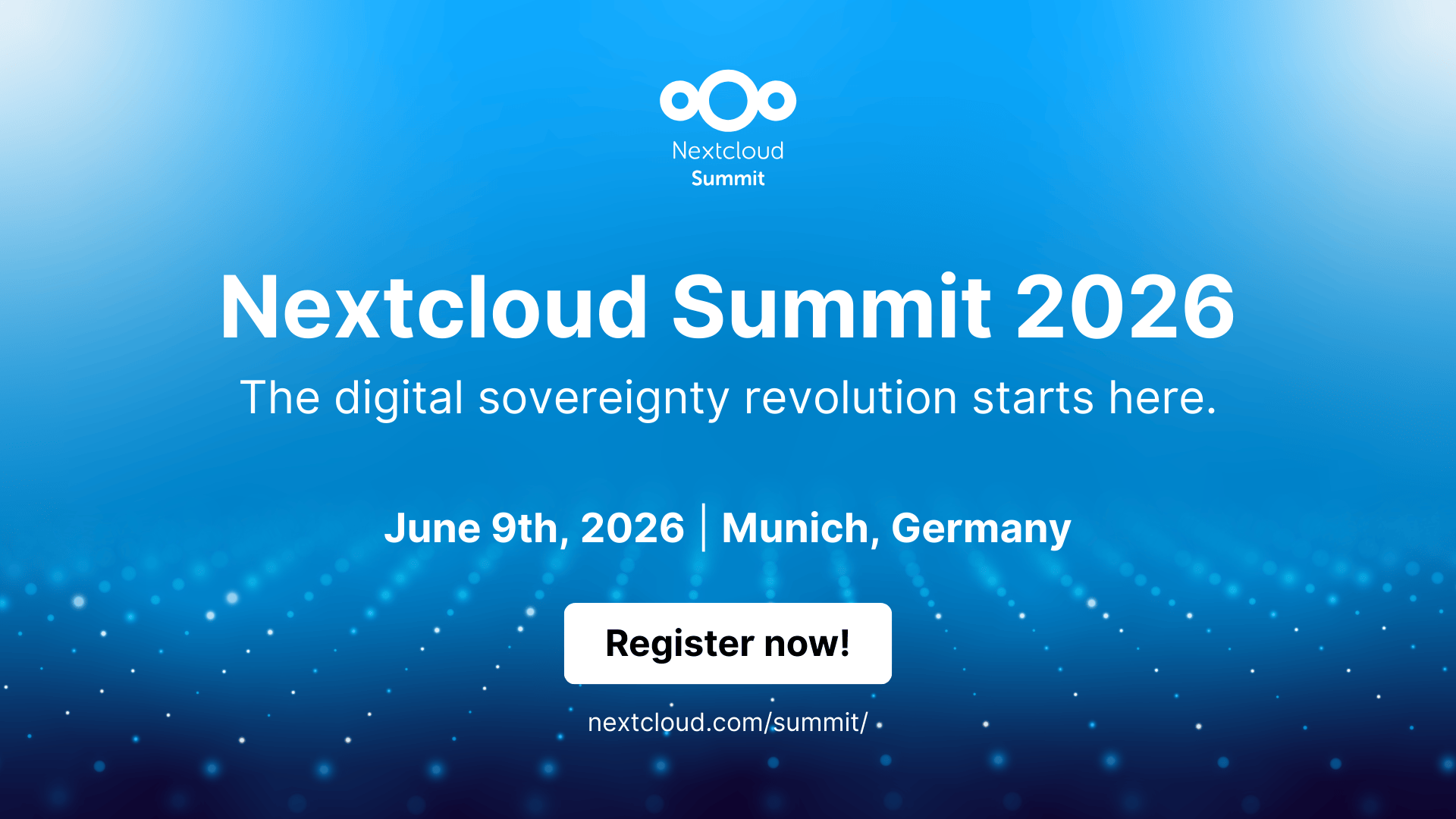
Nextcloud will gather leaders, innovators, and decision-makers in Munich, Germany, on June 9, 2026, to discuss and shape the future of digital sovereignty. Through keynotes, strategic discussions, and hands-on workshops on secure collaboration, open source infrastructure, and self-hosted technologies, participants gain insights and connections to help drive meaningful change.
This is the second time we are organizing the Nextcloud Summit, following the overwhelming success of last year’s edition.
Expect even more inspiring keynotes, thought-provoking panels, fireside chats, and interactive workshops. This is your chance to discover new approaches to secure technologies, look at practical solutions, and connect with the people building Europe’s sovereign digital infrastructure.
Get your ticket today
Join us for the Nextlcoud Summit, our biggest event up until now! Access a full day of learning, sharing, and collaborating on regaining freedom over your data, ensuring data remains in the hands of those who create it.
How do you modernize digital collaboration in government without losing control over your data?
Austria’s Federal Ministry for Economy, Energy and Tourism (BMWET) faced this challenge in 2024 - and decided to take a clear, pragmatic step toward digital sovereignty.
Nextcloud Hub 25 Autumn makes it easier to get started with powerful collaboration while fully in control of your data. From global design updates to improved usability and performance, discover our latest release in this blog.
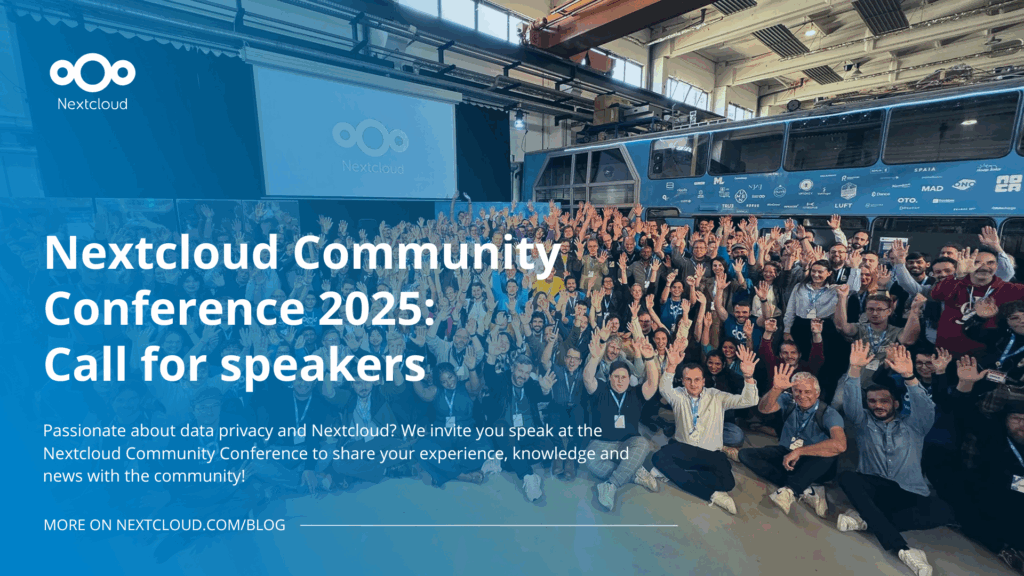
Passionate about data privacy and Nextcloud? We invite you speak at the Nextcloud Community Conference to share your experience, knowledge and news with the community!
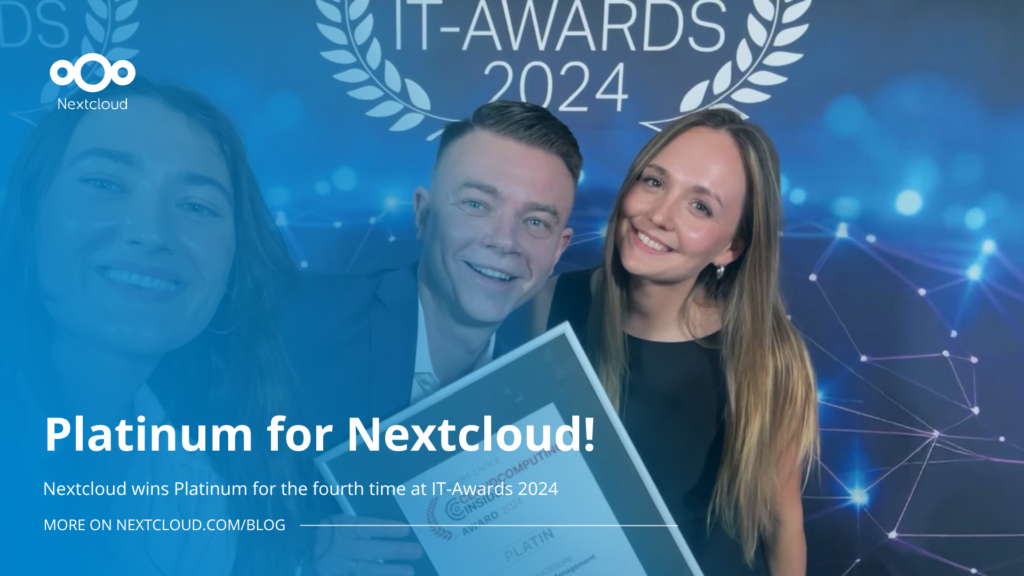
For the ninth time, Nextcloud has been nominated for the CloudComputing-Insider Readers’ Choice Award in the category of Cloud Content Management. We’d love to reach the top again! And we’re looking for the support of you and everyone else in our amazing community to get there. Nextcloud as the best Cloud Content Management tool? Only […]
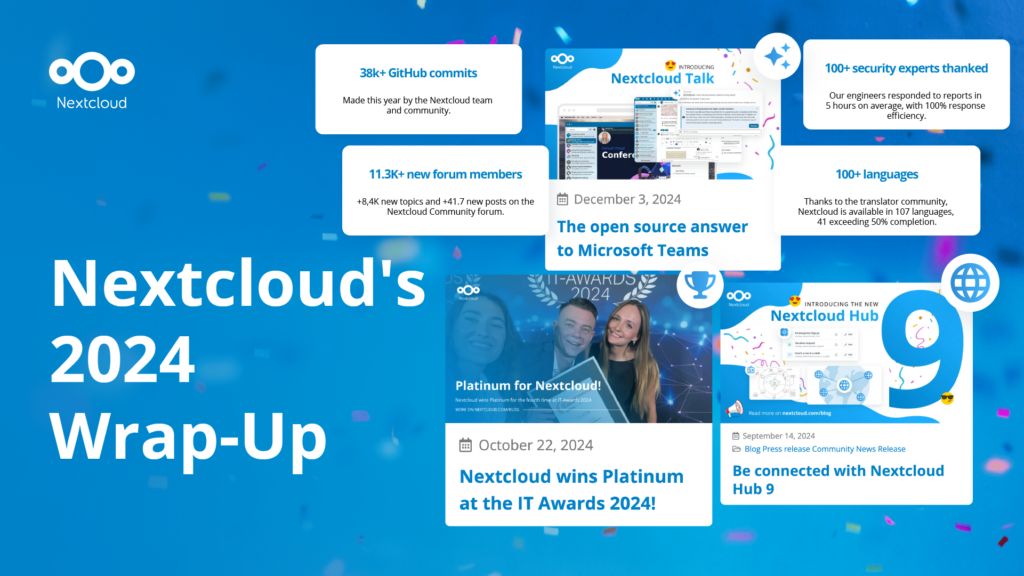
In the Nextcloud 2024 wrap-up, we want to take a moment to celebrate this year's achievements. Join us as we continue to reimagine what’s possible - shaping a world where open source, privacy and connection come together and drive progress for the greater good.
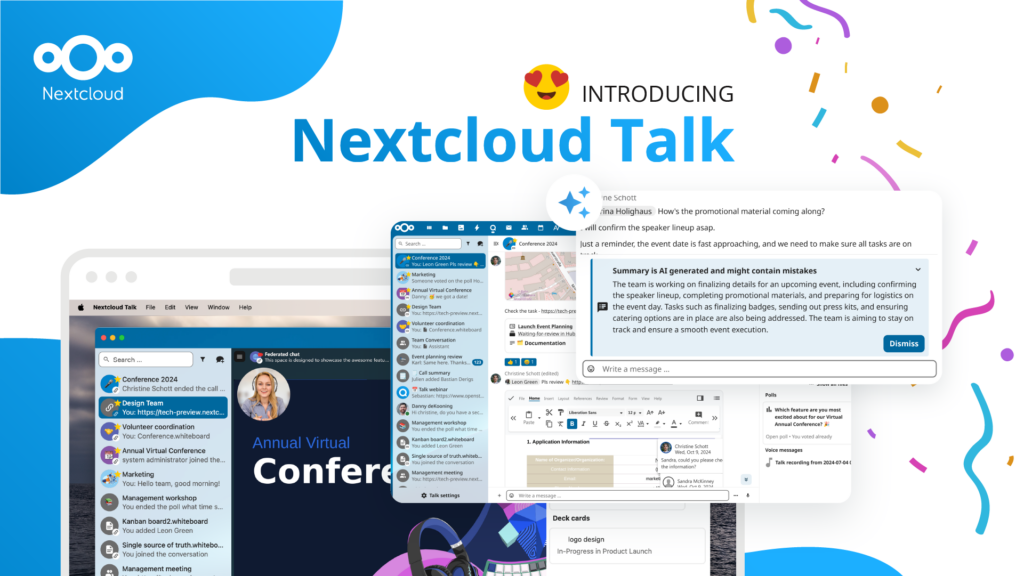
Organisations, small and large, need a way to ensure the resiliency and digital sovereignty of their operations – an open-source, privacy-respecting alternative to Teams. And today, we present that solution - Nextcloud Talk.
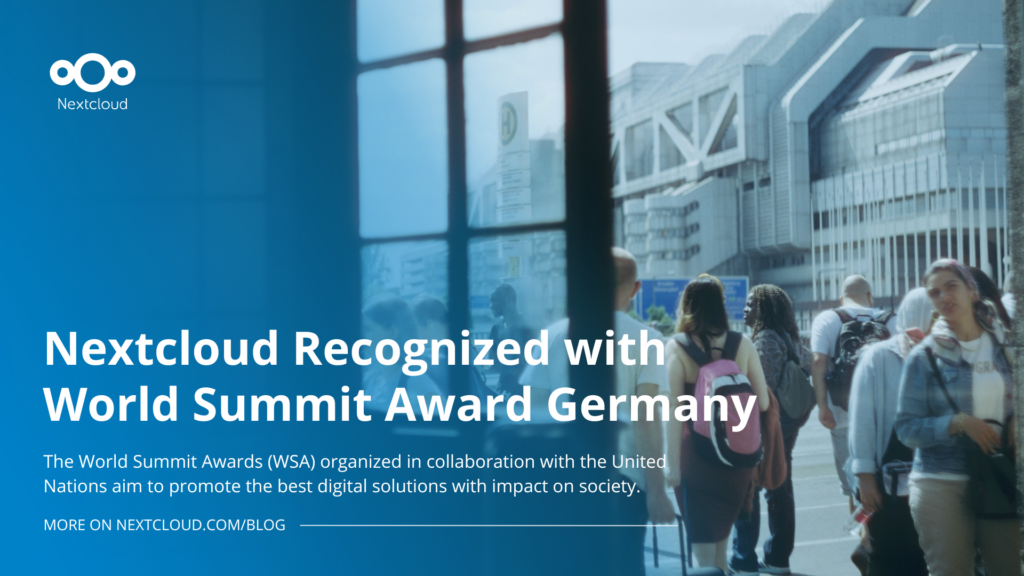
Nextcloud has been recognized with the World Summit Award Germany that selects and promotes local digital innovation improving society, aiming to contribute to the United Nations' agenda of sustainable development goals.
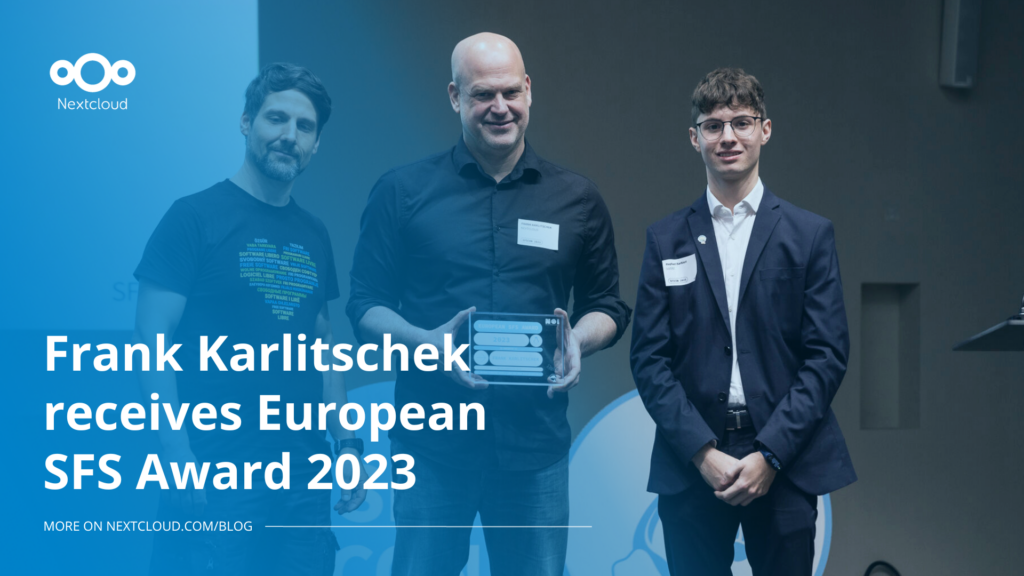
DIE ZEIT, a prominent German outlet, interviewed Nextcloud’s founder Frank Karlitschek for an article on Microsoft’s anti-competitive behaviour on the European office software market. Read for a recap of the article and the key takeaways.
MagentaCLOUD’s migration to Nextcloud in 2021 resulted in a fully equipped Online Storage with an integrated online office suite that further improves the user experience, flexibility and security for customers.
We bring you a major update to the Nextcloud AI Assistant, plus the news we work with several big hosting providers like IONOS and OVHcloud to bring AI-as-a-Service options to you!
Bechtle and Nextcloud announce today a complete managed collaboration platform for the public sector that requires no tender and can be deployed immediately.
Discover how to make the switch from ownCloud to Nextcloud. Our quick guide provides insights into the migration process, helping you make the transition smoothly.
Today, US-based file sync & share vendor Kiteworks announced their acquisition of ownCloud and Dracoon. Kiteworks points out that their customers now have access to their file-sharing application. It is to be expected they will not maintain 3 similar products, but customers will have to migrate to the US firms’ platform or look for another […]
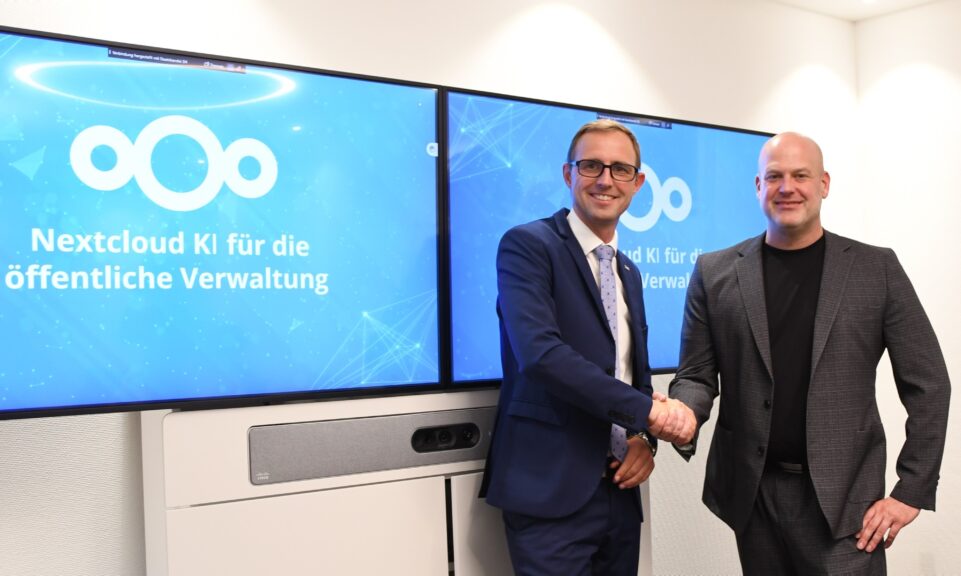
As part of Schleswig-Holstein's state digitization strategy, the state chancellery has announced they will work with Nextcloud to develop AI for working with government documents. This comes just after we announced the first private AI assistant last weekend with Hub 6. The German state already uses Nextcloud and their AI strategy aligns with our work on ethical, local AI technologies.
Over the last year, AI has become a popular topic. Some is hype, some is substance. Some is good, some is bad. We want to give you the good, not the bad, and ignore the hype! AI has a ton of opportunity – but also risk. So we put you in control – off by […]
Our mission is to help individuals, businesses and organizations achieve digital sovereignty and regain control over their data. Nextcloud Hub 5 marks a massive step forward towards achieving this mission, putting the power of AI into your hands – in a way that keeps you in control. New release, new possibilities Hub 5 builds on […]
Nextcloud joins more than 30 organizations in signing an open letter to Google opposing the Android developer verification program. Find the copy of the text in our blog and access the original letter.
We save some cookies to count visitors and make the site easier to use. This doesn't leave our server and isn't to track you personally!
See our Privacy Policy for more information. Customize
Statistics cookies collect information anonymously and help us understand how our visitors use our website. We use cloud-hosted Matomo
Service:Matomo
Cookies description:
_pk_ses*: Counts the first visit of the user
_pk_id*: Helps not to double count the visits.
mtm_cookie_consent: Remembers that consent for storing and using cookies was given by the user.
Cookies expiry:_pk_ses*: 30 Minuten
_pk_id*: 13 months
mtm_cookie_consent: 30 Dagen