In Canada, the digital sovereignty debate has focused largely on infrastructure and data location, while giving less attention to who owns and controls the software. Data-sovereignty researcher Joshua van Es found that 91% of communications tools available to Canadian organizations, including email, video calls and messaging, fall under foreign jurisdiction. Amazon, Microsoft and Google hold 85% of Canada’s public cloud market, which is well above their 66% global average, according to the report from the Canadian Anti-Monopoly Project.
In this article, we explore what this dependency puts at risk and what Canadian organizations can learn from Europe’s digital sovereignty movement as they seek alternatives to U.S. technology and closer ties with the EU.
How digitally sovereign is Canada?
In our Digital Sovereignty Index, Canada scores 14.79 points, which puts it below the average score in the EU. That’s slightly higher than the U.S. (13.49), but well behind top performers such as Finland (64.30) and Germany (53.70).
What do Canadians think about this dependency? 86% of public servants in Canada fear that the public could lose trust in government if personal citizen information is stored outside Canada, according to a KPMG Canada report. This matches the sentiment among Canadian consumers. According to CIRA Canadian Internet Trends 2026, 67% of Canadians say it’s important for personal data to be stored in Canada, while only 8% say it’s unimportant.
Seven of the eight cloud providers approved for use by the Canadian federal government are American.
Data from Tech Policy Press
Cloud and collaboration are the most exposed layers
Canada, like many countries worldwide, remains heavily reliant on U.S. Big Tech for collaboration tools, including cloud storage, office software, chat and videoconferencing:
7 of the 8 cloud providers approved for use by the Canadian federal government are American. The eighth, ThinkOn, is the only Canadian provider on the list.
Why is this a big problem?
Canada does not have a federal equivalent to the EU GDPR. Instead, it has a combination of federal and provincial privacy legislation. For example, a GDPR-style law already exists in Quebec: Law 25. PIPEDA, the federal private-sector privacy law, governs the collection, use and disclosure of personal information in the course of commercial activities.
Organizations using cloud services have three important responsibilities under PIPEDA:
They remain accountable for personal information you hand to service providers.
Organizations must tell customers when their data may be stored or accessed outside Canada, including by foreign authorities. But data stored by a U.S.-owned provider can still fall under U.S. warrants.
Bill C-36, tabled on June 15, 2026 and still awaiting second reading, would replace PIPEDA with the Protecting Privacy and Consumer Data Act, require a privacy impact assessment before personal data leaves Canada, and allow fines of up to C$10 million or 3% of global revenue.
Sensing Europe’s push for independence, Big Tech companies have responded with a new strategy: marketing services as “sovereign” because the data is stored in local data centres and/or the services are managed by local staff, while the provider remains subject to foreign laws.
In short, sovereignty-washing. Emily Osborne, a policy researcher at the Canadian Shield Institute, compares this term to the “maple-washing” Canadians saw when U.S. tariffs began.
It is easy to market a service as sovereign by emphasizing local data hosting and making misleading claims about the resilience it provides. The data is stored within national borders and subject to local laws, so doesn’t that make it sovereign?
The tale of resilience
As we put it in our analysis of Microsoft’s “Digital Principles for Europe“, if resilience depends on legal promises from a U.S.-based vendor, it’s not resilience, but risk management. Microsoft as a company is subject to U.S. law, and that includes the CLOUD Act.
Under the U.S. CLOUD Act, U.S. authorities can require U.S.-based companies to disclose data within their control, even when that data is stored outside the United States.This means that storing data in Canada does not, by itself, protect it from U.S. legal demands. And while a Canadian entity owned and managed in Canada generally falls outside of the CLOUD Act, a Canadian subsidiary of a U.S. company can be compelled to comply with it.
A promise to challenge government orders doesn’t change that. Microsoft’s own transparency report shows it received 190 law enforcement requests worldwide for enterprise cloud customer data in the second half of 2025. Nearly half of it resulted in some form of handover, where 45 of 94 cases included customer content.
In 2025, Anton Carniaux, Microsoft France’s director of public and legal affairs, told the French Senate he could not guarantee French public sector data would never reach U.S. authorities without French consent.
Legally, the situation would not be different for any company in Canada that relies on U.S. providers.
Learnings from Europe
So what can a Canadian organization seeking to regain control over its IT learn from the European digital sovereignty practice?
European governments and business have been looking for a way out of lock-in with U.S. Big Tech in the past decade, especially since Trump’s second term began in 2025. Many countries are already taking digital sovereignty very seriously.
In France, digital sovereignty grows at national scale. France’s Ministry of National Education is rolling out Nextcloud to 1.2 million employees. The Île-de-France region uses it for 550,000 teachers and students.
Austria is migrating away from Microsoft, avoiding disruption with a unique hybrid model. A federal ministry moved 1,200 employees from Microsoft to Nextcloud in a few months, while keeping familiar workflows.
In the German state of Schleswig-Holstein, open source is a state strategy. The state is among the first to start shifting its administration to digitally sovereign technology. Another German state, Mecklenburg-Vorpommern, is already building on its publicly available strategy, introducing a sovereign collaboration platform for state and municipal public servants with a goal of reaching more than 50,000 employees.
In Switzerland, open source is written into law. In the Netherlands, Nextcloud saw an eight-fold increase in inquiries about sovereign workplace tools in 2025.
The list goes on. Europe’s move toward digital sovereignty is still young, especially compared to its decades of reliance on U.S. Big Tech, and calling the region fully digitally resilient would be an overstatement. But a growing number of public and private sector organizations show how to turn digital independence from theory into practice.
That experience gives Canadian organizations a head start: the path has already been tested.
Good fences make good neighbors. It’s time to take control over your data
Who really controls your data when a foreign government has legal access to your cloud? Who owns the technology roadmap, licensing, updates, product availability and terms of service? As we wrote in our recent article on Microsoft’s so-called “Sovereign Cloud“, while customers may control more settings – they certainly won’t get any control over the platform itself.
Nextcloud is a good place to begin establishing control over your IT. It is a 100% open source collaboration platform that runs in a private cloud, self-hosted or through a trusted local provider who knows your regulations. In Canada, Nextcloud partners with cloud service provider cloud&more that is helping businesses, organizations, and enterprises to retain data control and uphold privacy.
With a paced migration plan, you avoid disrupting your work while your users adopt new tools without pushback. Learning from thousands of organizations in Europe, our experts at Nextcloud can help you map out your scenario. Feel free to look at Nextcloud migration cases and connect with our engineering team to request an assessment.
For larger organizations that need to run and enterprise-scale setup, we recommend the Nextcloud Enterprise package. It comes with direct support from the Nextcloud engineering team and gives you the opportunity to contribute to future roadmap.
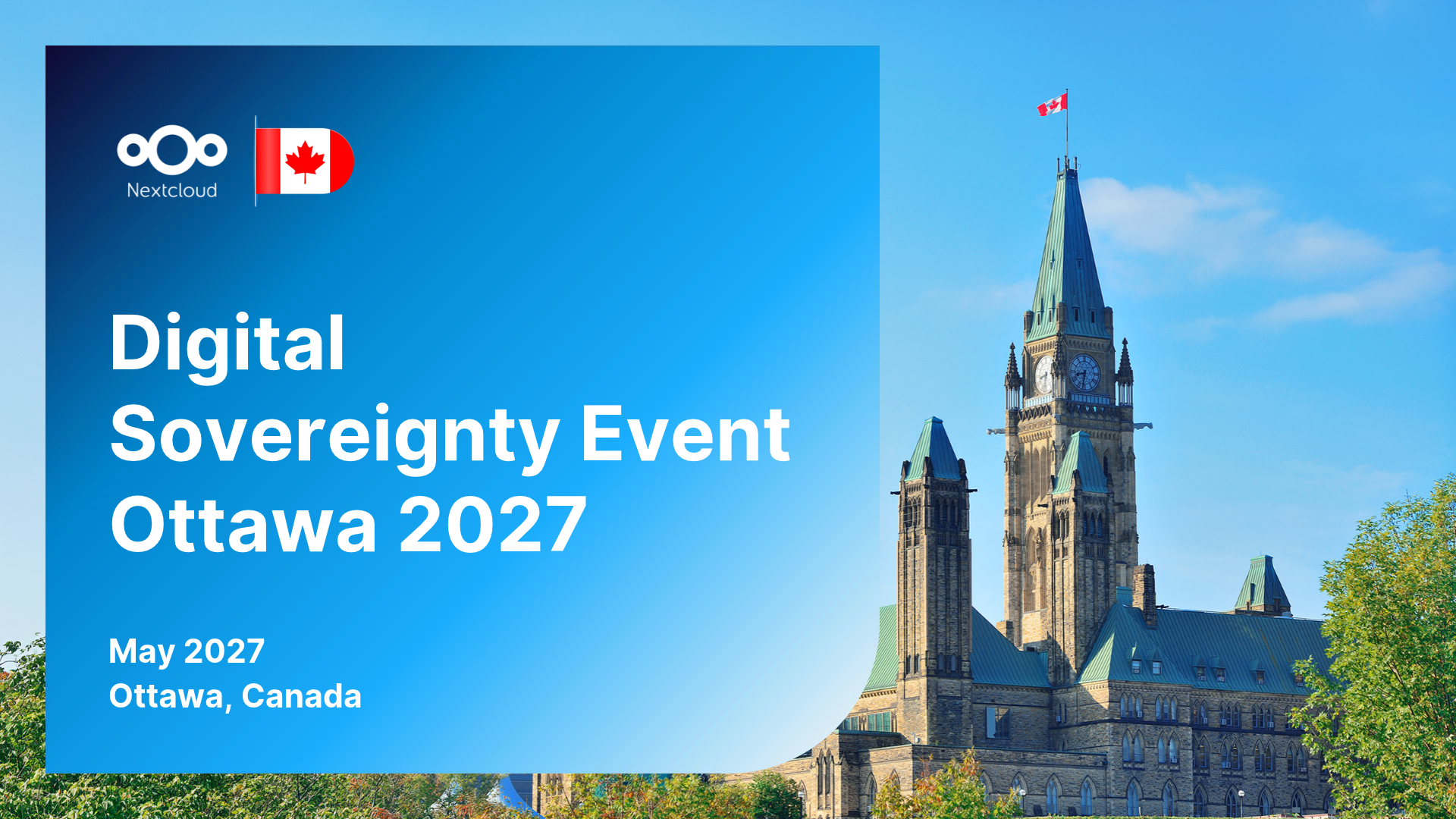
Join us in Ottawa
Our upcoming event is designed for IT professionals, project managers, decision-makers, and public sector leaders, exploring how to regain control over digital infrastructure and build secure, sustainable, and digitally sovereign environments. Date and venue to be announced soon. Pre-register now:
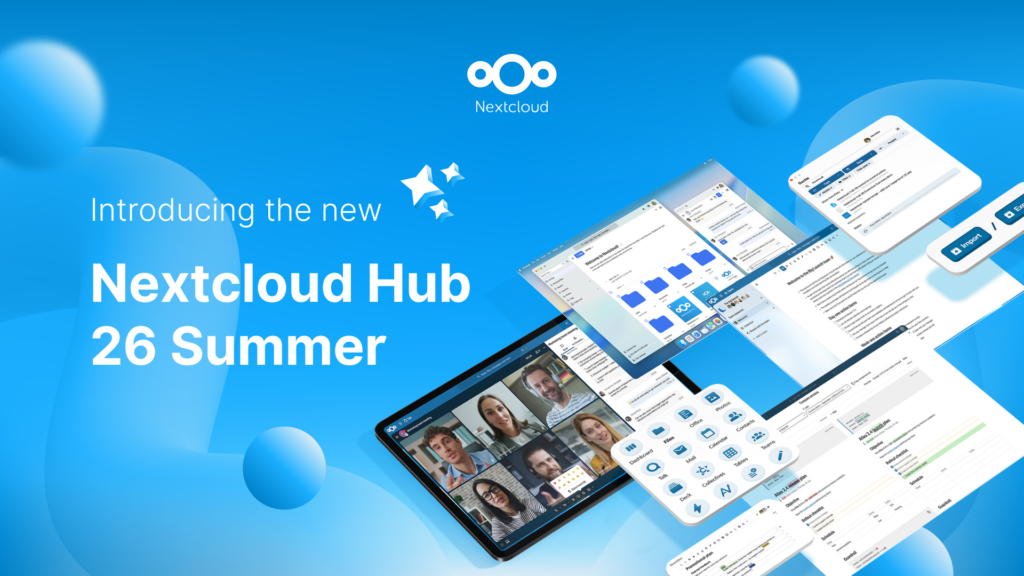
Fruto del trabajo conjunto de nuestro equipo, la comunidad y nuestros partners, Nextcloud Hub 26 Summer aprende de personas reales que utilizan nuestras herramientas a diario. Crea un espacio propio para tu equipo con Nextcloud Teams, organiza tus recuerdos en el nuevo Nextcloud Photos y disfruta de las actualizaciones que pediste en todas las aplicaciones. ¡Sigue leyendo para conocer todos los detalles de nuestra última versión!
Nextcloud Hub offers several types of integrations for AI, from completely self-hosted options to integrations with external services like Open AI. Here's an overview of what you can use and where, and where it stands on our Ethical AI scale.
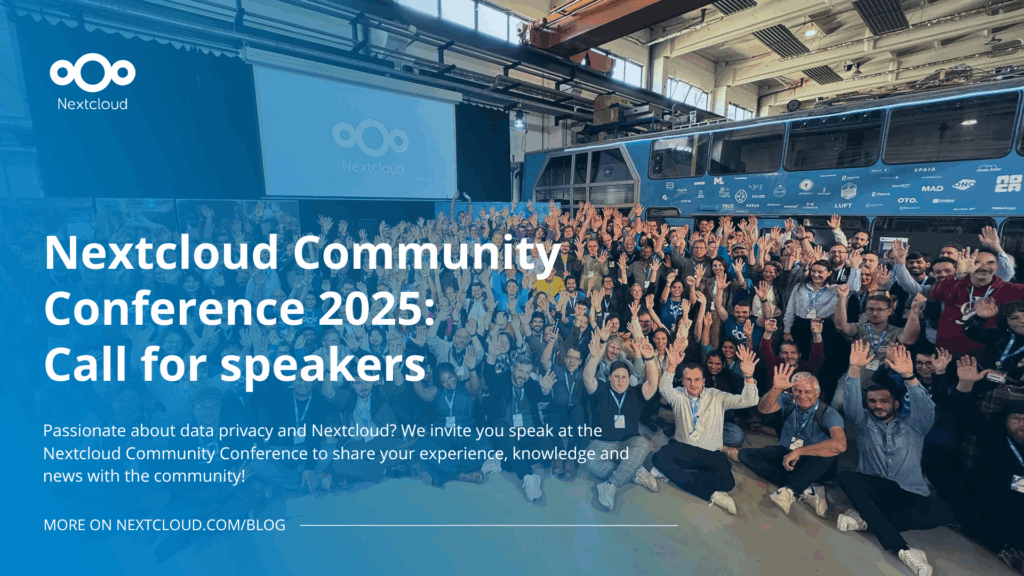
Passionate about data privacy and Nextcloud? We invite you speak at the Nextcloud Community Conference to share your experience, knowledge and news with the community!
For the ninth time, Nextcloud has been nominated for the CloudComputing-Insider Readers’ Choice Award in the category of Cloud Content Management. We’d love to reach the top again! And we’re looking for the support of you and everyone else in our amazing community to get there. Nextcloud as the best Cloud Content Management tool? Only […]
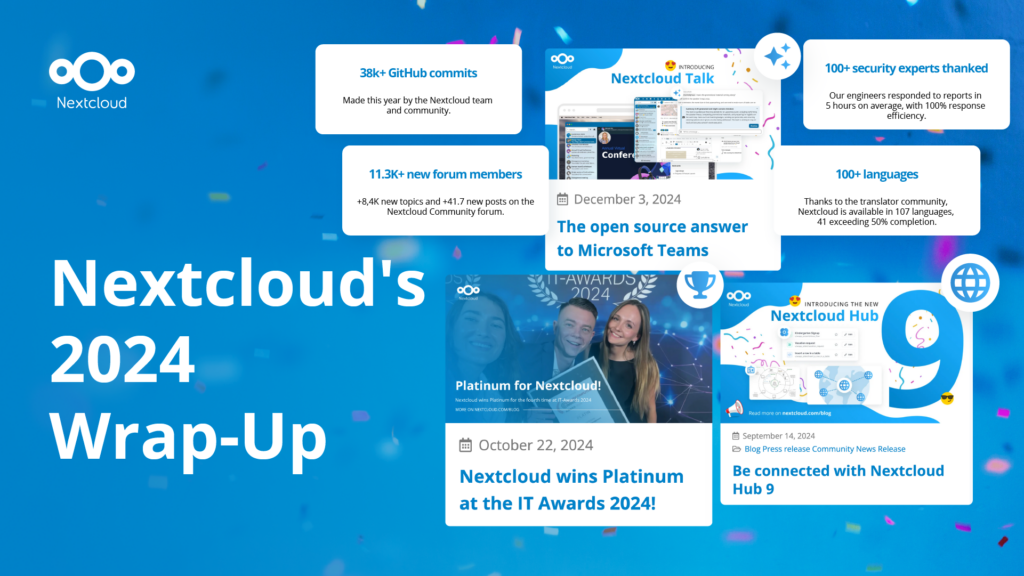
In the Nextcloud 2024 wrap-up, we want to take a moment to celebrate this year's achievements. Join us as we continue to reimagine what’s possible - shaping a world where open source, privacy and connection come together and drive progress for the greater good.
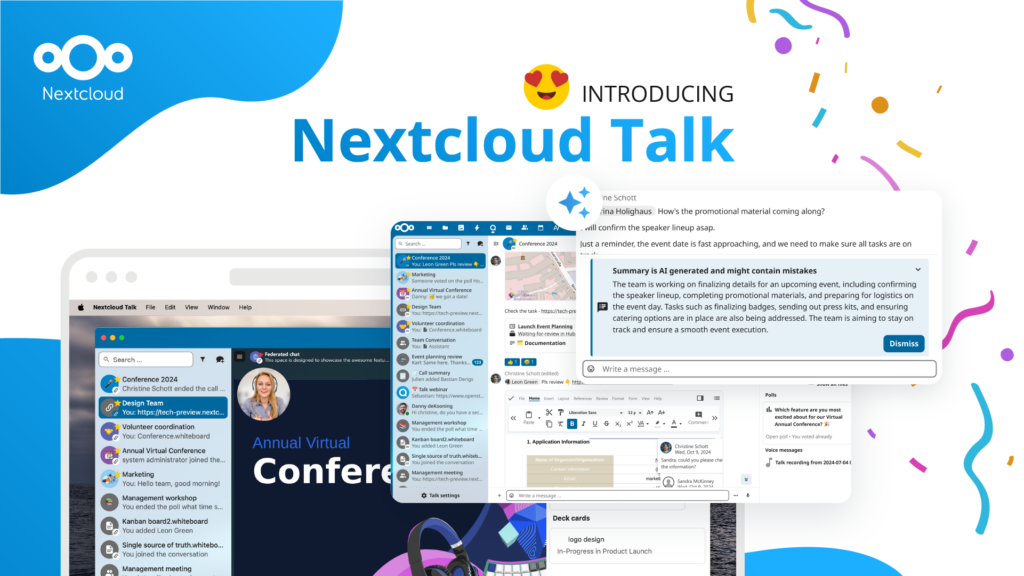
Las organizaciones, grandes y pequeñas, necesitan una forma de garantizar la resiliencia y la soberanía digital de sus operaciones: una alternativa de código abierto que respete la privacidad frente a Teams. Y hoy, presentamos esa solución: Nextcloud Talk.
Nextcloud has been recognized with the World Summit Award Germany that selects and promotes local digital innovation improving society, aiming to contribute to the United Nations' agenda of sustainable development goals.
DIE ZEIT, a prominent German outlet, interviewed Nextcloud’s founder Frank Karlitschek for an article on Microsoft’s anti-competitive behaviour on the European office software market. Read for a recap of the article and the key takeaways.
MagentaCLOUD’s migration to Nextcloud in 2021 resulted in a fully equipped Online Storage with an integrated online office suite that further improves the user experience, flexibility and security for customers.
We bring you a major update to the Nextcloud AI Assistant, plus the news we work with several big hosting providers like IONOS and OVHcloud to bring AI-as-a-Service options to you!
Bechtle and Nextcloud announce today a complete managed collaboration platform for the public sector that requires no tender and can be deployed immediately.
Discover how to make the switch from ownCloud to Nextcloud. Our quick guide provides insights into the migration process, helping you make the transition smoothly.
Today, US-based file sync & share vendor Kiteworks announced their acquisition of ownCloud and Dracoon. Kiteworks points out that their customers now have access to their file-sharing application. It is to be expected they will not maintain 3 similar products, but customers will have to migrate to the US firms’ platform or look for another […]
As part of Schleswig-Holstein's state digitization strategy, the state chancellery has announced they will work with Nextcloud to develop AI for working with government documents. This comes just after we announced the first private AI assistant last weekend with Hub 6. The German state already uses Nextcloud and their AI strategy aligns with our work on ethical, local AI technologies.
Nuestra misión es ayudar a particulares, empresas y organizaciones a alcanzar la soberanía digital y recuperar el control sobre sus datos. Nextcloud Hub 5 supone un enorme paso adelante en la consecución de esta misión, poniendo el poder de la IA en tus manos, de forma que mantengas el control. Nueva versión, nuevas posibilidades Hub […]
Jan Vales, System Administrator for the TUcloud at TU Wien, tells us about university's 35,000-user Nextcloud setup, how share links solved TU Wien’s external collaboration problems, and why he thinks open source should win over closed source.
La aplicación de escritorio Euro-Office ya está aquí. Infórmate sobre las funciones de la aplicación, cómo instalarla y cómo coeditar archivos con tu equipo a través de Nextcloud Hub.
New maintenance updates are available for Nextcloud Hub. Read more in this post or access the full changelog on our website. Keep your server up-to-date!
Guardamos algunas cookies para contar los visitantes y facilitar el uso del sitio. Esto no sale de nuestro servidor y no es para rastrearte personalmente. Consulta nuestra política de privacidad para obtener más información. Personalización
Cookies utilizadas para guardar los datos introducidos en los formularios, como nombre, correo electrónico, número de teléfono e idioma preferido.
Nombre de la cookie:nc_form_fields
Descripción de la cookie:Recuerda los datos introducidos en los formularios para la próxima vez (nombre, correo electrónico, teléfono e idioma preferido)
Caducidad de la cookie:30 días
Consentir
Nombre de la cookie:nc_utm_parameters
Descripción de la cookie:We use cookies to store UTM parameters from your visit so we can understand how you arrived at our website.
Las cookies estadísticas recopilan información de forma anónima y nos ayudan a comprender cómo utilizan nuestro sitio web nuestros visitantes. Utilizamos Matomo alojado en la nube.
Servicio:Matomo
Descripción de la cookie:
_pk_ses*: Cuenta la primera visita del usuario
_pk_id*: Ayuda a no contar dos veces las visitas.
mtm_cookie_consent: Recuerda que el usuario ha dado su consentimiento para almacenar y utilizar cookies.
Caducidad de la cookie:_pk_ses*: 30 minutos
_pk_id*: 13 meses
mtm_cookie_consent: 30 días