Since launching on March 27, Euro-Office has moved quickly. We have been heads-down on the things that matter most for a young open-source project: making it easier to build & contribute to, documenting our code and processes, and publishing a Euro-Office roadmap.
We are also happy to welcome two new members to the coalition, and existing coalition members are hiring. Besides these formal contributions, significant community contributions have been received, especially in improving security and performance.
Here is an update on where things stand.
Euro-Office roadmap: Security, performance, and ODF support
Over the coming days, we plan to publish a roadmap on GitHub, so everyone can see where we are headed. While we collect existing tickets and create new things, we wanted to share an overview of our goals so the community has a clear picture of where Euro-Office is headed.
Already started & ongoing
When we started, our focus was on making Euro-Office easier to build, removing unneeded dependencies, replacing binary blobs, and so on. Much of this work is done, but there is still a fair bit to do:
Improve the build process further
Set up automated testing
Translate code comments that aren’t in English
Improve documentation
Clean up and refactor code that has outdated dependencies or binary blobs
When we went live, a lot of the contributions had to do with performance or were related to security. These are, of course, important concerns, and we will keep working on them.
Improve security: Various PR’s were done, including updates to an outdated OpenSSL and more
Improve performance
Bugfixes/improve stability
Removal of some artificial restrictions, like limits to mobile editing and the admin panel
Next steps: improved ODF support, integrations, mobile apps, and more
While we work on all those very technical things, we also want to ship a product! Our goal is first to make a production-ready build of the server, clean up the code, and make integration with the various products like Nextcloud and OpenProject easier. Then we will work on the desktop and mobile apps.
Make Euro-Office production-ready on the server (incl PDF editor)
Improve ODF support
Improve integration features: Allow skipping different cloud services, chat, and other unneeded features, and allow using a different AI back-end
Improve Nextcloud integration: Build an easy Office selector, and integrate Smart Picker and other tools
Release the desktop app for Windows, Mac, and Linux
Release Mobile apps for Android and iOS
One item we want to call out specifically: Euro-Office will work towards full ODF support. That is not only because it matters technically, but also reflects our priorities: a focus on open standards.
OOXML, or Office Open XML, was not designed for interoperability, but to do something very specific: to encode Microsoft Office’s binary formats in XML in such a way as to allow Microsoft to claim compliance with the standard without relinquishing control over users through lock-in.
The Document Foundation
Global Community Blog
Euro-Office exists precisely to give users and organisations a genuine alternative — one that treats open standards as a foundation, not a compatibility afterthought. Prioritizing improvements to ODF support is a natural expression of that commitment.
New members joining Euro-Office: OX and Office EU
Next, we are pleased to announce that two new organisations are joining the Euro-Office coalition: Open-Xchange and Office.EU. Both bring resources and commitment that will meaningfully accelerate the project, and of course, both are very much aligned with our mission.
Office EU
Office EU joined the Euro-Office open source project to strengthen a growing ecosystem of European platforms united by open collaboration. Open standards should be the norm, not the exception. When platforms work together on shared foundations, everyone benefits. A step forward in regaining control and building a free, transparent, and sovereign working environment for Europe.
Open-Xchange (OX)
Open-Xchange (OX) welcomes the Euro-Office initiative, as it believes it is essential that end-users have a choice of real alternatives to solutions from global hyperscalers that are truly independent and support the drive to digital sovereignty; This includes a secure and open office suite that can handle existing formats.
Next, let’s address the question of how you, too, can join the Euro-Office project.
Euro-Office: How to get involved and governance
A trustworthy open-source project needs clear rules on how newcomers can become part of the community and how decisions are made. We have taken concrete steps on both fronts.
Contributing to Euro-Office
We have introduced a CONTRIBUTE.md file covering everything a new contributor needs to know: design principles, coding guidelines, and how we handle pull requests. You should be able to get started there right away!
This process seems to be working even before we published this documentation. We are incredibly humbled by all the attention and the many contributions we have already seen.
Besides our team, a dozen external developers opened 15 pull requests across the repositories. A third of these have been merged, 1 was closed without a merge, while the rest are under review. Many relate to security and performance, bringing immediate benefits across the code base.
Apart from code contributions, over 120 people engaged in conversations, tested builds, reported issues, and contributed bug reports and feature requests. We welcome more contributions in any of those areas going forward!
For those looking for a more formal membership, the process of becoming a member has been defined in the README. It works as follows:
For individuals: Contribute over the course of a few months, and we will add you to the GitHub project. Sustained contribution is the bar; there is no formal application process.
For organisations: Reach out, tell us what you want to work on, and we will discuss and vote on your involvement following the governance process above. Once approved, your organisation joins the list of members, and your team members are added to the project.
Governance at Euro-Office
The README now includes a governance section, alongside a code of conduct based on the widely-adopted Contributor Covenant. For now, our current decision-making model is straightforward: we follow the open-source principle of who codes, decides with consensus-based decision-making in case of disagreement. Concretely:
Decisions are made by consensus among all project members — meaning full agreement, or an agreed-to-disagree outcome.
Members are the members of the GitHub project.
Regular contributors are added to the project by consensus of existing members.
These rules can be changed by a majority vote.
This is a starting point, not an endpoint. As we scale up, we will set up a more formal steering committee, and we will share more on that structure as it takes shape. But for now, these basic rules will suffice, as they do for many other open source projects.
Euro-Office is hiring!
Of course, there is a third way to get involved: join one of the teams at the various current contributors to Euro-Office!
In response to the immense interest from the market in Euro-Office, Nextcloud plans to double the team working on it. The same goes for IONOS, which has already shared details here. Please check our jobs page and submit your resume if you’re interested in working full-time at Euro-Office, and stay tuned for more messages about Euro-Office from IONOS on LinkedIn!
Of course, other partners are also ramping up their efforts, and we will keep you updated.
Join us
We now have a Euro-Office roadmap, a governance model, a contribution process, and a growing coalition with lots of open job positions. The foundations are solid. If your organisation shares our belief in digital sovereignty, open standards, and software that genuinely serves its users, now is a great time to get involved. Reach out, and let’s talk.
Euro-Office is gaining momentum with a clear roadmap focused on security, performance, and full ODF support. New coalition members, growing community contributions, and defined governance mark the next phase of building an open, sovereign office ecosystem.
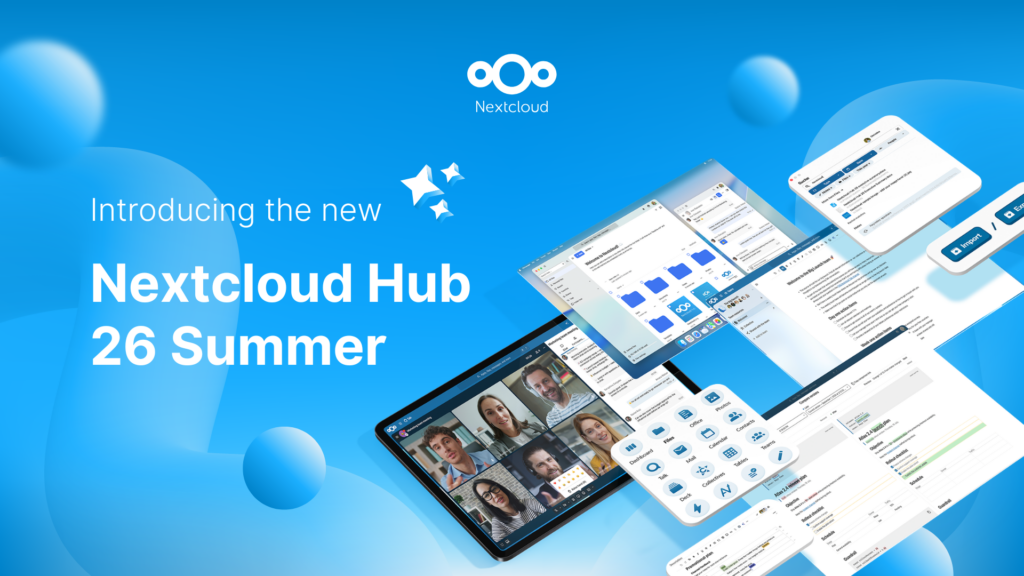
Créé grâce à un effort conjoint de notre équipe, de la communauté et de nos partenaires, Nextcloud Hub 26 Summer s'inspire des personnes réelles qui utilisent nos outils au quotidien. Créez votre propre espace d’équipe avec Nextcloud Teams, organisez vos souvenirs dans le nouveau Nextcloud Photos et profitez des améliorations que vous avez demandées dans l’ensemble des applications. Poursuivez votre lecture pour un aperçu complet de notre dernière version !
Nextcloud Hub 25 Autumn facilite le démarrage d'une collaboration puissante tout en gardant le contrôle de vos données. Des mises à jour globales du design à l'amélioration de la convivialité et des performances, découvrez notre dernière version dans ce blog.
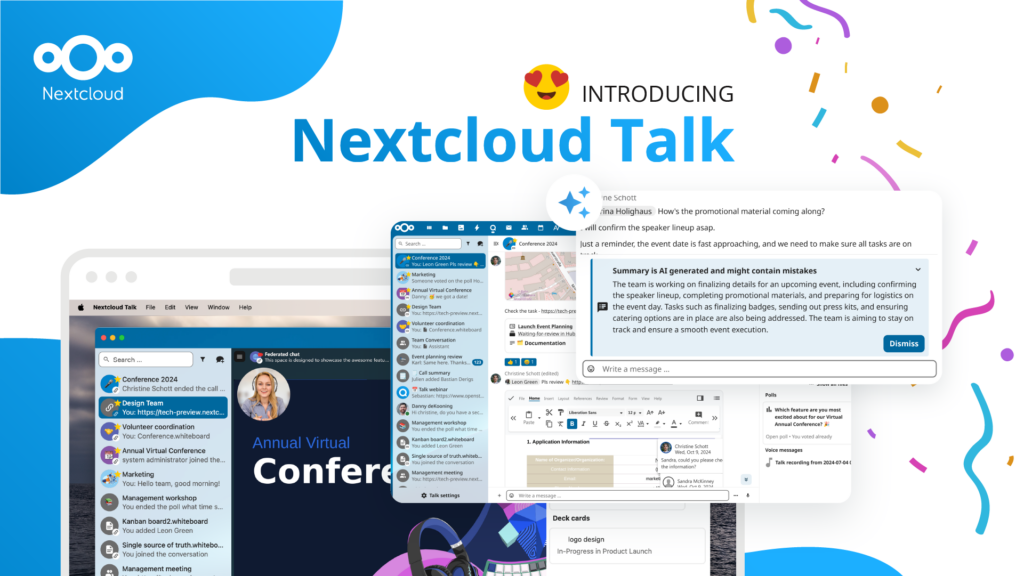
Les organisations, petites et grandes, ont besoin d'un moyen d'assurer la résilience et la souveraineté numérique de leurs opérations - une alternative à Teams, open-source et respectueuse de la vie privée. Aujourd'hui, nous vous présentons cette solution - Nextcloud Talk.
Nous vous présentons une mise à jour majeure de l'assistant Nextcloud IA, ainsi que de nouvelles informations sur notre collaboration avec plusieurs grands fournisseurs d'hébergement tels que IONOS et OVHcloud pour vous proposer des options d'IA en tant que service !
Bechtle et Nextcloud ont annoncé aujourd'hui une plateforme de collaboration entièrement administrée pour le secteur public, qui ne nécessite pas d'appel d'offres et peut être déployée immédiatement.
Découvrez comment passer de ownCloud à Nextcloud. Notre outil d'aide à la migration fournit des informations sur le processus de migration et vous aide à effectuer la transition en douceur.
Nous enregistrons certains cookies pour compter les visiteurs et faciliter l'utilisation du site. Ces données ne quittent pas notre serveur et ne sont pas destinées à vous suivre personnellement ! Consultez notre politique de confidentialité pour plus d'informations Personnaliser
Les cookies utilisés pour enregistrer les données saisies dans les formulaires, telles que le nom, l'adresse électronique, le numéro de téléphone et la langue préférée.
Nom du cookie :nc_form_fields
Description du cookie :Mémorise les données saisies dans les formulaires pour une prochaine visite (nom, adresse électronique, numéro de téléphone et langue préférée).
Expiration du cookie :30 jours
Consentement
Nom du cookie :nc_utm_parameters
Description du cookie :We use cookies to store UTM parameters from your visit so we can understand how you arrived at our website.
Les cookies statistiques collectent des informations de manière anonyme et nous aident à comprendre comment nos visiteurs utilisent notre site web. Nous utilisons la solution open source de mesure de statistiques web Matomo
Service:Matomo
Description du cookie :
_pk_ses*: Compte la première visite de l'utilisateur
_pk_id*: Aide à ne pas compter deux fois les visites.
mtm_cookie_consent: Se souvient que l'utilisateur a donné son accord pour le stockage et l'utilisation de cookies.
Expiration du cookie :_pk_ses*: 30 minutes
_pk_id*: 13 mois
mtm_cookie_consent: 30 jours