2025 was a strong year for digital sovereign solutions. Over the past year, countless individuals, governments, and private organizations have taken steps to regain control over their data. And this is happening not just in Europe, but across the globe.
Two million new professional Nextcloud users
From Berlin to São Paulo and from Amsterdam to Austin, organizations are turning to Nextcloud to power a digital workplace that is secure and truly theirs. Over the last year, over two million new users across schools, government organizations, and businesses started using Nextcloud for their day-to-day tasks.
There are some prominent names and numbers in the list:
About 100,000 researchers, teachers, and students across Dutch universities will soon be able to start working with Nextcloud through the Dutch IT cooperative for education and research, SURF.
Another French ministry, the Ministry of Education, has rolled out Nextcloud to 400,000 of its administrative employees and continues this rollout until it is available to the full 1.2 million employees.
And, as covered widely in the press, the German state of Schleswig-Holstein has made Nextcloud Hub available to tens of thousands of employees across the state’s administrative apparatus.
Dirk Schrödter, Minister of Digitalization in Schleswig-Holstein, and Frank Karlitschek, CEO and founder of Nextcloud
These organizations, along with many others you can find on this page, are more than just Nextcloud users or customers. They are leaders, pioneers who prove that sovereignty isn’t a niche concept idea but the future. And they are part of the Nextcloud community itself, providing feedback, sharing their experience with others, and even directly collaborating on code and improvements to the code base.
A fast-growing global movement
This isn’t just a European trend. While Germany, France, and the US are leading the way in terms of absolute demand, countries such as the Netherlands, Brazil, and Denmark are experiencing some of the fastest growth in demand.
For the company, this surge in adoption has resulted in a growth in bookings of over 50% compared to 2024. This continues its nearly decade-long exponential growth path and clearly indicates that more organizations than ever are investing in sovereign solutions.
Recognising this, Nextcloud has committed to investing 250 million euros over the next five years in research and development, product innovation, partner enablement, public education, and community projects, with the aim of promoting digital sovereignty in Europe.
A platform, not just a product
These developments build on the fact that Nextcloud is not a monolithic product from a single company or closed community. Rather, it has developed into a platform that enables a wide range of developers and organizations to create, adapt, and build their own capabilities on.
Several hundred developers contribute code to both the base and to applications built on top of Nextcloud. Some work for their own or at a small business, others are employed by major Nextcloud customers, universities, or consulting firms to build the capabilities they need.
Today, major functionality is provided by independent open source companies, like Office document editing, project management, powerful wiki software, document signature mechanisms, and a range of authentication and storage mechanisms.
This provides organizations that look to deploy Nextcloud not only unparalleled flexibility and integration in their infrastructure, but also the peace of mind that the ecosystem they are building their sovereign workplace on is healthy, resilient, and not dependent on any single entity.
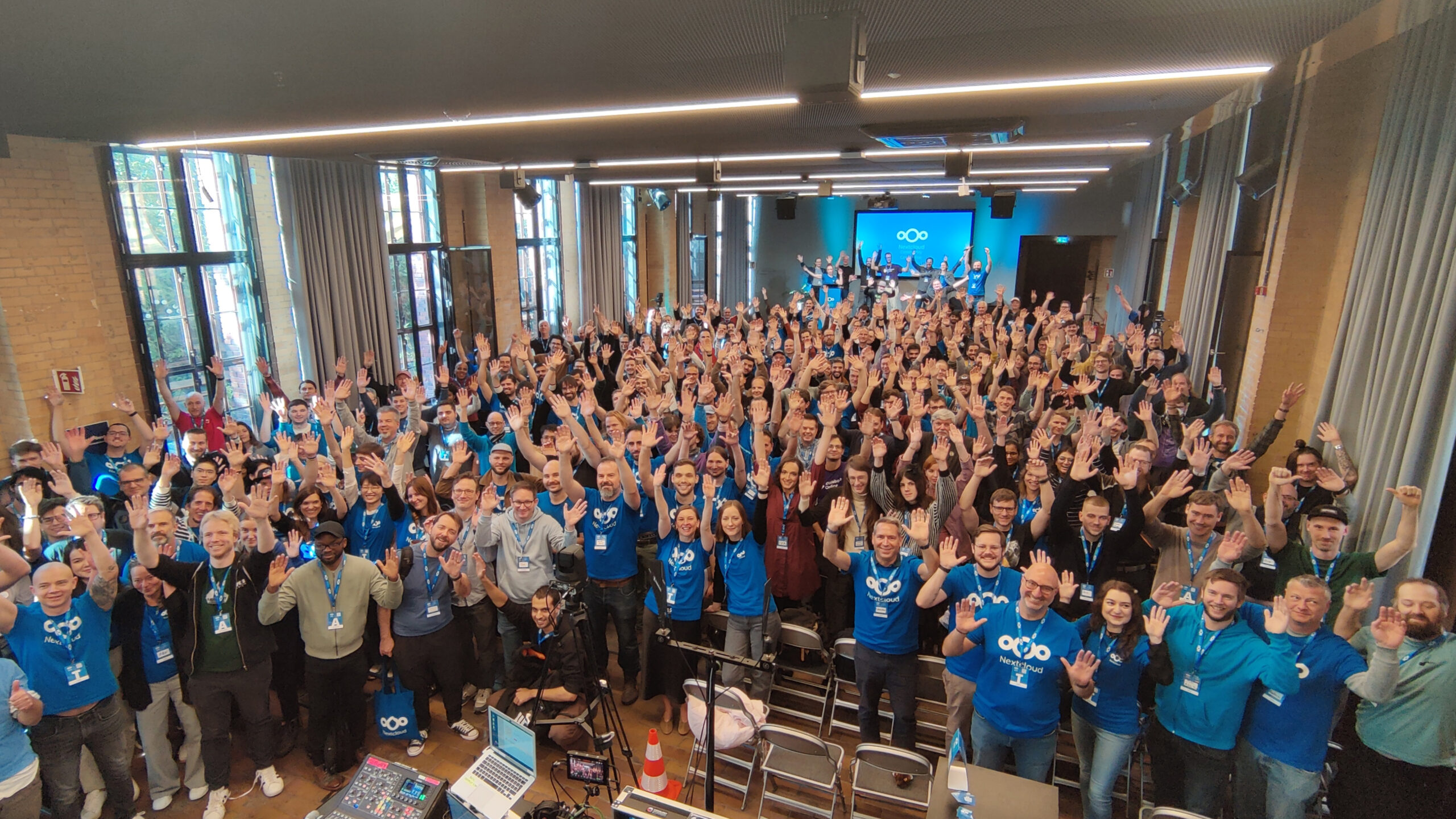
The Nextcloud community at the Community Conference in Berlin 2025
Growing partner ecosystem
The Nextcloud partner ecosystem also experienced enormous growth, expanding by 300% in 2025. Companies such as IONOS, Redpill Linpro, Smile, and KPN are helping to widen Nextcloud’s reach into regions and sectors in which they have expertise. Other companies are part of the bigger picture and are working with us to promote digital sovereignty.
Examples include:
XWiki has built a tool that can replace Confluence
Univention provides an identity and access management (IAM) alternative to Microsoft
OpenProject has created an open-source project management tool to compete with Jira
So, if you’re a developer looking to build on an open platform, an organization fed up with vendor lock-in, or someone who believes in digital freedom, now is your moment. The future of work isn’t just about efficiency, but about ownership.
Be part of the movement
Meet the community, explore real-world use cases, and connect with others building a more sovereign digital future. Explore events near you and join a growing global community of developers, partners, and organizations.
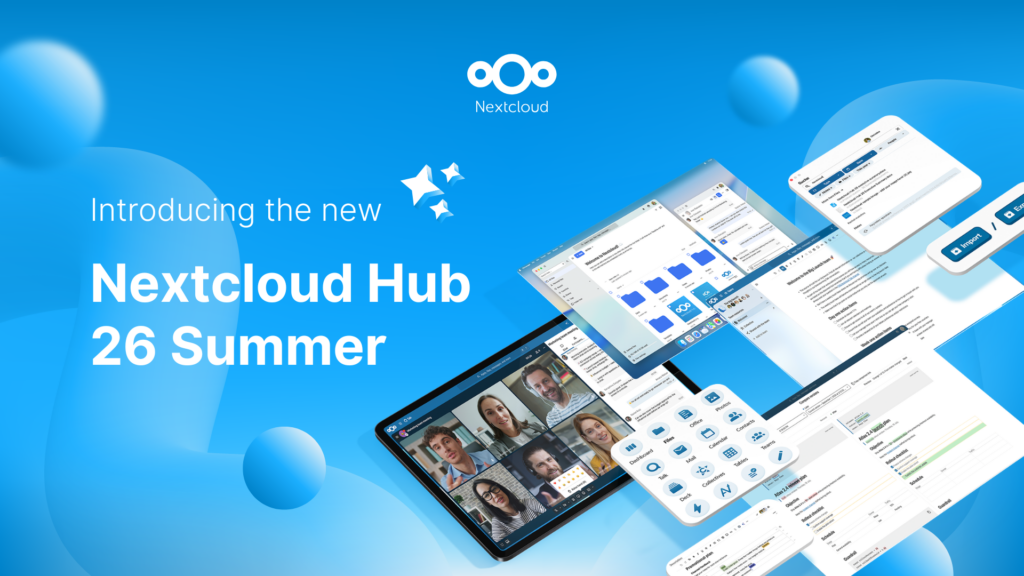
Créé grâce à un effort conjoint de notre équipe, de la communauté et de nos partenaires, Nextcloud Hub 26 Summer s'inspire des personnes réelles qui utilisent nos outils au quotidien. Créez votre propre espace d’équipe avec Nextcloud Teams, organisez vos souvenirs dans le nouveau Nextcloud Photos et profitez des améliorations que vous avez demandées dans l’ensemble des applications. Poursuivez votre lecture pour un aperçu complet de notre dernière version !
Nextcloud Hub 25 Autumn facilite le démarrage d'une collaboration puissante tout en gardant le contrôle de vos données. Des mises à jour globales du design à l'amélioration de la convivialité et des performances, découvrez notre dernière version dans ce blog.
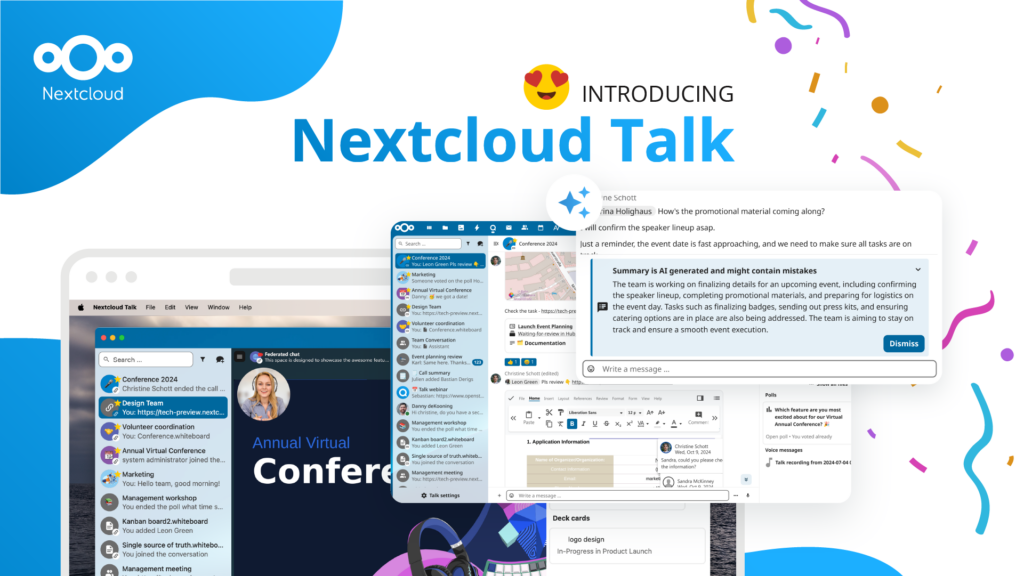
Les organisations, petites et grandes, ont besoin d'un moyen d'assurer la résilience et la souveraineté numérique de leurs opérations - une alternative à Teams, open-source et respectueuse de la vie privée. Aujourd'hui, nous vous présentons cette solution - Nextcloud Talk.
Nous vous présentons une mise à jour majeure de l'assistant Nextcloud IA, ainsi que de nouvelles informations sur notre collaboration avec plusieurs grands fournisseurs d'hébergement tels que IONOS et OVHcloud pour vous proposer des options d'IA en tant que service !
Bechtle et Nextcloud ont annoncé aujourd'hui une plateforme de collaboration entièrement administrée pour le secteur public, qui ne nécessite pas d'appel d'offres et peut être déployée immédiatement.
Découvrez comment passer de ownCloud à Nextcloud. Notre outil d'aide à la migration fournit des informations sur le processus de migration et vous aide à effectuer la transition en douceur.
Collabora Online 26.04.3-3 adds Landlock as a new sandboxing option, isolating each document's Kit process at the kernel level for stronger, faster protection.
New maintenance updates are available for Nextcloud Hub. Nextcloud Hub 25 Autumn reaches End of Life. Read more in this post or access the full changelog on our website. Keep your server up-to-date!
Nous enregistrons certains cookies pour compter les visiteurs et faciliter l'utilisation du site. Ces données ne quittent pas notre serveur et ne sont pas destinées à vous suivre personnellement ! Consultez notre politique de confidentialité pour plus d'informations Personnaliser
Les cookies utilisés pour enregistrer les données saisies dans les formulaires, telles que le nom, l'adresse électronique, le numéro de téléphone et la langue préférée.
Nom du cookie :nc_form_fields
Description du cookie :Mémorise les données saisies dans les formulaires pour une prochaine visite (nom, adresse électronique, numéro de téléphone et langue préférée).
Expiration du cookie :30 jours
Consentement
Nom du cookie :nc_utm_parameters
Description du cookie :We use cookies to store UTM parameters from your visit so we can understand how you arrived at our website.
Les cookies statistiques collectent des informations de manière anonyme et nous aident à comprendre comment nos visiteurs utilisent notre site web. Nous utilisons la solution open source de mesure de statistiques web Matomo
Service:Matomo
Description du cookie :
_pk_ses*: Compte la première visite de l'utilisateur
_pk_id*: Aide à ne pas compter deux fois les visites.
mtm_cookie_consent: Se souvient que l'utilisateur a donné son accord pour le stockage et l'utilisation de cookies.
Expiration du cookie :_pk_ses*: 30 minutes
_pk_id*: 13 mois
mtm_cookie_consent: 30 jours