From conferences to online talks: The conversation about migrating away from Big Tech platforms like Microsoft 365 seems to be everywhere. After all, there are plenty of reasons to make the switch. Just think of the concerns on compliance and data safety, the ever-rising subscription costs, and the growing geopolitical tensions. In other words, traditional Big Tech no longer offers the solution many organizations and public institutions are looking for, and there are a lot of incentives to migrate.
But while the motivation is clear, the execution often fails. From failed architectural setups to terrible user experiences: there are plenty of pitfalls that come with replacing Big Tech platforms.
So how can your organization make a successful switch, freeing itself from vendor lock-in, ensuring compliance, and regaining control over its data?
Replacing Microsoft 365: Common fails
When organizations look to replace a Big Tech solution, like Microsoft 365, they often choose one of two routes: building it themselves or bundling multiple open source tools.
How does it go wrong with these alternatives?
1. The struggles of in-house development: complexity, scope, and ownership
The reasons for building your own tech solution seem straightforward. You get to maintain full control, you can set up features tailored specifically to your organization, and you keep your digital autonomy.
However, in practice, large public-sector IT projects and in-house collaboration suites are prone to failure. So much so that there are public outcries to stop struggling with digital transformation projects.
Why do they fail?
Often organizations underestimate the complexity of the task, which was, for example, the case with the UK’s government project to overhaul the computer system of its national health service (NHS), which “achieved little and wasted billions.” Or the task starts out well, but once the scope expands, it becomes impossible to manage the project.
Add fragmented ownership and long delivery cycles to the pattern, and the in-house development idea becomes a recipe for disaster.
After all, collaboration platforms are not single tools. As ecosystems of tightly integrated services, including identity management, file sharing, communication apps, and search tools, they need strong product governance to succeed.
Rebuilding a tech stack from scratch, as well as ensuring compliance and lifecycle management, is rarely sustainable.
2. Bundling multiple open source tools: constant operational and productivity costs
A second and common route is assembling an offering of multiple products, such as a file-sharing solution, video conferencing tool, email system, chat app, and document editor.
Organizations can choose open source solutions for this. And often, they introduce them one by one, which at first thought seems like a good option.
As Adriana Groh from the Sovereign Tech Agency recently emphasized, open source is the « winning strategy » and « superior in terms of security, interoperability, and low development costs. No silo development can keep up with this speed.” And she is right in that. There are excellent open source tools out there for various use cases.
The risk is that, when introducing solutions one by one in isolation, you don’t end up with a cohesive collaboration environment. Rather, it is a fragmented mess! Even when looking to build a single solution, organizations often make the mistake of just bundling separate applications with little regard for user experience. But you have to keep in mind that the competition is Microsoft 365, a deeply integrated collaboration platform.
The productivity costs of constantly having to switch between tools and having to search for that final version of a document are high, easily adding up to an hour a day, according to studies. On top of that comes the operational complexity and associated security risks, as well as the performance problems of running multiple technology stacks in parallel.
Such an “all-in-one solution” from a bundle can quickly turn into poor user adoption and increased admin overhead. As an ICT manager, you have to take a step back and ask yourself: Can I afford to pay the constant price in terms of decreased productivity and increased operational costs, going forward?
The harsh reality is: A fragmented set of tools, even with a common theme and a sprinkle of integrations, simply cannot be a serious replacement for Microsoft 365.
The architectural difference: A bundle is not a platform
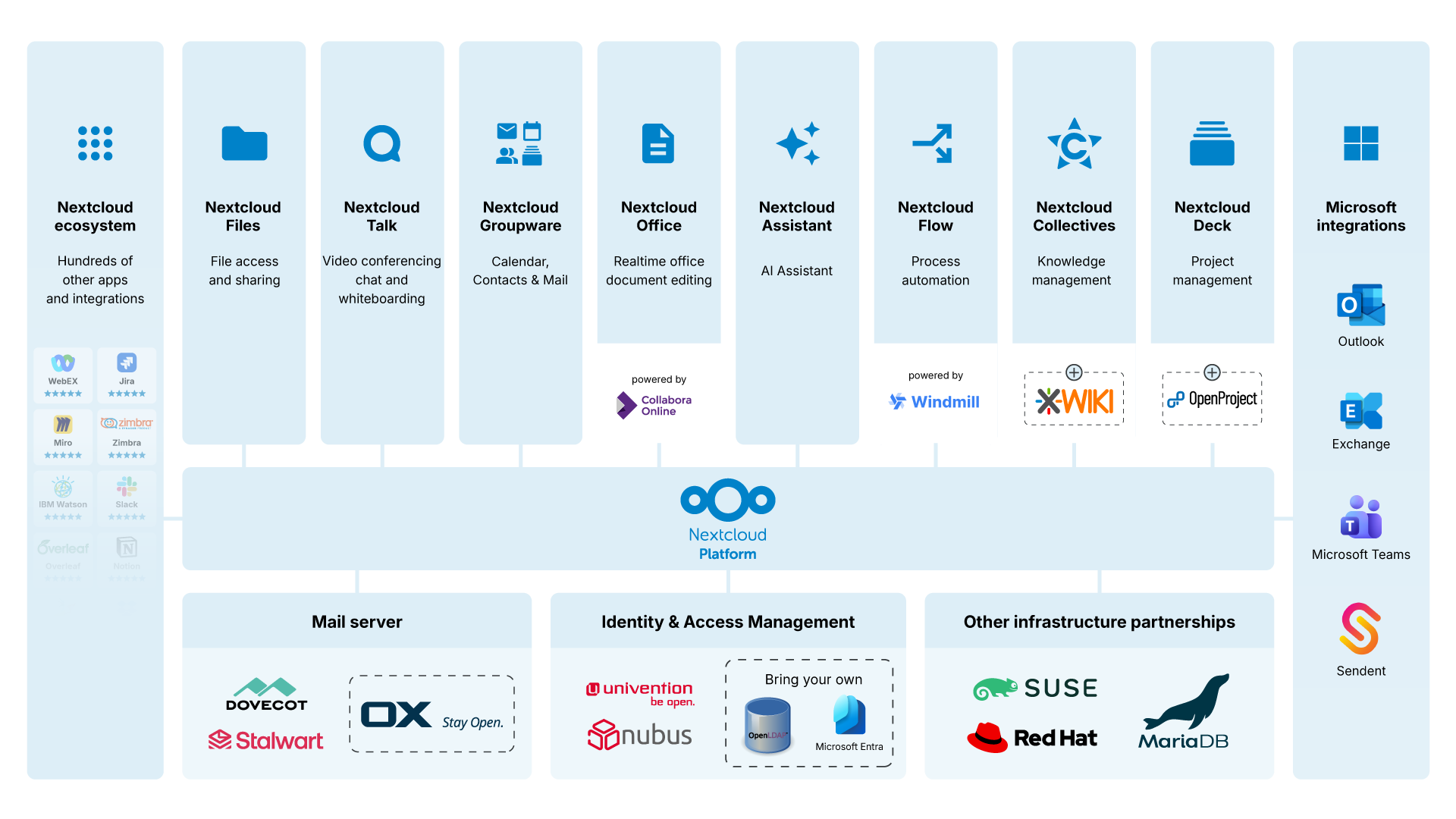
What matters is that replacing the Big Tech solution is not about setting up individual tools, but about replacing one platform with another. A real digital platform should provide you with strong collaboration tools, including:
Unified identity and presence
A consistent permission and sharing model
Integrated search, presence, and notifications across the platform
Coherent governance
Unified lifecycle management
A predictable user experience
In other words, a successful Microsoft 365 alternative must be designed from the ground up as an integrated platform.
Look for an open source collaboration platform that provides a strong architectural foundation, a transparent governance model, and a consistent user experience, so you are ensured of a future-ready platform.
How Nextcloud does it differently: An integrated platform that offers choice
Nextcloud is designed as a platform from the ground up. This means that you get a modular stack for a smart and personable digital experience instead of fragmented tools that leave your team members frustrated.
The benefits?
You get complete control over which apps you would like to use or replace, so you can create your own digital workspace. Nearly 600 apps offer a huge range of functionality and integrations with a wide range of third-party tools, ensuring perfect adaptation to your needs.
With a wide set of Nextcloud features, including online communication, project management, and AI-powered collaboration, you can design your own self-hosted platform to strengthen your team’s productivity and collaboration.
And of course, a single platform simplifies compliance and data control.
Beyond code, the Nextcloud solution also comes with an extensive ecosystem of partners that provide access to the expertise needed to operate a Nextcloud environment. From hosting and support to deployment advice, upgrade help, training, and documentation: these Nextcloud partners can build on, complement, and provide services around our platform.
In short, Nextcloud means you get a successful, well-performing, stable collaboration platform, which is very different from a bundle of code you download from a website.
Nextcloud is more than a single company or product
Nextcloud consists of a core with over 600 apps built on top, developed in a wide variety of computer languages and frameworks, as well as dozens of mobile and desktop applications connecting to it.
This platform is collaboratively developed by thousands of individual developers, companies and partners, and benefits from contributions and feedback from the hundreds of thousands of administrators and tens of millions of users from over 500.000 Nextcloud installations across the globe.
Their work, discussions, and commitment are what allow the platform to evolve in a sustainable way as the future of the sovereign digital workplace.
Making the switch: from Big Tech to open source with a unified platform
You might realize by now that digital sovereignty is not just an ideology, but also a practical concept that comes with operational conditions. If your organization decides to switch, be sure to choose a solution that you can adopt, manage, and trust. A platform, not a bundle of sticks. Something that evolves, adapts, and will provide collaboration for the future, not just today!
Start Nextcloud instant trial
Are you looking to move away from Big Tech without recreating the very fragmentation and dependency that you are trying to escape? Request an instant trial and discover how the Nextcloud platform can support you!
Le moment de reprendre le contrôle de vos données, c’est maintenant. Présentation du nouveau Nextcloud Hub, une puissante plateforme de collaboration open source qui vous met aux commandes. Découvrez les améliorations en matière de performance, de design et de sécurité, ainsi que de nombreux outils nouveaux et améliorés pour votre travail et votre vie quotidienne.
Nextcloud Hub 25 Autumn facilite le démarrage d'une collaboration puissante tout en gardant le contrôle de vos données. Des mises à jour globales du design à l'amélioration de la convivialité et des performances, découvrez notre dernière version dans ce blog.
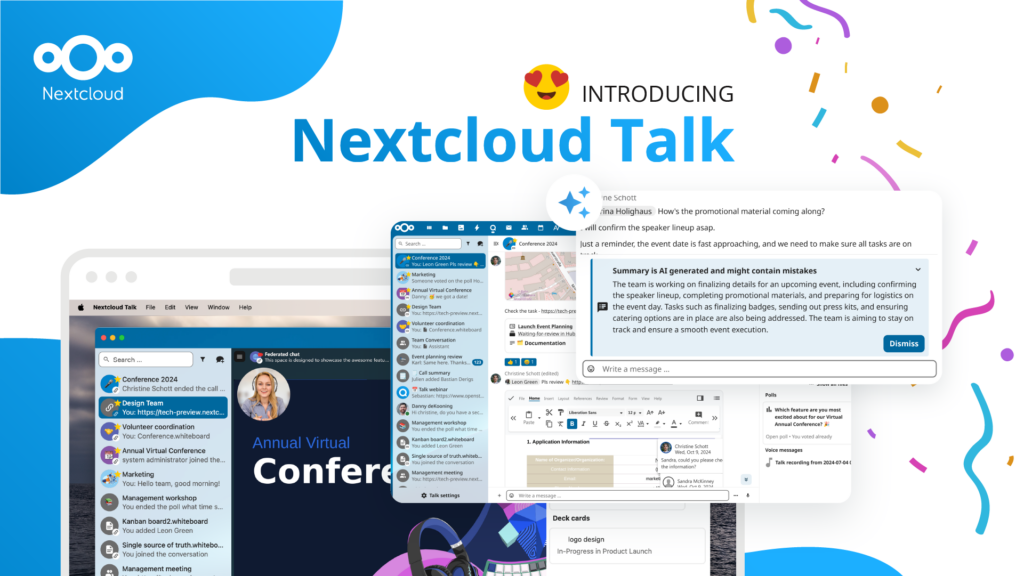
Les organisations, petites et grandes, ont besoin d'un moyen d'assurer la résilience et la souveraineté numérique de leurs opérations - une alternative à Teams, open-source et respectueuse de la vie privée. Aujourd'hui, nous vous présentons cette solution - Nextcloud Talk.
Nous vous présentons une mise à jour majeure de l'assistant Nextcloud IA, ainsi que de nouvelles informations sur notre collaboration avec plusieurs grands fournisseurs d'hébergement tels que IONOS et OVHcloud pour vous proposer des options d'IA en tant que service !
Bechtle et Nextcloud ont annoncé aujourd'hui une plateforme de collaboration entièrement administrée pour le secteur public, qui ne nécessite pas d'appel d'offres et peut être déployée immédiatement.
Découvrez comment passer de ownCloud à Nextcloud. Notre outil d'aide à la migration fournit des informations sur le processus de migration et vous aide à effectuer la transition en douceur.
Au cours de la dernière année, l'IA est devenue un sujet à la mode. Il y a de l'engouement, mais aussi du fondement. Il y a du positif et du négatif. Nous voulons vous offrir le positif, pas le négatif, et ignorer le battage médiatique ! […]
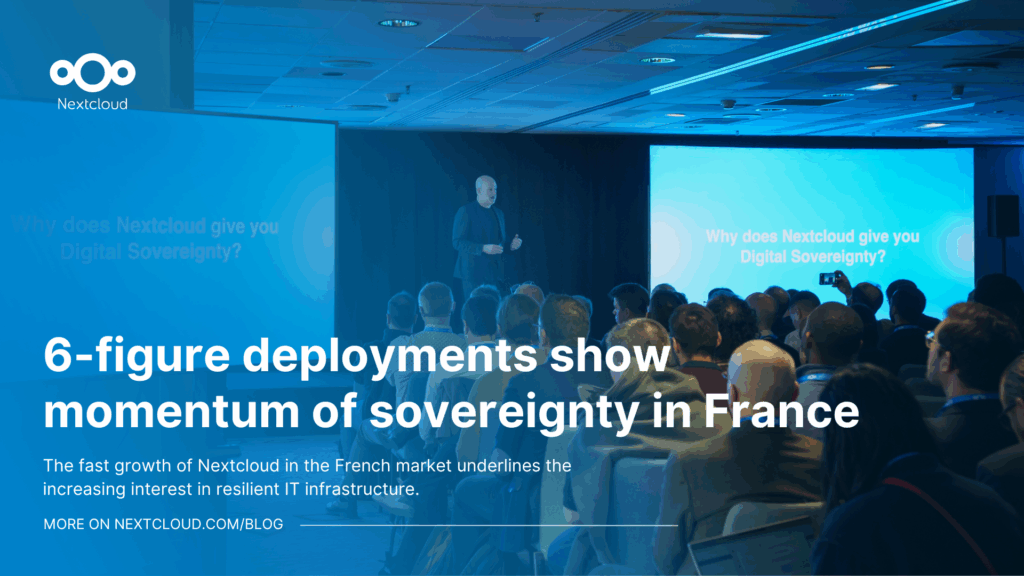
Les clients français de Nextcloud ont partagé leurs connaissances issues des récents déploiements de leur technologie souveraine d'espace de travail numérique auprès de millions d'utilisateurs, avec des discussions portant sur des déploiements à six chiffres au niveau des ministères, des villes et des États. La croissance rapide de Nextcloud sur le marché français souligne l'intérêt croissant pour les infrastructures informatiques résilientes, les clients exprimant leurs préoccupations concernant l'incertitude mondiale, les dépendances et les risques juridiques.
Nous enregistrons certains cookies pour compter les visiteurs et faciliter l'utilisation du site. Ces données ne quittent pas notre serveur et ne sont pas destinées à vous suivre personnellement ! Consultez notre politique de confidentialité pour plus d'informations Personnaliser
Les cookies utilisés pour enregistrer les données saisies dans les formulaires, telles que le nom, l'adresse électronique, le numéro de téléphone et la langue préférée.
Nom du cookie :nc_form_fields
Description du cookie :Mémorise les données saisies dans les formulaires pour une prochaine visite (nom, adresse électronique, numéro de téléphone et langue préférée).
Expiration du cookie :30 jours
Consentement
Nom du cookie :nc_utm_parameters
Description du cookie :We use cookies to store UTM parameters from your visit so we can understand how you arrived at our website.
Les cookies statistiques collectent des informations de manière anonyme et nous aident à comprendre comment nos visiteurs utilisent notre site web. Nous utilisons la solution open source de mesure de statistiques web Matomo
Service:Matomo
Description du cookie :
_pk_ses*: Compte la première visite de l'utilisateur
_pk_id*: Aide à ne pas compter deux fois les visites.
mtm_cookie_consent: Se souvient que l'utilisateur a donné son accord pour le stockage et l'utilisation de cookies.
Expiration du cookie :_pk_ses*: 30 minutes
_pk_id*: 13 mois
mtm_cookie_consent: 30 jours