Spain has always had digital sovereignty, pioneers. Barcelona built Decidim, the Madrid region or the Basque Country run their own open source education platform, and Amnesty International Spain has relied on independent IT for over a decade.
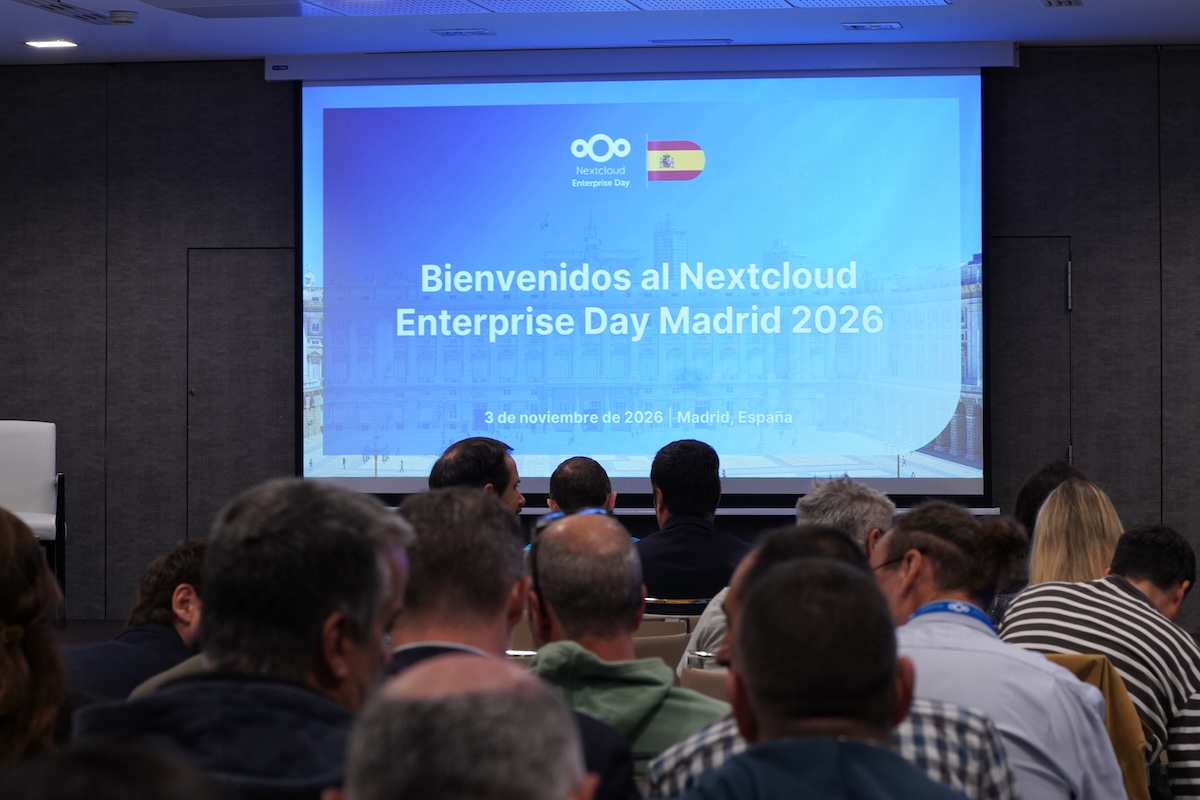
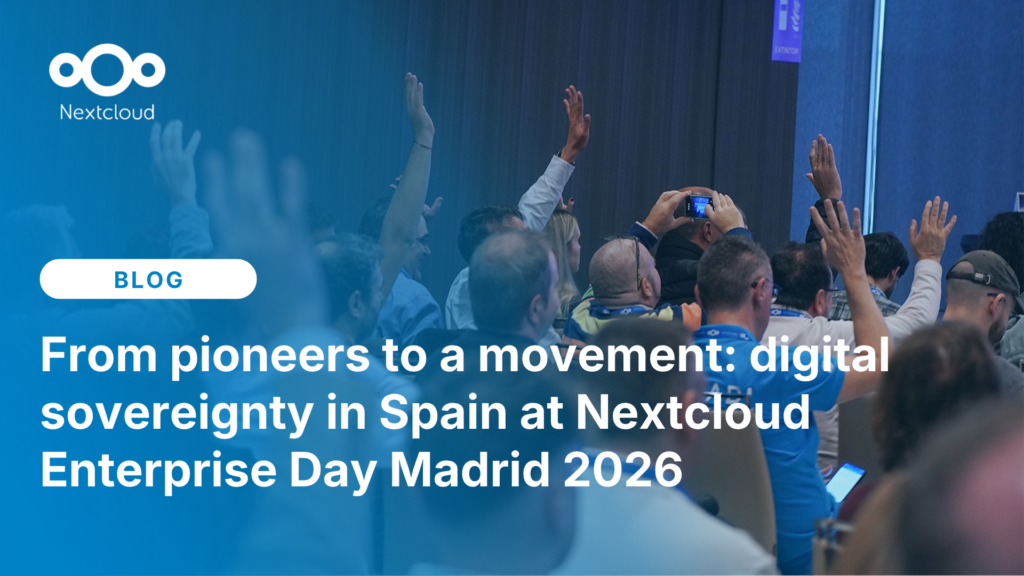
What’s new is the pace: more and more organizations are now asking how they can depend less on US Big Tech. On November 3, we held our first Nextcloud Enterprise Day in Spain, in Madrid. Public administrations, schools, NGOs, private companies, open source projects and Spain’s largest telecom provider joined us.
Why Spain, why now
Most Spanish organizations run email, documents, video calls, and cloud storage on US platforms. Experts have warned about this dependency for years but were not so much heard.
Then Spain landed in Donald Trump’s crosshairs. Washington has openly threatened the country with trade measures over political disagreements. If software access can turn into a political bargaining chip, IT departments are no longer the only ones who care. CEOs and ministers do too.
We heard this in more and more conversations with Spanish organizations. That’s why we brought Enterprise Day to Madrid. More than 160 people joined us, from public administration, education, private companies, NGOs, and the IT sector.
Andreas Rode, Chief Commercial Officer at Nextcloud, opened the day by giving an overview of what digital sovereignty really means and how it differs from the sovereignty-washing offerings from US providers. He mentioned three aspects to have in mind: data residence, operational autonomy, and legal jurisdiction. You are only truly sovereign when you have full control over your data in all three areas.
Mission (im)possible? A roadmap for Spain
The first guest speaker was Nil Homedes Busquet, Director of the Technical Office at the Decidim Association. Decidim is one of Spain’s open source pioneers. It started in Barcelona, and cities and governments around the world now use it.
Homedes asked what digital sovereignty actually means for Spain and what it could do for democracy and citizens. His answer: democratic control over technology. Software increasingly makes decisions that affect people’s lives, so citizens should be able to check how it works.
If code is law, why don’t we demand the same transparency for software as we do for laws?
Nil Homedes Busquet
Director of the Technical Office at the Decidim Association
Free software is a necessary condition for this, but not enough on its own, as long as around 80% of Europe’s digital infrastructure is imported. Spain already has building blocks such as the Barcelona Supercomputing Center, the public AI project ALIA and open source projects like Decidim and Penpot. Homedes called for concrete next steps: join the EU’s Digital Commons consortium (EDIC), map critical dependencies, and set up a state agency for free software.
The Basque Country and the Madrid region show how sovereignty works in schools
Daniel González Carbonero, Deputy Director of the Education Department at EJIE, brought a project that already runs. EJIE is the IT company of the Basque Government. For the region’s Department of Education, it built IRADI, an open source platform for digital teaching.
IRADI uses Nextcloud as its collaboration core, together with Collabora Online, Moodle and PeerTube, and stores all data in the Basque Government’s own data centers. After a pilot in four schools, it now serves 32 more. Next comes one Nextcloud instance per vocational school, plus AI running on local language models such as the Basque model Latxa.
We went from being mere consumers to building our own capabilities.
Daniel González Carbonero
Deputy Director of the Education Department at EJIE
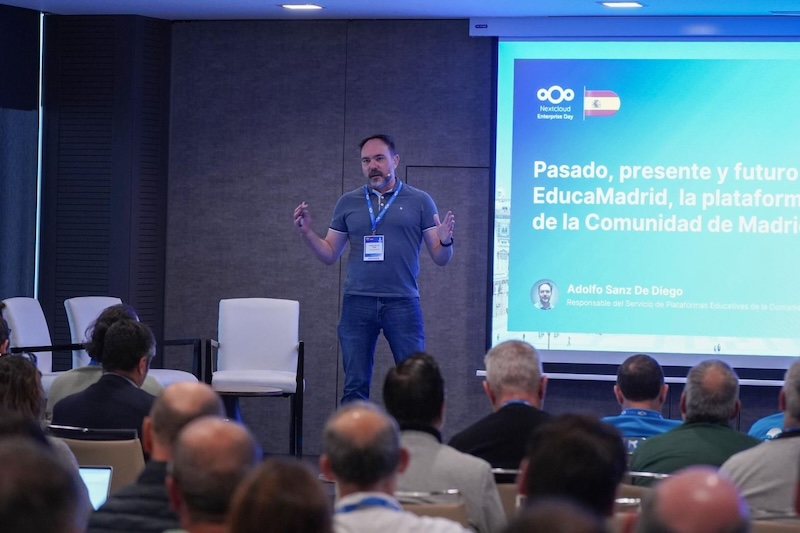
The Madrid region has its own example. Adolfo Sanz De Diego presented EducaMadrid, an education platform that runs on its own servers and open source software. Today it serves around 500,000 users, handles 400 million emails a year and uses Nextcloud and Collabora for file sharing and document editing. The goal is clear: to make EducaMadrid a European reference for digital sovereignty, and a model for Spain and the EU.
Telefónica: AI and cloud without giving up control
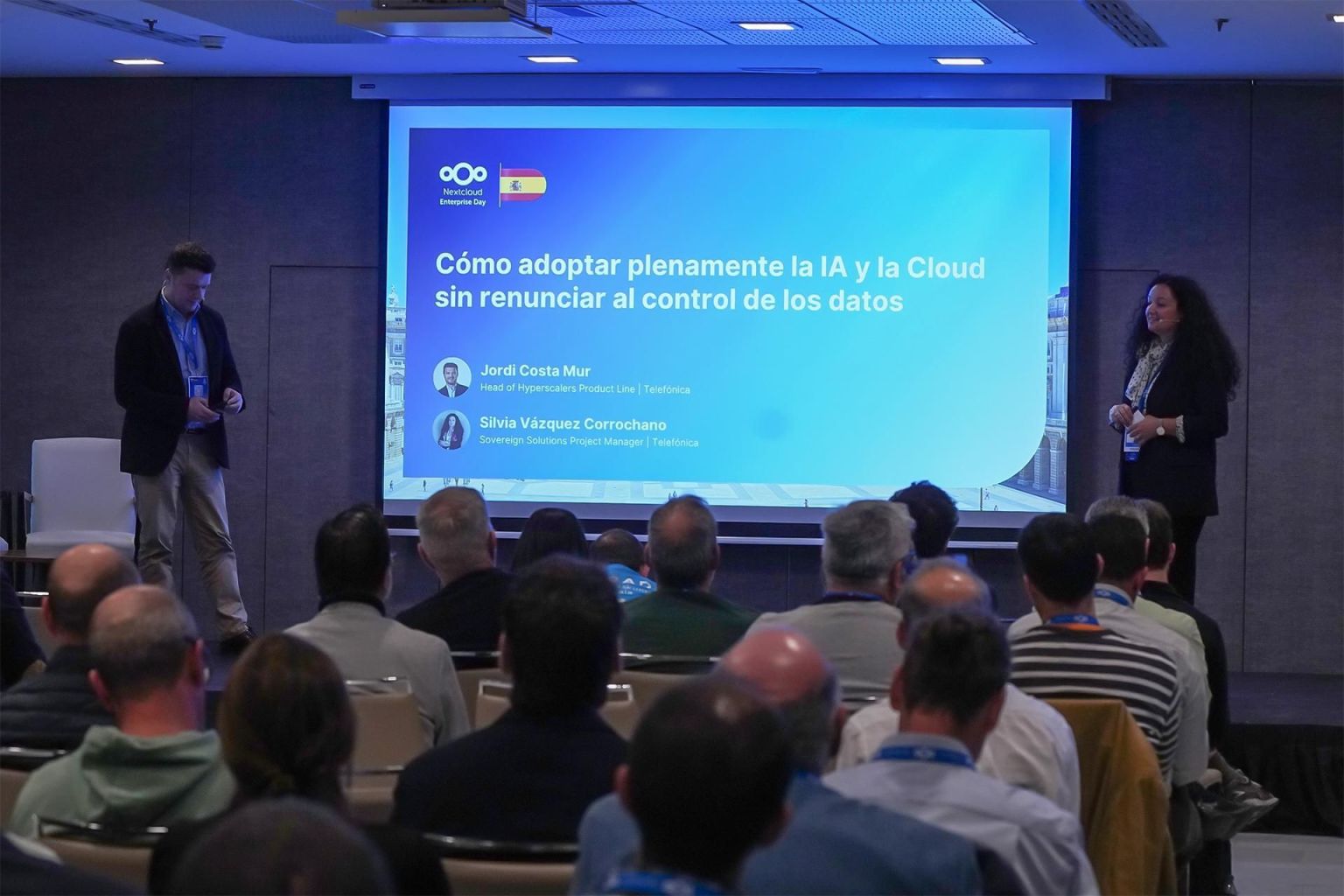
Telefónica’s keynote made clear that sovereignty is a topic for big companies too. Silvia Vázquez Corrochano, Sovereign Solutions Project Manager, and Jordi Costa Mur, Head of Hyperscalers Product Line, explained how organizations can use AI and the cloud and still keep control of their data.
According to Telefónica, it starts with four questions. What needs protection? Who can access the data? How may it be used? Which laws and dependencies apply? The answers decide where each workload should run.
Practical sessions: the ecosystem behind the switch
In the afternoon, two breakout tracks showed how the switch works in practice. Partners explained how organizations can leave Microsoft, Jira and Confluence without losing data or disrupting how their teams work.
On stage were Spanish IT provider Danysoft, migration specialist audriga, Microsoft integration specialist Sendent, IONOS Cloud Spain, Collabora Productivity, XWiki and OpenProject.
Panel: what triggers a real migration, and what holds it back
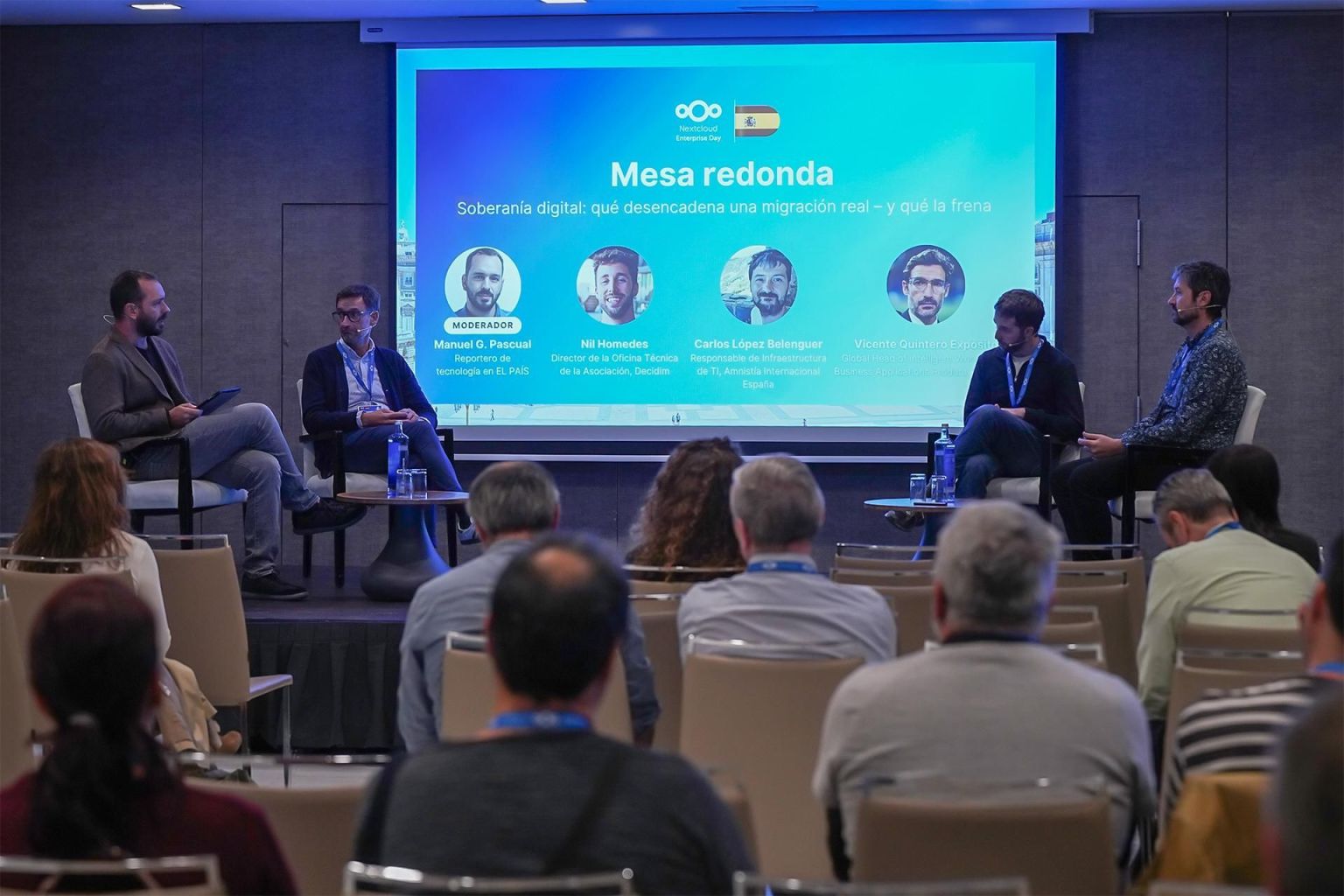
Manuel G. Pascual, technology journalist at El País, moderated the closing panel with Nil Homedes Busquet (Decidim), Carlos López Belenguer (Amnesty International Spain) and Vicente Expósito Quintero, Global Head of Intelligent Workplace at Telefónica. An open source association, an NGO and a telecom company: three very different organizations. Their answers were surprisingly close.
What makes an organization stop talking about sovereignty and actually switch? Right now it’s geopolitics, the panelists said, and above all pressure from the United States.
That pressure hits an NGO as much as a multinational company. Switching still has a price. A migration costs money, and productivity can drop at first. Many organizations also have small budgets and too few technical staff. So they stay with their provider even though they know about the lock-in, because the short-term pain looks bigger than the long-term risk. The panelists argued for the long view anyway: organizations that switch win back control and independence.
The way an organization migrates decides a lot. Users need to come along, and someone has to manage their expectations from day one.
The panel’s recommendation: start with a small pilot and add complexity step by step.
Spain is picking up speed
Spain doesn’t start from zero. The Basque Country and the Madrid region run open source platforms in their schools. Amnesty International Spain has relied on independent IT for over a decade. Decidim started in Barcelona and is now used around the world. What has changed is the momentum. Telefónica talks openly about data control, and the pressure from Washington speeds things up. Most organizations we met in Madrid no longer ask whether to switch, but how fast they can do it.
Créé grâce à un effort conjoint de notre équipe, de la communauté et de nos partenaires, Nextcloud Hub 26 Summer s'inspire des personnes réelles qui utilisent nos outils au quotidien. Créez votre propre espace d’équipe avec Nextcloud Teams, organisez vos souvenirs dans le nouveau Nextcloud Photos et profitez des améliorations que vous avez demandées dans l’ensemble des applications. Poursuivez votre lecture pour un aperçu complet de notre dernière version !
Les organisations, petites et grandes, ont besoin d'un moyen d'assurer la résilience et la souveraineté numérique de leurs opérations - une alternative à Teams, open-source et respectueuse de la vie privée. Aujourd'hui, nous vous présentons cette solution - Nextcloud Talk.
Nous vous présentons une mise à jour majeure de l'assistant Nextcloud IA, ainsi que de nouvelles informations sur notre collaboration avec plusieurs grands fournisseurs d'hébergement tels que IONOS et OVHcloud pour vous proposer des options d'IA en tant que service !
Bechtle et Nextcloud ont annoncé aujourd'hui une plateforme de collaboration entièrement administrée pour le secteur public, qui ne nécessite pas d'appel d'offres et peut être déployée immédiatement.
Découvrez comment passer de ownCloud à Nextcloud. Notre outil d'aide à la migration fournit des informations sur le processus de migration et vous aide à effectuer la transition en douceur.
Digital sovereignty in Spain is no longer a niche topic. At our first Nextcloud Enterprise Day in Madrid, more than 160 people from public administration, education, NGOs and companies, including Telefónica, discussed how to depend less on US Big Tech. Speakers from Decidim, EJIE, EducaMadrid and Amnesty International Spain shared what already works and what still holds organizations back.
Cyberattacks can now be carried out faster than ever, with less human involvement and on a much larger scale. Air-gapped environments offer a way to protect sensitive data and critical systems from increasingly sophisticated attacks.
Fancy names, same lock-in: here's why Microsoft’s digital sovereignty promises don’t protect European data from US law and why its “sovereign” cloud still leaves you dependent.
Nous enregistrons certains cookies pour compter les visiteurs et faciliter l'utilisation du site. Ces données ne quittent pas notre serveur et ne sont pas destinées à vous suivre personnellement ! Consultez notre politique de confidentialité pour plus d'informations Personnaliser
Les cookies utilisés pour enregistrer les données saisies dans les formulaires, telles que le nom, l'adresse électronique, le numéro de téléphone et la langue préférée.
Nom du cookie :nc_form_fields
Description du cookie :Mémorise les données saisies dans les formulaires pour une prochaine visite (nom, adresse électronique, numéro de téléphone et langue préférée).
Expiration du cookie :30 jours
Consentement
Nom du cookie :nc_utm_parameters
Description du cookie :We use cookies to store UTM parameters from your visit so we can understand how you arrived at our website.
Les cookies statistiques collectent des informations de manière anonyme et nous aident à comprendre comment nos visiteurs utilisent notre site web. Nous utilisons la solution open source de mesure de statistiques web Matomo
Service:Matomo
Description du cookie :
_pk_ses*: Compte la première visite de l'utilisateur
_pk_id*: Aide à ne pas compter deux fois les visites.
mtm_cookie_consent: Se souvient que l'utilisateur a donné son accord pour le stockage et l'utilisation de cookies.
Expiration du cookie :_pk_ses*: 30 minutes
_pk_id*: 13 mois
mtm_cookie_consent: 30 jours