From conferences to online talks: The conversation about migrating away from Big Tech platforms like Microsoft 365 seems to be everywhere. After all, there are plenty of reasons to make the switch. Just think of the concerns on compliance and data safety, the ever-rising subscription costs, and the growing geopolitical tensions. In other words, traditional Big Tech no longer offers the solution many organizations and public institutions are looking for, and there are a lot of incentives to migrate.
But while the motivation is clear, the execution often fails. From failed architectural setups to terrible user experiences: there are plenty of pitfalls that come with replacing Big Tech platforms.
So how can your organization make a successful switch, freeing itself from vendor lock-in, ensuring compliance, and regaining control over its data?
Replacing Microsoft 365: Common fails
When organizations look to replace a Big Tech solution, like Microsoft 365, they often choose one of two routes: building it themselves or bundling multiple open source tools.
How does it go wrong with these alternatives?
1. The struggles of in-house development: complexity, scope, and ownership
The reasons for building your own tech solution seem straightforward. You get to maintain full control, you can set up features tailored specifically to your organization, and you keep your digital autonomy.
However, in practice, large public-sector IT projects and in-house collaboration suites are prone to failure. So much so that there are public outcries to stop struggling with digital transformation projects.
Why do they fail?
Often organizations underestimate the complexity of the task, which was, for example, the case with the UK’s government project to overhaul the computer system of its national health service (NHS), which “achieved little and wasted billions.” Or the task starts out well, but once the scope expands, it becomes impossible to manage the project.
Add fragmented ownership and long delivery cycles to the pattern, and the in-house development idea becomes a recipe for disaster.
After all, collaboration platforms are not single tools. As ecosystems of tightly integrated services, including identity management, file sharing, communication apps, and search tools, they need strong product governance to succeed.
Rebuilding a tech stack from scratch, as well as ensuring compliance and lifecycle management, is rarely sustainable.
2. Bundling multiple open source tools: constant operational and productivity costs
A second and common route is assembling an offering of multiple products, such as a file-sharing solution, video conferencing tool, email system, chat app, and document editor.
Organizations can choose open source solutions for this. And often, they introduce them one by one, which at first thought seems like a good option.
As Adriana Groh from the Sovereign Tech Agency recently emphasized, open source is the «winning strategy» and «superior in terms of security, interoperability, and low development costs. No silo development can keep up with this speed.” And she is right in that. There are excellent open source tools out there for various use cases.
The risk is that, when introducing solutions one by one in isolation, you don’t end up with a cohesive collaboration environment. Rather, it is a fragmented mess! Even when looking to build a single solution, organizations often make the mistake of just bundling separate applications with little regard for user experience. But you have to keep in mind that the competition is Microsoft 365, a deeply integrated collaboration platform.
The productivity costs of constantly having to switch between tools and having to search for that final version of a document are high, easily adding up to an hour a day, according to studies. On top of that comes the operational complexity and associated security risks, as well as the performance problems of running multiple technology stacks in parallel.
Such an “all-in-one solution” from a bundle can quickly turn into poor user adoption and increased admin overhead. As an ICT manager, you have to take a step back and ask yourself: Can I afford to pay the constant price in terms of decreased productivity and increased operational costs, going forward?
The harsh reality is: A fragmented set of tools, even with a common theme and a sprinkle of integrations, simply cannot be a serious replacement for Microsoft 365.
The architectural difference: A bundle is not a platform
What matters is that replacing the Big Tech solution is not about setting up individual tools, but about replacing one platform with another. A real digital platform should provide you with strong collaboration tools, including:
Unified identity and presence
A consistent permission and sharing model
Integrated search, presence, and notifications across the platform
Coherent governance
Unified lifecycle management
A predictable user experience
In other words, a successful Microsoft 365 alternative must be designed from the ground up as an integrated platform.
Look for an open source collaboration platform that provides a strong architectural foundation, a transparent governance model, and a consistent user experience, so you are ensured of a future-ready platform.
How Nextcloud does it differently: An integrated platform that offers choice
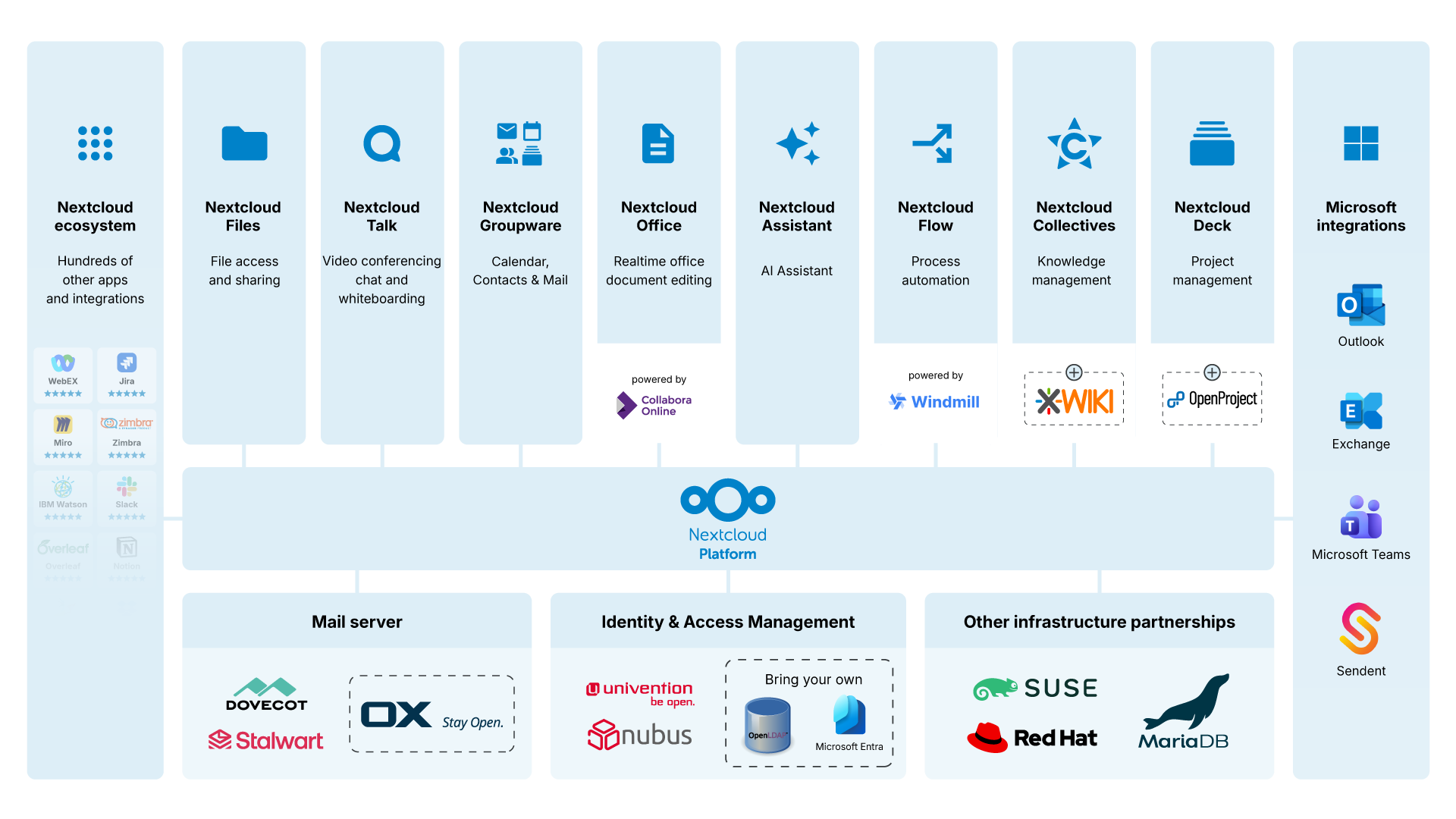
Nextcloud is designed as a platform from the ground up. This means that you get a modular stack for a smart and personable digital experience instead of fragmented tools that leave your team members frustrated.
The benefits?
You get complete control over which apps you would like to use or replace, so you can create your own digital workspace. Nearly 600 apps offer a huge range of functionality and integrations with a wide range of third-party tools, ensuring perfect adaptation to your needs.
With a wide set of Nextcloud features, including online communication, project management, and AI-powered collaboration, you can design your own self-hosted platform to strengthen your team’s productivity and collaboration.
And of course, a single platform simplifies compliance and data control.
Beyond code, the Nextcloud solution also comes with an extensive ecosystem of partners that provide access to the expertise needed to operate a Nextcloud environment. From hosting and support to deployment advice, upgrade help, training, and documentation: these Nextcloud partners can build on, complement, and provide services around our platform.
In short, Nextcloud means you get a successful, well-performing, stable collaboration platform, which is very different from a bundle of code you download from a website.
Nextcloud is more than a single company or product
Nextcloud consists of a core with over 600 apps built on top, developed in a wide variety of computer languages and frameworks, as well as dozens of mobile and desktop applications connecting to it.
This platform is collaboratively developed by thousands of individual developers, companies and partners, and benefits from contributions and feedback from the hundreds of thousands of administrators and tens of millions of users from over 500.000 Nextcloud installations across the globe.
Their work, discussions, and commitment are what allow the platform to evolve in a sustainable way as the future of the sovereign digital workplace.
Making the switch: from Big Tech to open source with a unified platform
You might realize by now that digital sovereignty is not just an ideology, but also a practical concept that comes with operational conditions. If your organization decides to switch, be sure to choose a solution that you can adopt, manage, and trust. A platform, not a bundle of sticks. Something that evolves, adapts, and will provide collaboration for the future, not just today!
Start Nextcloud instant trial
Are you looking to move away from Big Tech without recreating the very fragmentation and dependency that you are trying to escape? Request an instant trial and discover how the Nextcloud platform can support you!
El momento de poseer tus datos es ahora. Te presentamos el nuevo Nextcloud Hub, una potente plataforma de colaboración de código abierto que te pone en control. Descubre las mejoras en rendimiento, diseño y seguridad, y muchas herramientas nuevas y mejoradas para tu trabajo y vida diaria.
Nextcloud Hub 25 Otoño facilita la puesta en marcha de una potente colaboración mientras controlas totalmente tus datos. Desde actualizaciones globales de diseño hasta mejoras de usabilidad y rendimiento, descubre nuestra última versión en este blog.
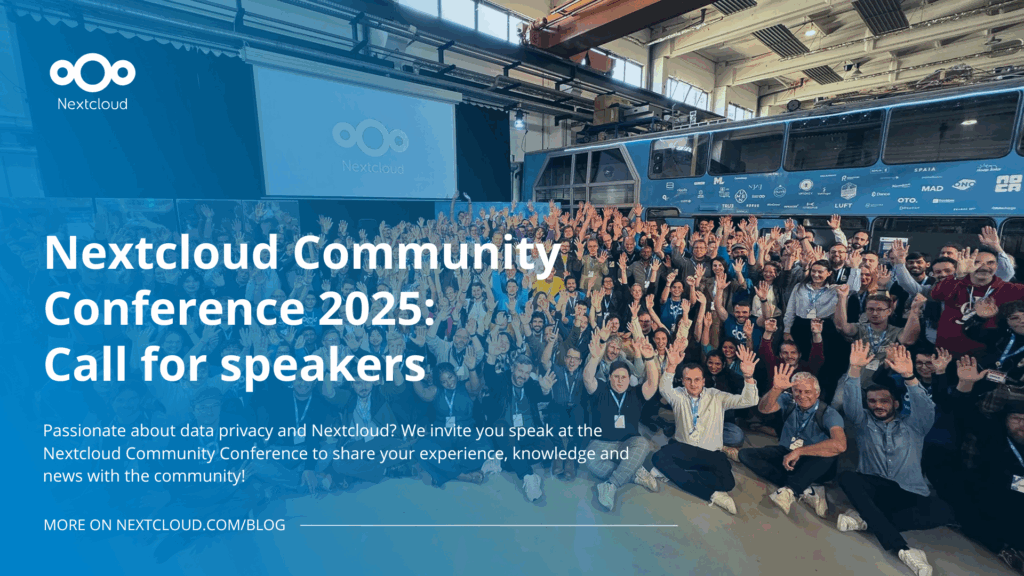
Passionate about data privacy and Nextcloud? We invite you speak at the Nextcloud Community Conference to share your experience, knowledge and news with the community!
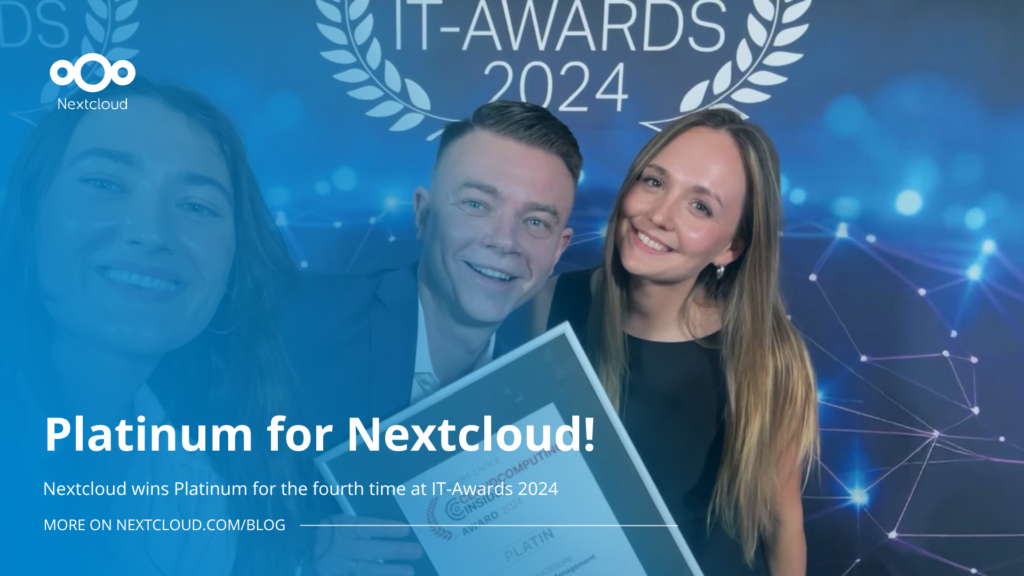
For the ninth time, Nextcloud has been nominated for the CloudComputing-Insider Readers’ Choice Award in the category of Cloud Content Management. We’d love to reach the top again! And we’re looking for the support of you and everyone else in our amazing community to get there. Nextcloud as the best Cloud Content Management tool? Only […]
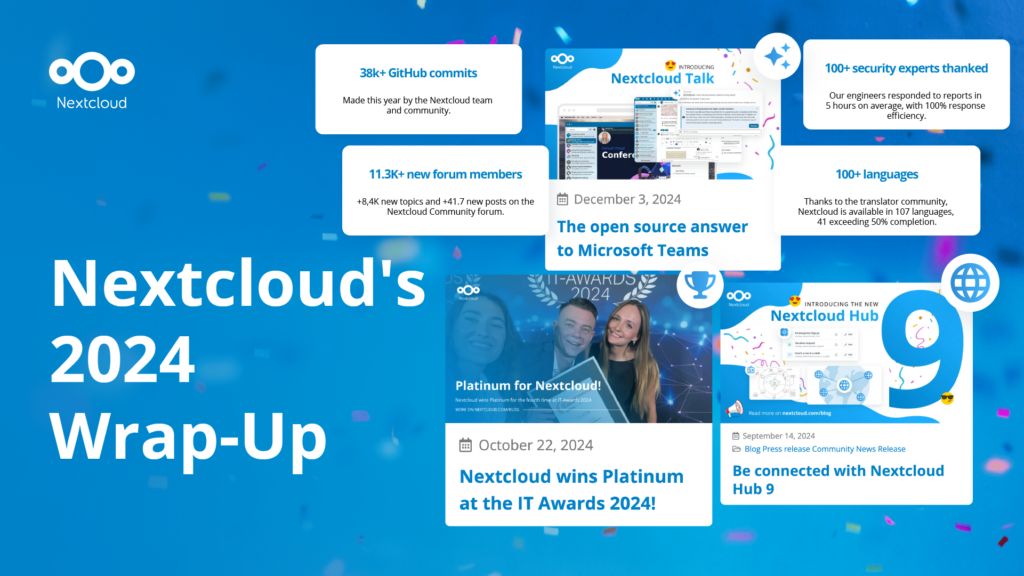
In the Nextcloud 2024 wrap-up, we want to take a moment to celebrate this year's achievements. Join us as we continue to reimagine what’s possible - shaping a world where open source, privacy and connection come together and drive progress for the greater good.
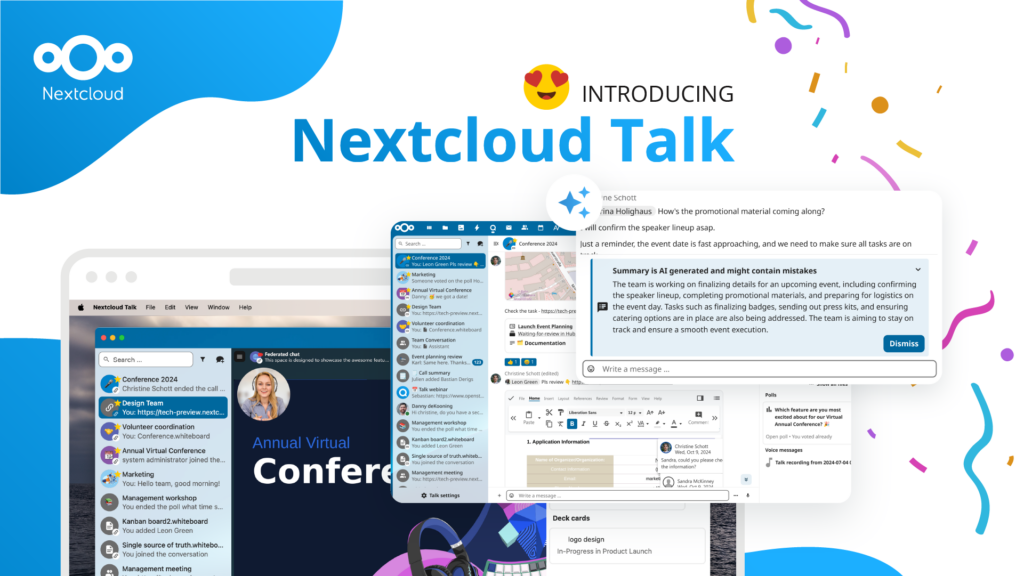
Organisations, small and large, need a way to ensure the resiliency and digital sovereignty of their operations – an open-source, privacy-respecting alternative to Teams. And today, we present that solution - Nextcloud Talk.
Nextcloud has been recognized with the World Summit Award Germany that selects and promotes local digital innovation improving society, aiming to contribute to the United Nations' agenda of sustainable development goals.
DIE ZEIT, a prominent German outlet, interviewed Nextcloud’s founder Frank Karlitschek for an article on Microsoft’s anti-competitive behaviour on the European office software market. Read for a recap of the article and the key takeaways.
MagentaCLOUD’s migration to Nextcloud in 2021 resulted in a fully equipped Online Storage with an integrated online office suite that further improves the user experience, flexibility and security for customers.
We bring you a major update to the Nextcloud AI Assistant, plus the news we work with several big hosting providers like IONOS and OVHcloud to bring AI-as-a-Service options to you!
Bechtle and Nextcloud announce today a complete managed collaboration platform for the public sector that requires no tender and can be deployed immediately.
Discover how to make the switch from ownCloud to Nextcloud. Our quick guide provides insights into the migration process, helping you make the transition smoothly.
Today, US-based file sync & share vendor Kiteworks announced their acquisition of ownCloud and Dracoon. Kiteworks points out that their customers now have access to their file-sharing application. It is to be expected they will not maintain 3 similar products, but customers will have to migrate to the US firms’ platform or look for another […]
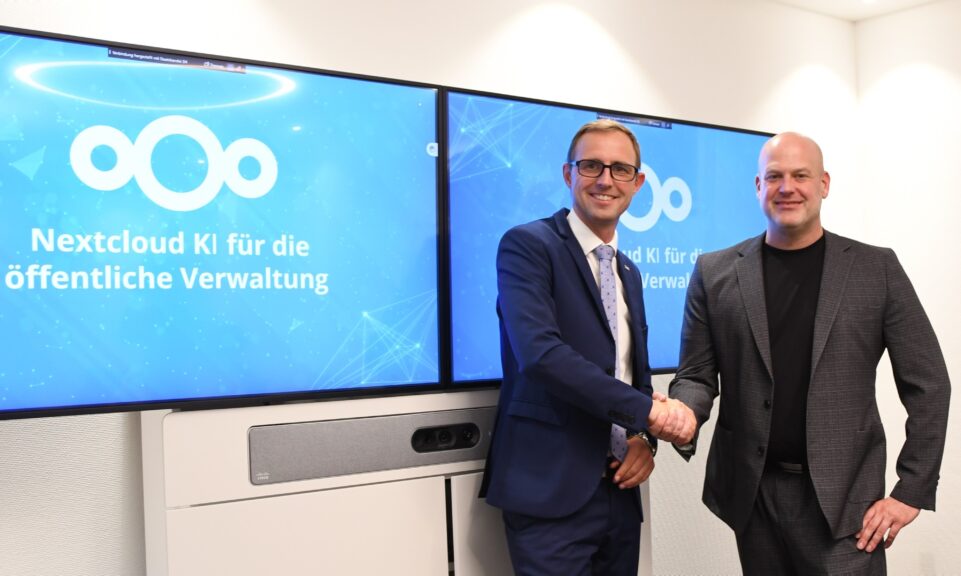
As part of Schleswig-Holstein's state digitization strategy, the state chancellery has announced they will work with Nextcloud to develop AI for working with government documents. This comes just after we announced the first private AI assistant last weekend with Hub 6. The German state already uses Nextcloud and their AI strategy aligns with our work on ethical, local AI technologies.
Over the last year, AI has become a popular topic. Some is hype, some is substance. Some is good, some is bad. We want to give you the good, not the bad, and ignore the hype! AI has a ton of opportunity – but also risk. So we put you in control – off by […]
Nuestra misión es ayudar a particulares, empresas y organizaciones a alcanzar la soberanía digital y recuperar el control sobre sus datos. Nextcloud Hub 5 supone un enorme paso adelante en la consecución de esta misión, poniendo el poder de la IA en tus manos, de forma que mantengas el control. Nueva versión, nuevas posibilidades Hub […]
Comparamos la interoperabilidad de Nextcloud y Microsoft para entender qué herramientas están más conectadas y son conectables, y por qué es importante.
Guardamos algunas cookies para contar los visitantes y facilitar el uso del sitio. Esto no sale de nuestro servidor y no es para rastrearte personalmente. Consulta nuestra política de privacidad para obtener más información. Personalización
Cookies utilizadas para guardar los datos introducidos en los formularios, como nombre, correo electrónico, número de teléfono e idioma preferido.
Nombre de la cookie:nc_form_fields
Descripción de la cookie:Recuerda los datos introducidos en los formularios para la próxima vez (nombre, correo electrónico, teléfono e idioma preferido)
Caducidad de la cookie:30 días
Consentir
Nombre de la cookie:nc_utm_parameters
Descripción de la cookie:We use cookies to store UTM parameters from your visit so we can understand how you arrived at our website.
Las cookies estadísticas recopilan información de forma anónima y nos ayudan a comprender cómo utilizan nuestro sitio web nuestros visitantes. Utilizamos Matomo alojado en la nube.
Servicio:Matomo
Descripción de la cookie:
_pk_ses*: Cuenta la primera visita del usuario
_pk_id*: Ayuda a no contar dos veces las visitas.
mtm_cookie_consent: Recuerda que el usuario ha dado su consentimiento para almacenar y utilizar cookies.
Caducidad de la cookie:_pk_ses*: 30 minutos
_pk_id*: 13 meses
mtm_cookie_consent: 30 días