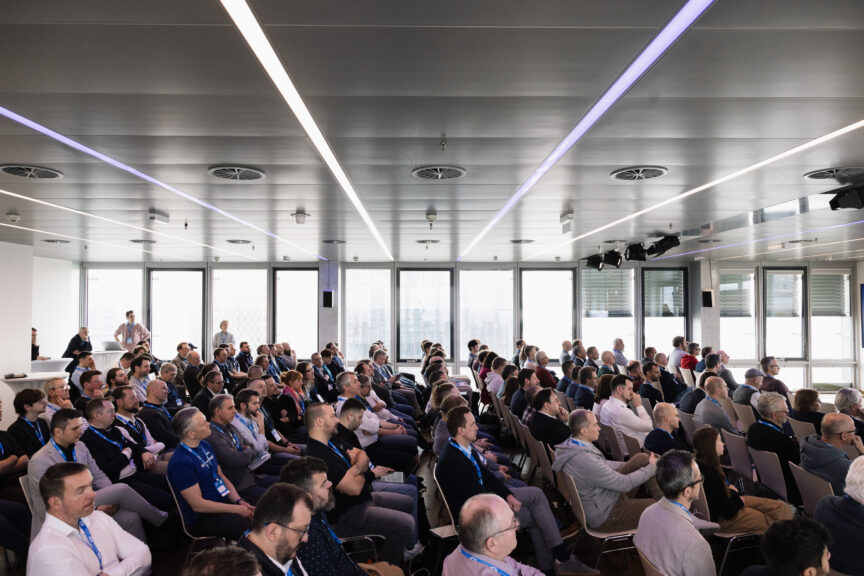
With our first Austrian Nextcloud Enterprise day we aimed for 100 participants. In the end, nearly 300 people registered from across Austria’s public sector, academia and enterprise community, requiring some last-minute adjustments to the venue. Was it worth it? Definetly. Especially because one thing became clear: from government institutions to research organisations and private companies, there is a growing urgency to regain control over data, infrastructure and digital collaboration. And Austria is not just part of this shift. It is actively shaping it with great lighthouse projects, as part of a movement of millions of new enterprise users that moved to a sovereign, Nextcloud based workspace across Europe last year.
High demand for secure data handling in the austrian public sector
The Austrian Federal Ministry for Digital and Economic Affairs (BMWET) is such a leading example for digital sovereinty. On stage, Florian Zinnagl, CIO of the ministry, walked participants through the migration of 1200 users in just a few months from Microsoft to Nextcloud. The success was made possible thanks to close collaboration with Nextcloud, Nextcloud partner Sendent, and help from Atos, the IT service provider for BMWET. The Microsoft integrations from Sendent allowed users to keep familiar workflows while moving sensitive data and collaboration to a sovereign platform. The result was a transition that did not interrupt day-to-day work, but still significantly reduced dependency on external cloud providers.
At the same time, institutions such as TU Wien are contributing through research and by building – and testing open digital infrastructure. Jan Vales, System Administrator for the TUcloud, presented their sovereign file sharing system on stage, emphasizing the great responsibility involved in processing student data.
He wants to encourage people and organizations to step out of their comfort zone: „With Nextcloud we were able to solve many problems in our collaboration, especially when it comes to working together with external people or when it comes to mobile work. To everyone who is considering choosing a sovereign solution like Nextcloud i’d clearly say: just set it up. It works.“
Also at the University of Innsbruck, Nextcloud is used as a central platform for collaboration. It brings together file storage, communication and project organization in one place, so teams can work on documents, coordinate tasks and manage schedules within a shared environment. Tools like chat and video calls are integrated, as well as structured work spaces for different groups and projects.
The platform is operated on-premises by the university’s IT services. All data remains on servers within the university network in Innsbruck and is handled according to internal data protection policies. This gives the university full control over how sensitive information is stored, accessed and shared.
This approach reflects a broader shift, particularly in the education sector, where questions of data protection and control are becoming central to IT decisions.
Michael Redinger, Head of the central IT service at the university, described how this change has become visible over the past year: «The shift in public discourse in Austria has only really been noticeable for the past year: Now, finally, people are talking about digital sovereignty – it is the main driver of current developments. This pleases us and confirms that we are on the right path.»
The discussions at the Enterprise Day in Vienna showed how differently organizations are approaching the same challenge. While some are already running sovereign infrastructure in production, others are still evaluating how to reduce dependencies without disrupting existing systems.
What they have in common is a growing focus on control, not just over data, but over the way digital workplaces are structured and operated. This was reflected in many of the conversations throughout the day, which often moved quickly from technical questions to organizational and strategic considerations.
This broader perspective also shaped the final panel discussion. Alongside practical implementation experiences, the conversation turned to economic aspects: the cost of dependency, the long-term impact of vendor lock-in and the question of how to build sustainable alternatives. Wenzel Mehnert, Jakob Steinschaden, Peter Garlock and Paul Zwiefelhofer discussed how digital sovereignty is not just a technical issue, but increasingly a matter of economic and strategic importance.
Austria’s institutions are part of a broader European movement
2025 was a strong year for sovereign solutions. Across sectors, organizations are moving away from vendor lock-in and towards systems they can control and adapt. Over the past year, more than two million new professional users joined Nextcloud. Adoption grew across public administration, education and private companies, with bookings at Nextcloud once again increasing by more than 50 percent compared to the previous year.
Demand is particularly high in countries such as Germany, France and the United States, but growth is also accelerating in places like the Netherlands, Brazil and Denmark. Austria clearly fits into this picture. The same questions are being asked, and similar decisions are being made.
At the same time, the conversations in Vienna showed that there is a strong and growing interest in moving these discussions forward locally. The exchange throughout the day was open, practical and focused on real challenges.
We are looking forward to continue this conversation and meet again in beautiful Vienna soon!
El momento de poseer tus datos es ahora. Te presentamos el nuevo Nextcloud Hub, una potente plataforma de colaboración de código abierto que te pone en control. Descubre las mejoras en rendimiento, diseño y seguridad, y muchas herramientas nuevas y mejoradas para tu trabajo y vida diaria.
Nextcloud Hub 25 Otoño facilita la puesta en marcha de una potente colaboración mientras controlas totalmente tus datos. Desde actualizaciones globales de diseño hasta mejoras de usabilidad y rendimiento, descubre nuestra última versión en este blog.
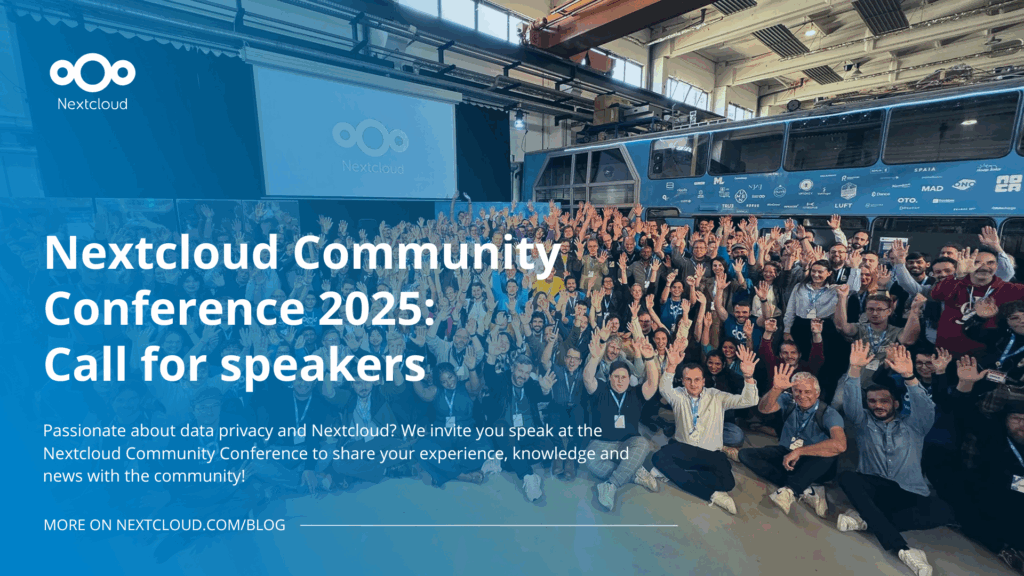
Passionate about data privacy and Nextcloud? We invite you speak at the Nextcloud Community Conference to share your experience, knowledge and news with the community!
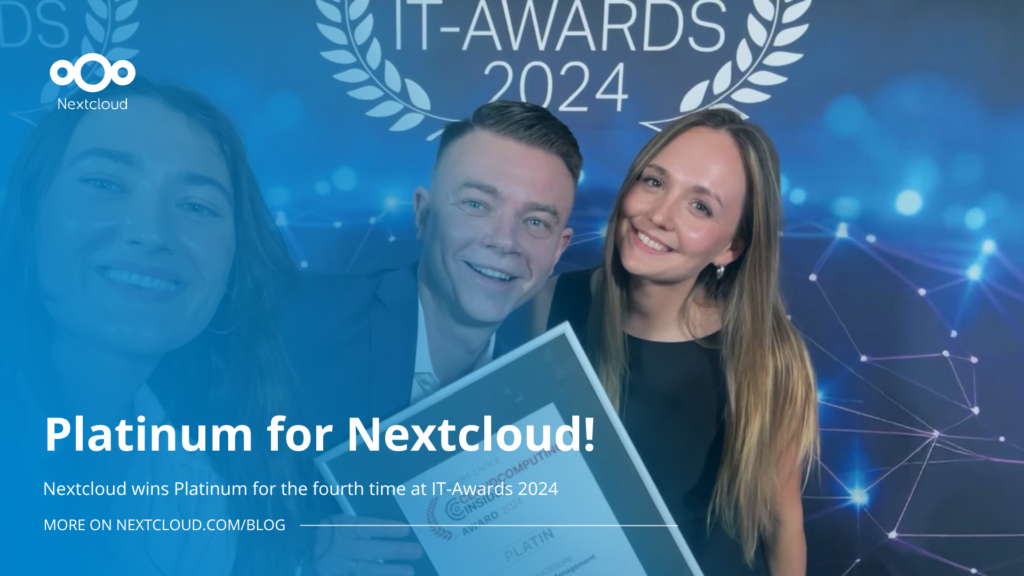
For the ninth time, Nextcloud has been nominated for the CloudComputing-Insider Readers’ Choice Award in the category of Cloud Content Management. We’d love to reach the top again! And we’re looking for the support of you and everyone else in our amazing community to get there. Nextcloud as the best Cloud Content Management tool? Only […]
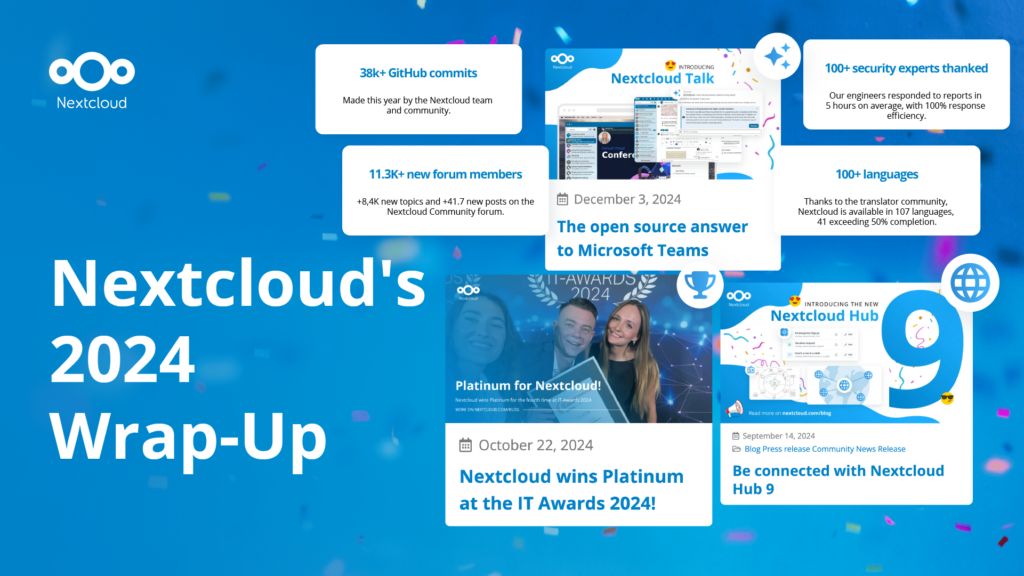
In the Nextcloud 2024 wrap-up, we want to take a moment to celebrate this year's achievements. Join us as we continue to reimagine what’s possible - shaping a world where open source, privacy and connection come together and drive progress for the greater good.
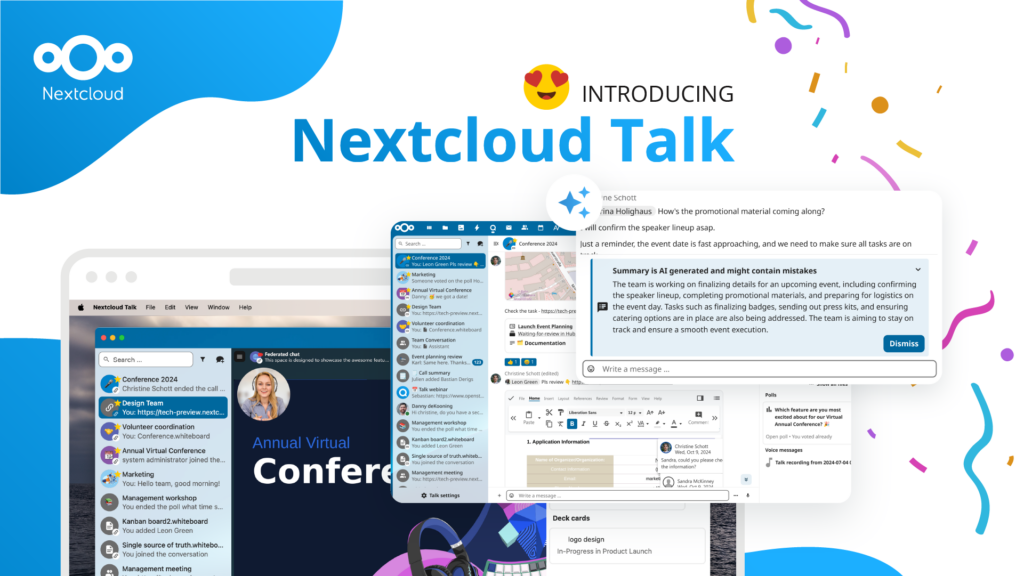
Organisations, small and large, need a way to ensure the resiliency and digital sovereignty of their operations – an open-source, privacy-respecting alternative to Teams. And today, we present that solution - Nextcloud Talk.
Nextcloud has been recognized with the World Summit Award Germany that selects and promotes local digital innovation improving society, aiming to contribute to the United Nations' agenda of sustainable development goals.
DIE ZEIT, a prominent German outlet, interviewed Nextcloud’s founder Frank Karlitschek for an article on Microsoft’s anti-competitive behaviour on the European office software market. Read for a recap of the article and the key takeaways.
MagentaCLOUD’s migration to Nextcloud in 2021 resulted in a fully equipped Online Storage with an integrated online office suite that further improves the user experience, flexibility and security for customers.
We bring you a major update to the Nextcloud AI Assistant, plus the news we work with several big hosting providers like IONOS and OVHcloud to bring AI-as-a-Service options to you!
Bechtle and Nextcloud announce today a complete managed collaboration platform for the public sector that requires no tender and can be deployed immediately.
Discover how to make the switch from ownCloud to Nextcloud. Our quick guide provides insights into the migration process, helping you make the transition smoothly.
Today, US-based file sync & share vendor Kiteworks announced their acquisition of ownCloud and Dracoon. Kiteworks points out that their customers now have access to their file-sharing application. It is to be expected they will not maintain 3 similar products, but customers will have to migrate to the US firms’ platform or look for another […]
As part of Schleswig-Holstein's state digitization strategy, the state chancellery has announced they will work with Nextcloud to develop AI for working with government documents. This comes just after we announced the first private AI assistant last weekend with Hub 6. The German state already uses Nextcloud and their AI strategy aligns with our work on ethical, local AI technologies.
Over the last year, AI has become a popular topic. Some is hype, some is substance. Some is good, some is bad. We want to give you the good, not the bad, and ignore the hype! AI has a ton of opportunity – but also risk. So we put you in control – off by […]
Nuestra misión es ayudar a particulares, empresas y organizaciones a alcanzar la soberanía digital y recuperar el control sobre sus datos. Nextcloud Hub 5 supone un enorme paso adelante en la consecución de esta misión, poniendo el poder de la IA en tus manos, de forma que mantengas el control. Nueva versión, nuevas posibilidades Hub […]
Guardamos algunas cookies para contar los visitantes y facilitar el uso del sitio. Esto no sale de nuestro servidor y no es para rastrearte personalmente. Consulta nuestra política de privacidad para obtener más información. Personalización
Cookies utilizadas para guardar los datos introducidos en los formularios, como nombre, correo electrónico, número de teléfono e idioma preferido.
Nombre de la cookie:nc_form_fields
Descripción de la cookie:Recuerda los datos introducidos en los formularios para la próxima vez (nombre, correo electrónico, teléfono e idioma preferido)
Caducidad de la cookie:30 días
Consentir
Nombre de la cookie:nc_utm_parameters
Descripción de la cookie:We use cookies to store UTM parameters from your visit so we can understand how you arrived at our website.
Las cookies estadísticas recopilan información de forma anónima y nos ayudan a comprender cómo utilizan nuestro sitio web nuestros visitantes. Utilizamos Matomo alojado en la nube.
Servicio:Matomo
Descripción de la cookie:
_pk_ses*: Cuenta la primera visita del usuario
_pk_id*: Ayuda a no contar dos veces las visitas.
mtm_cookie_consent: Recuerda que el usuario ha dado su consentimiento para almacenar y utilizar cookies.
Caducidad de la cookie:_pk_ses*: 30 minutos
_pk_id*: 13 meses
mtm_cookie_consent: 30 días