Digital sovereignty is no longer just a policy debate, but a question of real-world decisions.
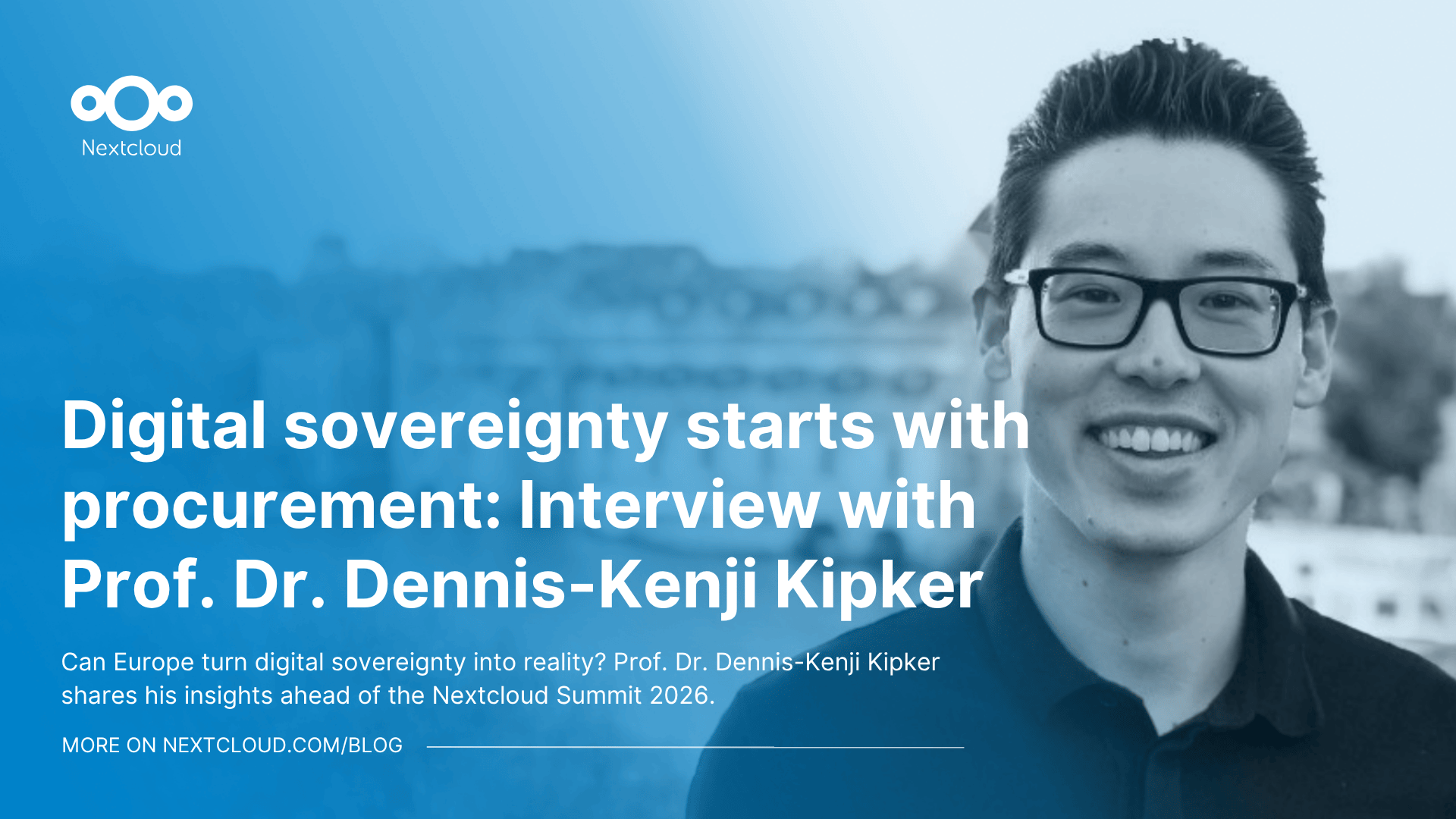
To explore what that means in practice, we spoke with Professor Dennis-Kenji Kipker ahead of the Nextcloud Summit 2026 in Munich, Germany, on June 9.
Working at the intersection of law and technology, he advises governments and institutions on cybersecurity, global regulation, and digital resilience, from Europe to the U.S. and China.
Discover why he thinks sovereignty starts with procurement, where Europe still falls short, and what it will take to turn ambition into reality.
1. How do you define digital sovereignty, and how do you apply it in your daily life?
Digital sovereignty is, first and foremost, a procurement question, not a definitional one. No amount of conceptual debate makes us more digitally sovereign in practice.
Both consumers and organizations need to understand that political declarations alone do not produce sovereignty. Every single procurement decision is a vote for or against greater digital independence.
Digital sovereignty is not something that can be distributed by decree across a country like water from a watering can in the form of political decisions. It materializes through concrete choices.
That is precisely why I believe the state has a co-responsibility to make digitally sovereign solutions accessible to everyone, not just to large institutions with dedicated IT departments.
In my own life, I try to use sovereign tools and solutions wherever it is feasible. And frankly, in the personal sphere, that turns out to be considerably easier than most people initially assume.
Every procurement decision is a vote for or against digital independence.
Prof. Dr. Dennis-Kenji Kipker
Speaker at the Nextcloud Summit 2026
2. Your work sits at the intersection of law and technology. Those two fields often operate very differently. Especially in areas like cybersecurity and AI, that gap can be challenging. How do you bring them together?
Law and technology may operate on different timescales and speak different languages, but they are ultimately both systems for governing behavior and managing risk, which makes their intersection unavoidable rather than optional.
In cybersecurity and AI, the connection becomes particularly visible when we ask who bears responsibility when systems fail, who sets the standards by which «secure» or «trustworthy» is defined, and who has the authority to enforce those standards.
Technology creates facts on the ground. Law defines what those facts mean and what consequences follow. The challenge is not that the two fields are incompatible.
Technology creates facts on the ground. Law defines what those facts mean.
Prof. Dr. Dennis-Kenji Kipker
Speaker at the Nextcloud Summit 2026
It is that law has traditionally been reactive, codifying norms after society has already absorbed the impact of a technology, whereas effective cybersecurity and AI governance demands a more anticipatory approach.
Bridging the two requires legal scholars who are technically literate enough to understand what they are regulating, and technologists who appreciate that design choices are never value-neutral but are always already embedded in a normative framework.
3. And how do you see the role of the government in leveling the playing field for the digital market in Europe?
The government has several distinct levers here, and the key is using all of them coherently rather than in isolation. Competition law must be enforced with genuine ambition; breaking up or constraining the market power of digital monopolies is a precondition for any meaningful level playing field.
At the same time, targeted support for European start-ups and scale-ups is essential, because a healthy competitive ecosystem cannot emerge if promising companies are either acquired by incumbents before they mature or simply leave for more favorable jurisdictions.
Perhaps most underappreciated, however, is the role of public procurement: governments are among the largest buyers of digital products and services in Europe, and systematically making alternative, sovereign solutions accessible through procurement frameworks would both create demand and send a clear market signal.
These three approaches, competition enforcement, innovation support, and procurement reform, need to work in concert if Europe is to move from a position of digital dependence to one of genuine strategic agency.
Who is the Nextcloud Summit 2026 for?
This highly anticipated yearly Nextcloud event is centered around a clear vision: making sure attendees can take back control over their data. You can expect:
Concrete use cases from public administrations, universities, and enterprises already building sovereign infrastructures
Practical insights on security, compliance, and data control you can apply immediately
Hands-on demos and expert sessions focused on deployment, scalability, and integration
Direct peer exchange with professionals facing the same regulatory and operational pressures
Ecosystem expo & networking with partners shaping the European open source landscape
If you are responsible for IT strategy, digital policy, infrastructure, or innovation in your organization, this Summit is designed to give you clarity, direction, and actionable next steps.
4. As an advisor to the German Federal Government and the European Commission, what main challenge(s) do you see remaining in the EU to achieve digital sovereignty?
The most persistent challenge is the gap between regulatory ambition and operational reality. The EU has produced genuinely significant legislation. This includes the GDPR, the NIS2 Directive, the AI Act, and the Cyber Resilience Act. But the effectiveness of that legislative architecture depends on consistent, well-resourced enforcement across 27 member states with very different administrative capacities and political appetites.
A regulation that is enforced vigorously in one member state but largely ignored in another does not create a level playing field; it creates regulatory arbitrage. Beyond enforcement, there is also the structural challenge that European digital infrastructure remains deeply dependent on a small number of non-European providers for cloud, semiconductors, and foundational AI models.
Changing that dependency requires not only investment but a willingness to accept a degree of short-term friction. Think of slower procurement, higher initial costs, and more complex vendor management. But in exchange, you get long-term strategic resilience. Communicating that trade-off honestly to policymakers and the public remains genuinely difficult.
The real challenge is the gap between regulatory ambition and operational reality.
Prof. Dr. Dennis-Kenji Kipker
Speaker at the Nextcloud Summit 2026
5. The CII also focuses on supporting young people and promising cyber start-ups. What advice would you give to them with regard to digital sovereignty?
My core advice is to treat digital sovereignty not as a compliance burden or a marketing label, but as a genuine design principle from day one.
For young founders and developers, the decisions made in the earliest stages of a product — which cloud provider to use, which data model to adopt, which jurisdictions to build for — have compounding consequences that become very costly to reverse later.
Building with sovereignty in mind from the start is dramatically easier than retrofitting it after growth has locked you into dependencies. Beyond the technical dimension, I would encourage young people in this space to engage seriously with the policy and regulatory environment rather than treating it as an external constraint.
The rules being written right now on AI, cybersecurity, or data markets will shape the competitive landscape for the next decade, and those who understand them deeply will have a significant advantage over those who merely react to them.
Sovereignty, in the end, is also about knowing the rules of the field you are playing on.
6. What do you expect from the Nextcloud Summit?
I come to the Nextcloud Summit with a specific interest in where the community stands on translating the concept of digital sovereignty from a principled commitment into scalable, enterprise-ready practice.
The Nextcloud Summit is one credible proof point to show that open, sovereign infrastructure can compete on functionality, but the gap between what is technically possible and what actually gets deployed in governments, hospitals, and mid-sized companies remains significant.
I am hoping for honest conversations about that last mile: the procurement barriers, the interoperability challenges, and the organizational inertia that still prevent sovereign solutions from reaching their full potential adoption.
More broadly, I see events like this as important nodes in the ecosystem where policy people, technologists, and practitioners can stress-test each other’s assumptions. And that kind of productive friction is exactly what the field needs right now.
Join the conversation
Be part of the Nextcloud Summit, our biggest event up until now, and access a full day of learning, sharing, and collaborating on regaining freedom over your data, ensuring data remains in the hands of those who create it.
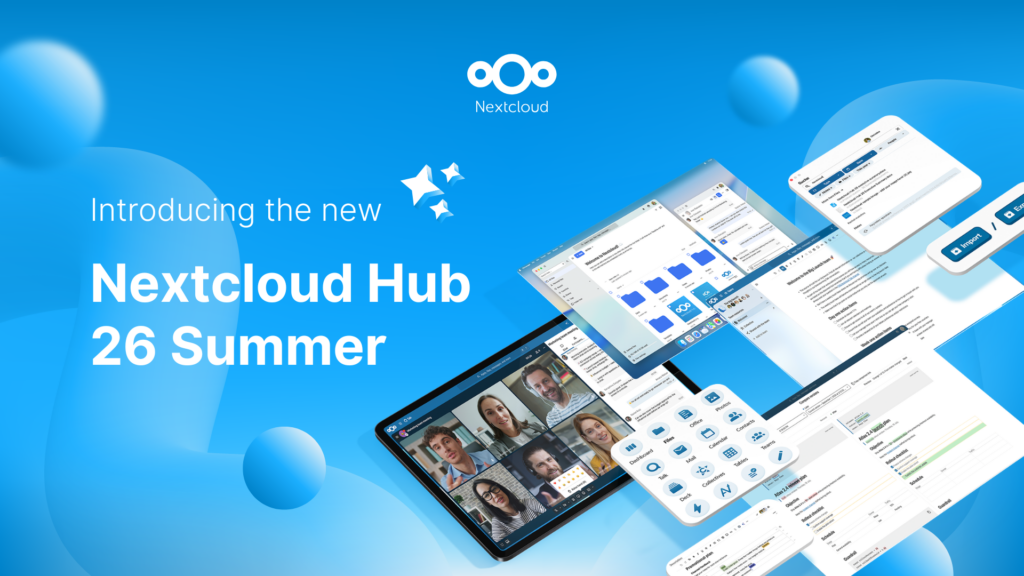
Fruto del trabajo conjunto de nuestro equipo, la comunidad y nuestros partners, Nextcloud Hub 26 Summer aprende de personas reales que utilizan nuestras herramientas a diario. Crea un espacio propio para tu equipo con Nextcloud Teams, organiza tus recuerdos en el nuevo Nextcloud Photos y disfruta de las actualizaciones que pediste en todas las aplicaciones. ¡Sigue leyendo para conocer todos los detalles de nuestra última versión!
Nextcloud Hub offers several types of integrations for AI, from completely self-hosted options to integrations with external services like Open AI. Here's an overview of what you can use and where, and where it stands on our Ethical AI scale.
Nextcloud Hub 25 Otoño facilita la puesta en marcha de una potente colaboración mientras controlas totalmente tus datos. Desde actualizaciones globales de diseño hasta mejoras de usabilidad y rendimiento, descubre nuestra última versión en este blog.
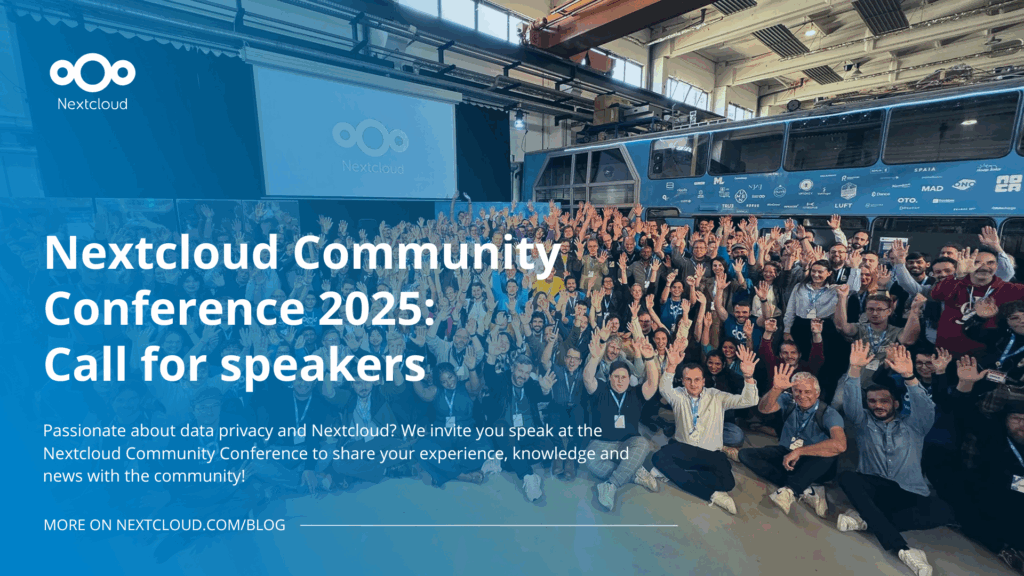
Passionate about data privacy and Nextcloud? We invite you speak at the Nextcloud Community Conference to share your experience, knowledge and news with the community!
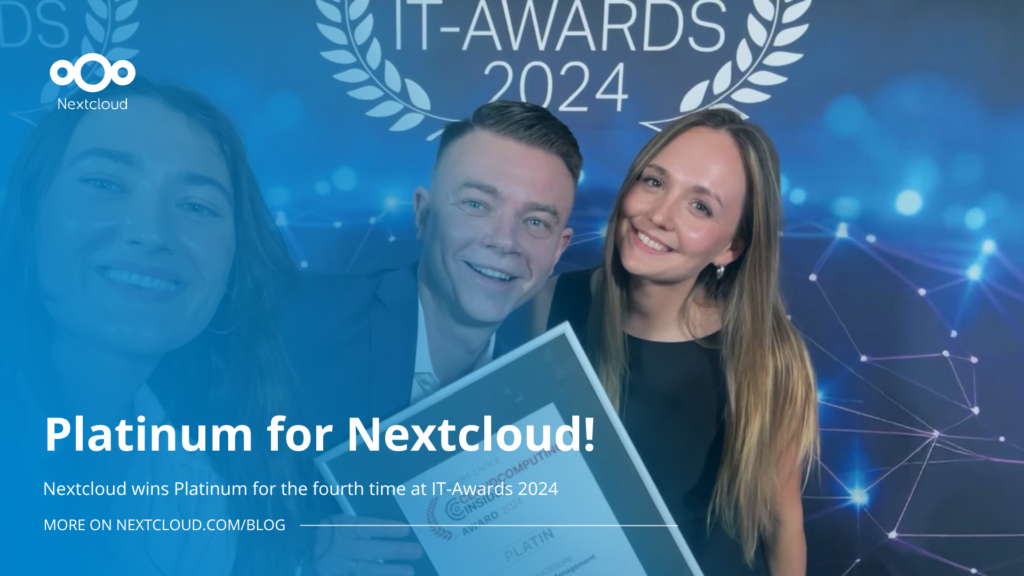
For the ninth time, Nextcloud has been nominated for the CloudComputing-Insider Readers’ Choice Award in the category of Cloud Content Management. We’d love to reach the top again! And we’re looking for the support of you and everyone else in our amazing community to get there. Nextcloud as the best Cloud Content Management tool? Only […]
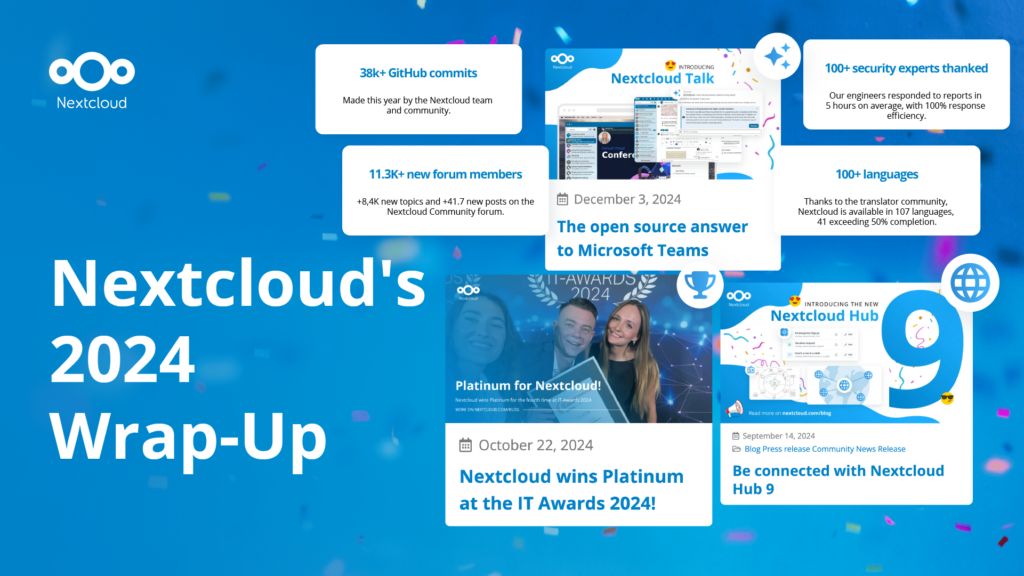
In the Nextcloud 2024 wrap-up, we want to take a moment to celebrate this year's achievements. Join us as we continue to reimagine what’s possible - shaping a world where open source, privacy and connection come together and drive progress for the greater good.
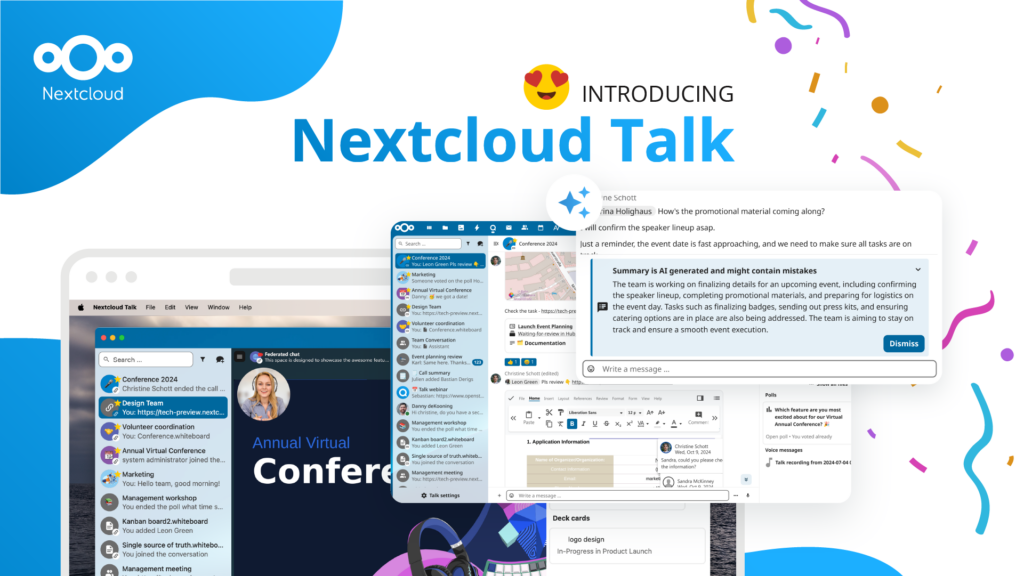
Las organizaciones, grandes y pequeñas, necesitan una forma de garantizar la resiliencia y la soberanía digital de sus operaciones: una alternativa de código abierto que respete la privacidad frente a Teams. Y hoy, presentamos esa solución: Nextcloud Talk.
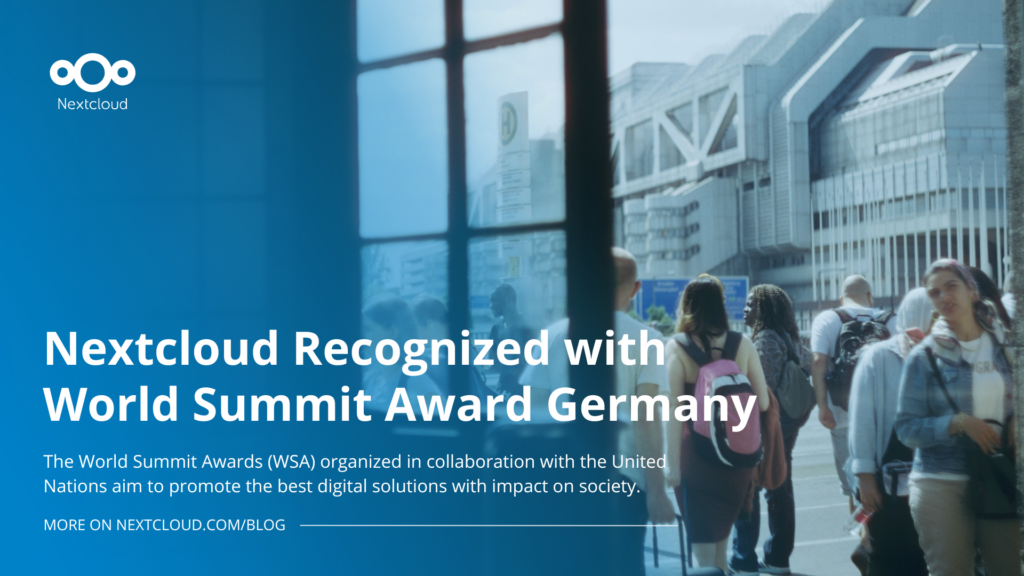
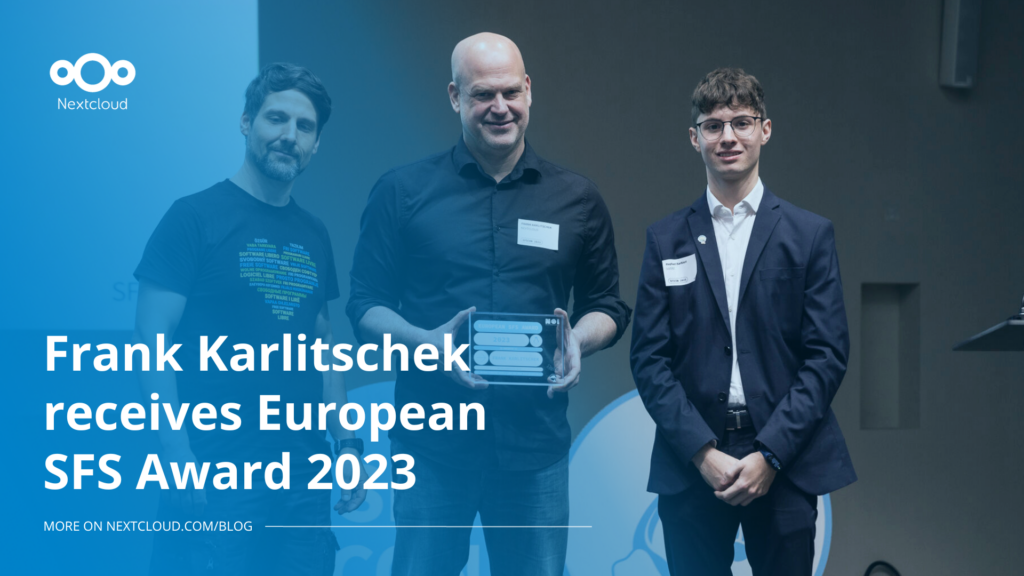
Nextcloud has been recognized with the World Summit Award Germany that selects and promotes local digital innovation improving society, aiming to contribute to the United Nations' agenda of sustainable development goals.
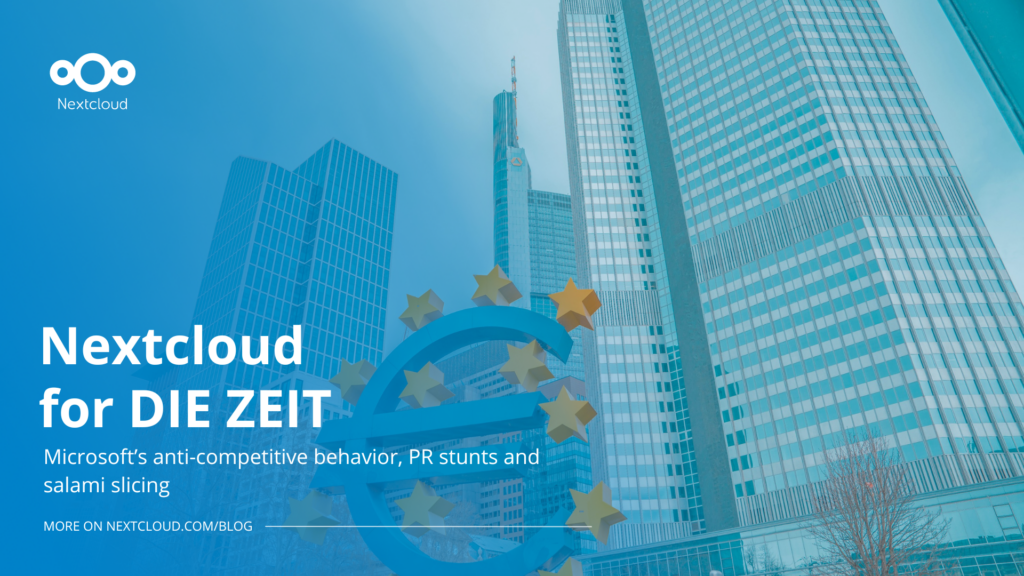
DIE ZEIT, a prominent German outlet, interviewed Nextcloud’s founder Frank Karlitschek for an article on Microsoft’s anti-competitive behaviour on the European office software market. Read for a recap of the article and the key takeaways.
MagentaCLOUD’s migration to Nextcloud in 2021 resulted in a fully equipped Online Storage with an integrated online office suite that further improves the user experience, flexibility and security for customers.
We bring you a major update to the Nextcloud AI Assistant, plus the news we work with several big hosting providers like IONOS and OVHcloud to bring AI-as-a-Service options to you!
Bechtle and Nextcloud announce today a complete managed collaboration platform for the public sector that requires no tender and can be deployed immediately.
Discover how to make the switch from ownCloud to Nextcloud. Our quick guide provides insights into the migration process, helping you make the transition smoothly.
Today, US-based file sync & share vendor Kiteworks announced their acquisition of ownCloud and Dracoon. Kiteworks points out that their customers now have access to their file-sharing application. It is to be expected they will not maintain 3 similar products, but customers will have to migrate to the US firms’ platform or look for another […]
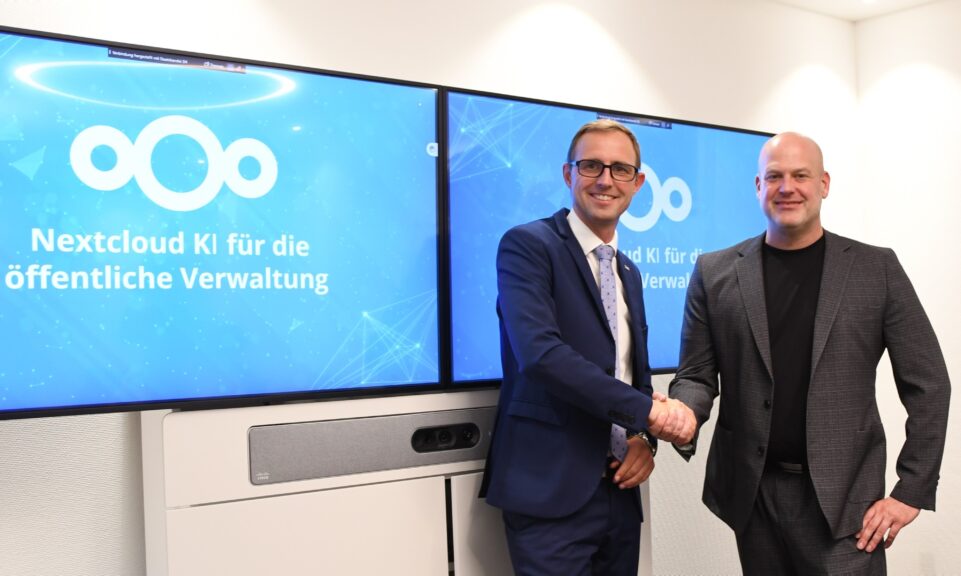
As part of Schleswig-Holstein's state digitization strategy, the state chancellery has announced they will work with Nextcloud to develop AI for working with government documents. This comes just after we announced the first private AI assistant last weekend with Hub 6. The German state already uses Nextcloud and their AI strategy aligns with our work on ethical, local AI technologies.
Nuestra misión es ayudar a particulares, empresas y organizaciones a alcanzar la soberanía digital y recuperar el control sobre sus datos. Nextcloud Hub 5 supone un enorme paso adelante en la consecución de esta misión, poniendo el poder de la IA en tus manos, de forma que mantengas el control. Nueva versión, nuevas posibilidades Hub […]
El momento de poseer tus datos es ahora. Te presentamos el nuevo Nextcloud Hub, una potente plataforma de colaboración de código abierto que te pone en control. Descubre las mejoras en rendimiento, diseño y seguridad, y muchas herramientas nuevas y mejoradas para tu trabajo y vida diaria.
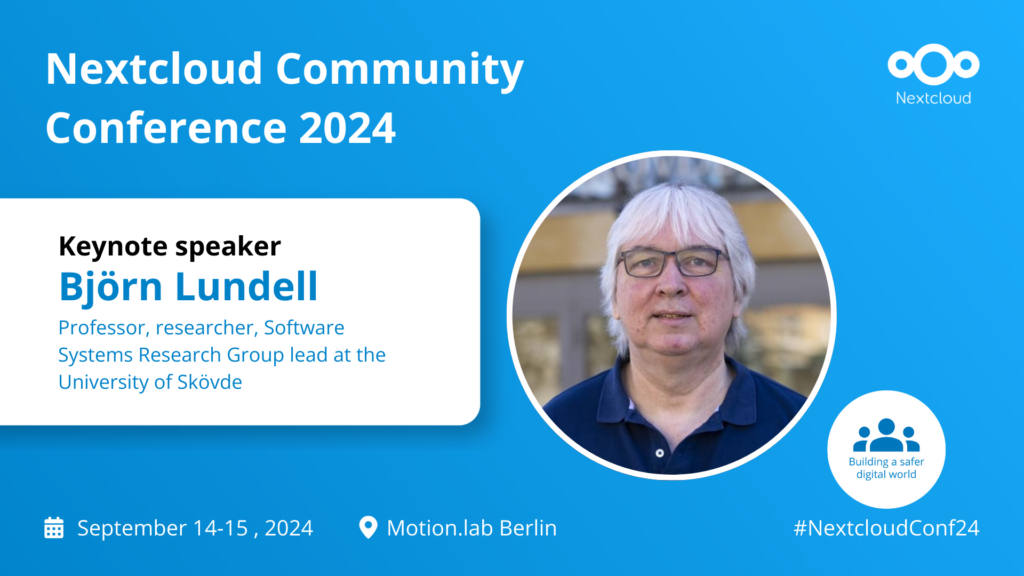
Announcing a keynote speaker at the Nextcloud Community Conference 2024 — professor Björn Lundell, a staff member and researcher at the University of Skövde who is leading the Software Systems Research Group.
Guardamos algunas cookies para contar los visitantes y facilitar el uso del sitio. Esto no sale de nuestro servidor y no es para rastrearte personalmente. Consulta nuestra política de privacidad para obtener más información. Personalización
Cookies utilizadas para guardar los datos introducidos en los formularios, como nombre, correo electrónico, número de teléfono e idioma preferido.
Nombre de la cookie:nc_form_fields
Descripción de la cookie:Recuerda los datos introducidos en los formularios para la próxima vez (nombre, correo electrónico, teléfono e idioma preferido)
Caducidad de la cookie:30 días
Consentir
Nombre de la cookie:nc_utm_parameters
Descripción de la cookie:We use cookies to store UTM parameters from your visit so we can understand how you arrived at our website.
Las cookies estadísticas recopilan información de forma anónima y nos ayudan a comprender cómo utilizan nuestro sitio web nuestros visitantes. Utilizamos Matomo alojado en la nube.
Servicio:Matomo
Descripción de la cookie:
_pk_ses*: Cuenta la primera visita del usuario
_pk_id*: Ayuda a no contar dos veces las visitas.
mtm_cookie_consent: Recuerda que el usuario ha dado su consentimiento para almacenar y utilizar cookies.
Caducidad de la cookie:_pk_ses*: 30 minutos
_pk_id*: 13 meses
mtm_cookie_consent: 30 días