Amnesty International in Spain modernized its collaboration environment by replacing an outdated Samba-based system with a secure, self-hosted Nextcloud platform. With Nextcloud, the organization gained full data control, confidential sharing capabilities, remote access, and a modern workspace for employees and activists across Spain.
Deployment was fast, completed in roughly one week. The new platform now powers everyday collaboration through Nextcloud Files, Nextcloud Office, Nextcloud Notes, and more, helping teams to work together in real time while keeping sensitive human rights data protected. Nextcloud gave Amnesty the flexibility and independence they lacked with proprietary systems, offering secure sharing, mobile access, and on-premises control without ethical compromises.
Goal:
Set up an on-premises Nextcloud instance for employees and activists to collaborate and share files with securely while safeguarding confidentiality
Organization:
Amnesty International in Spain
Sector:
NGO, non-profit
Employees:
80
Activists:
2,300
External partners:
100,000
Carlos Lopez Belenguer, IT Manager at Amnesty International in Spain, was searching for a solution that would enable large file sharing, remote work options, and give them control over their data. Mr. Belenguer identified an immense opportunity with Nextcloud: the leading Content Collaboration Platform that powers on-premises collaboration and data protection. The result was an advanced and powerful self-hosted cloud that benefited the integrity of the entire organization. With Nextcloud, Amnesty International in Spain was able to increase collaboration while maintaining confidentiality for employees and board members, integral to the success and reputation of the organization.
Amnesty International is an NGO, but also a global movement of over 10 million members, activists, and supporters who advocate for human rights, freedom, and dignity. Within Spain, the organization boasts more than 100,000 partners and over 2,300 members across the country who lead campaigns in line with the organization’s mission. Beyond that, there is a Federal General Assembly that votes on relevant issues, a Governing Board, a Federal General Council, which serves as a space for debates among activists, and a State Secretariat located in Madrid.
This customer case study presents the challenges Amnesty International in Spain previously faced, why Nextcloud was chosen as the most ideal solution, how it was implemented, why Amnesty International is happy with the results, and finally, the future outlook of the organization.
Previously, Amnesty International in Spain stored everything locally in a Samba server with mapped folders on the machines. Everything was shared either through mail or external services. As this system became outdated and inefficient, Mr. Belenguer and the rest of the IT team decided to test out Nextcloud. He was familiar with Nextcloud personally, and thought it would work well for the organization’s needs and goals.
One of the several challenges the organization faced was the lack of ability to share large files and the desired level of external file sharing security. Nextcloud provides intuitive sharing for every document, spreadsheet, presentation and note both internal and external, with a host of sharing permissions like view, edi,t and download restrictions.
Another challenge was that their teams were not as collaborative as they could be and lacked workplace fluidity. Documents were shared by mail and got long, random names like “project proposal_v4_final_reviewed-by-milan.dox” and such. The design of Nextcloud, with its fully integrated apps, provides a far more efficient collaboration space, keeping documents in one place and enabling team members to work on the same document at the same time.
Lastly, Amnesty was restricted to the limitations of their old systems. With Samba, you cannot access or sync with your files from home or mobile devices. With Nextcloud, any file is accessible anytime, anywhere, boosting flexibility. In addition, Samba does not provide the option to share files outside of your organization, which is extremely limiting. With Nextcloud, there are several options to share externally with File Drop and sharing via a link with secure access permissions. What’s more, they have the opportunity to host their servers at home, giving them full independence, flexibility, and control over their data, as Mr. Belenguer states:
A swift deployment of Nextcloud
In November 2018, the implementation phase began. The IT team provisioned a VM (virtual machine) and deployed the Nextcloud server. They connected the Nextcloud instance to their AD, and, after some work on the mem cache configuration and REDIS, they implemented an LDAP filter that suited their needs. Overall, due to great documentation, deploying Nextcloud took only about one week to implement.
From there, only some tweaks and fine tuning led to the Nextcloud setup they have today.
- Location of hardware: Remote data center
- Servers: 2
- Users: 230
- Systems: Dell Hardware
They have two main locations that have several Proxmox clusters that host VMs and containers.Almost everything is stored in SSD RAIDs 5 and 6 disk subsystems with tons of RAM.
“The Cloud”: Amnesty International in Spain’s Nextcloud
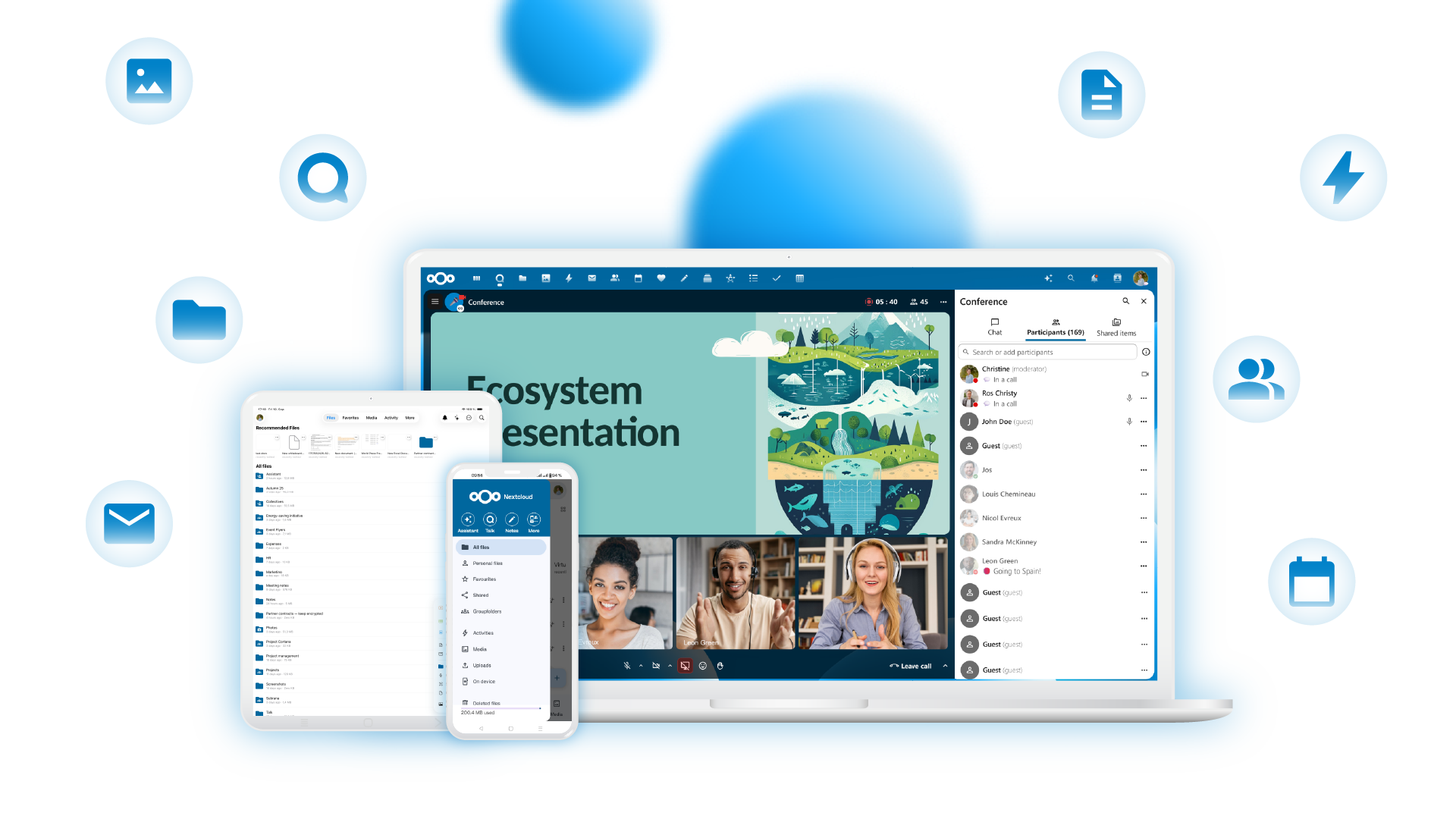
Amnesty International’s Nextcloud instance has become known as “the cloud” or “la nube” in Spanish. Consisting of Nextcloud Files, Nextcloud Office, and other smaller applications like Notes and Keeweb, the platform has transformed the way Amnesty International in Spain’s employees and activists work.
When Nextcloud was first introduced to employees, it passed with flying colors. According to one activist team consisting of members with little technical knowledge and experience, the new technology was embraced from day one. The human rights team works to write letters to government entities, and before Nextcloud, they struggled with collaborating and sharing documents. Once Nextcloud was made available, the team started to use internal shared folders with their colleagues. They also discovered the simplicity of sharing links to external activists and could even work from home. The team noted how grateful they were for the new collaboration infrastructure and how easy it was to use everything.
With Nextcloud, the teams can work with the reassurance that no confidential data will be compromised, even when files are sent to third parties.
Key advantages of Nextcloud
Embracing Technological Advancements: Vision for AI Integration
Looking forward, Amnesty International in Spain is interested in integrating AI capabilities into its Nextcloud instance. With the implementation of a local Large Language Model, they will be able to optimize and speed up the efficiency of their teams using AI functionality. Nextcloud’s on-premises AI options and publicly available models, from cloud solutions like Aleph Alpha to on-prem technology like Stable Diffusion, can be used to perform text generation, speech-to-text dictation, image generation, and so much more. The Nextcloud Assistant would work as a personal tool for employees to perform their tasks and projects quicker and easier.
Conclusion
In conclusion, the adoption of Nextcloud by Amnesty International in Spain has marked a transformative journey in enhancing collaboration and data security within the organization. Facing the challenges of an outdated system and the need for confidentiality, Nextcloud emerged as the ideal solution, which the IT team seamlessly integrated in a remarkably short time. The implementation of Nextcloud, referred to as “the cloud” within the organization, has not only streamlined internal processes but also empowered teams, such as the activist group, to work efficiently and securely.
With a future-oriented mindset, Amnesty International in Spain looks forward to integrating AI into its Nextcloud instance, further optimizing its operations. Nextcloud provides control over data without compromising ethical standards, making it an invaluable asset for Amnesty International in Spain’s mission for human rights, freedom, and dignity.