Digital sovereignty is becoming a defining issue for Europe’s future. Geopolitical tensions are reshaping alliances and forcing countries to reconsider how they cooperate and support one another. For Europe, this raises a critical question:
How can we pursue a more independent security policy that is less reliant on the United States, its long-standing Cold War partner?
Building a credible and independent defence system is no longer limited to traditional measures of military protection. It must expand into the digital world, where we host our communication, our data, and, increasingly, our democratic functions.
In other words, we cannot afford to rely solely on U.S. providers, whose systems can be cut off at their discretion.
Stronger dependencies mean less control
The case of the ICC, the International Criminal Court, has shown that such dependencies translate into a serious loss of control. Europe cannot expose its most sensitive data to external powers. Ensuring the security of our digital infrastructure must become a central pillar of our sovereignty and defence strategy.
Yet what is missing in Europe is not capability, talent, or technology. What it lacks is leadership and courage. In defence as in digital policy, the United States has historically taken the lead. Without the U.S., Europe’s military landscape would look very differently, and that dependence continues to shape transatlantic relations.
A pattern of reliance on U.S. tech, ready to be broken
A similar pattern exists in the digital world. Since the early days of the internet, Europeans have heavily relied on American technology. From Microsoft and Apple to Google and Meta, their solutions have become household names across Europe and enjoy immense popularity.
While Europe’s digital development began more slowly, it has gathered momentum.
Today, European alternatives exist across the stack, from cloud to operating systems and collaborative tools, and they are ready to compete.
Rising awareness of data protection and changes in U.S. regulations that allow for governmental access and, as such, higher surveillance, have only reinforced the need to keep data under European oversight. This is especially important for governments handling classified information.
Digital sovereignty in Europe: What does it take to champion European products and solutions?
So the real question is not whether Europe can create competitive digital solutions (spoiler: it already did!) but whether it will adopt them.
This is not a question about protectionism or capacity. It is a question of political will and confidence. After all, did Steve Jobs have a detailed master plan when Apple began? Hardly.
Apple’s success was driven by vision, allowing for some uncertainties, and persistence, not by detailed planning of outcomes. Europe needs a similar mindset: independent-thinking politicians and decision makers who question the status quo and have the competence to effect change.
Examples of change: Governments choosing digitally sovereign solutions
Some European institutions and companies have become synonymous with this spirit.
They started small, learned, and grew. Most importantly, they trusted their people to adapt to the new systems, and that the trust is reciprocal.
That is what Europe needs now: to act with confidence and follow its own best interests. The tools are there, the solutions exist. What is missing is the unwavering certainty that sovereignty (digital or otherwise) must be owned, not outsourced. Slowly but surely, Europe is waking up to this truth, seeing opportunities where before it saw only obstacles.
Be part of the digital sovereignty conversation: the Nextcloud Summit
As reliance on Big Tech continues to grow, so do concerns about data control, compliance, and security. The Nextcloud Summit brings together organizations, governments, and experts to exchange ideas and explore practical solutions for a more independent digital future.
What does this mean in practice?
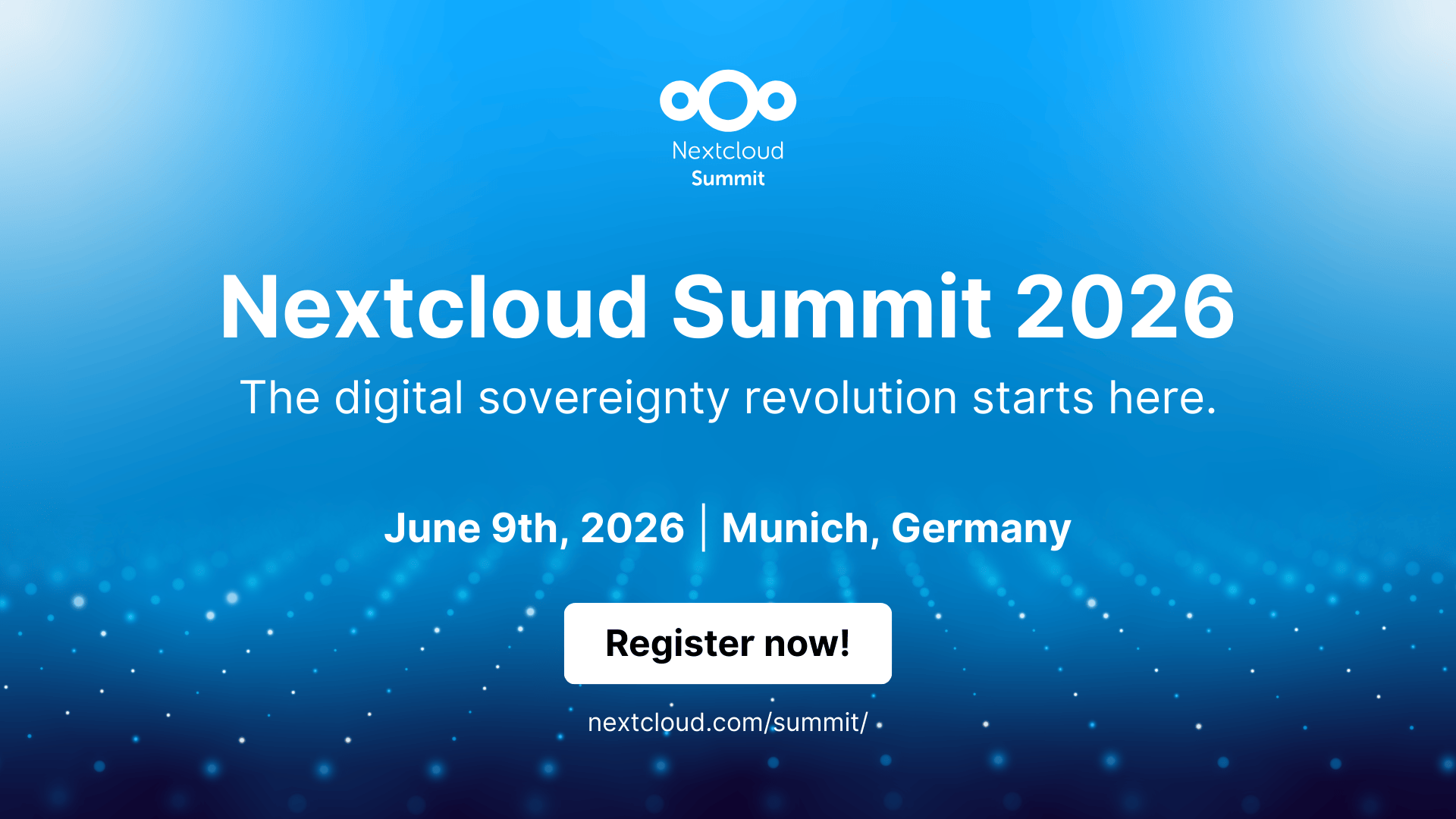
Nextcloud will gather leaders, innovators, and decision-makers in Munich, Germany, on June 9, 2026, to discuss and shape the future of digital sovereignty. Through keynotes, strategic discussions, and hands-on workshops on secure collaboration, open source infrastructure, and self-hosted technologies, participants gain insights and connections to help drive meaningful change.
This is the second time we are organizing the Nextcloud Summit, following the overwhelming success of last year’s edition.
Expect even more inspiring keynotes, thought-provoking panels, fireside chats, and interactive workshops. This is your chance to discover new approaches to secure technologies, look at practical solutions, and connect with the people building Europe’s sovereign digital infrastructure.
Get your ticket today
Join us for the Nextlcoud Summit, our biggest event up until now! Access a full day of learning, sharing, and collaborating on regaining freedom over your data, ensuring data remains in the hands of those who create it.
Le moment de reprendre le contrôle de vos données, c’est maintenant. Présentation du nouveau Nextcloud Hub, une puissante plateforme de collaboration open source qui vous met aux commandes. Découvrez les améliorations en matière de performance, de design et de sécurité, ainsi que de nombreux outils nouveaux et améliorés pour votre travail et votre vie quotidienne.
Nextcloud Hub 25 Autumn facilite le démarrage d'une collaboration puissante tout en gardant le contrôle de vos données. Des mises à jour globales du design à l'amélioration de la convivialité et des performances, découvrez notre dernière version dans ce blog.
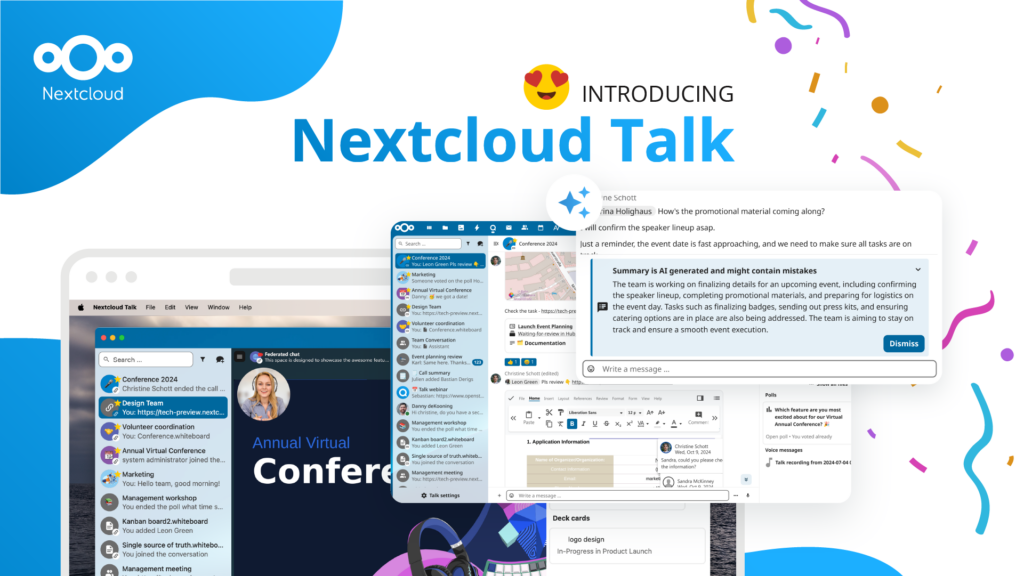
Les organisations, petites et grandes, ont besoin d'un moyen d'assurer la résilience et la souveraineté numérique de leurs opérations - une alternative à Teams, open-source et respectueuse de la vie privée. Aujourd'hui, nous vous présentons cette solution - Nextcloud Talk.
Nous vous présentons une mise à jour majeure de l'assistant Nextcloud IA, ainsi que de nouvelles informations sur notre collaboration avec plusieurs grands fournisseurs d'hébergement tels que IONOS et OVHcloud pour vous proposer des options d'IA en tant que service !
Bechtle et Nextcloud ont annoncé aujourd'hui une plateforme de collaboration entièrement administrée pour le secteur public, qui ne nécessite pas d'appel d'offres et peut être déployée immédiatement.
Découvrez comment passer de ownCloud à Nextcloud. Notre outil d'aide à la migration fournit des informations sur le processus de migration et vous aide à effectuer la transition en douceur.
Au cours de la dernière année, l'IA est devenue un sujet à la mode. Il y a de l'engouement, mais aussi du fondement. Il y a du positif et du négatif. Nous voulons vous offrir le positif, pas le négatif, et ignorer le battage médiatique ! […]
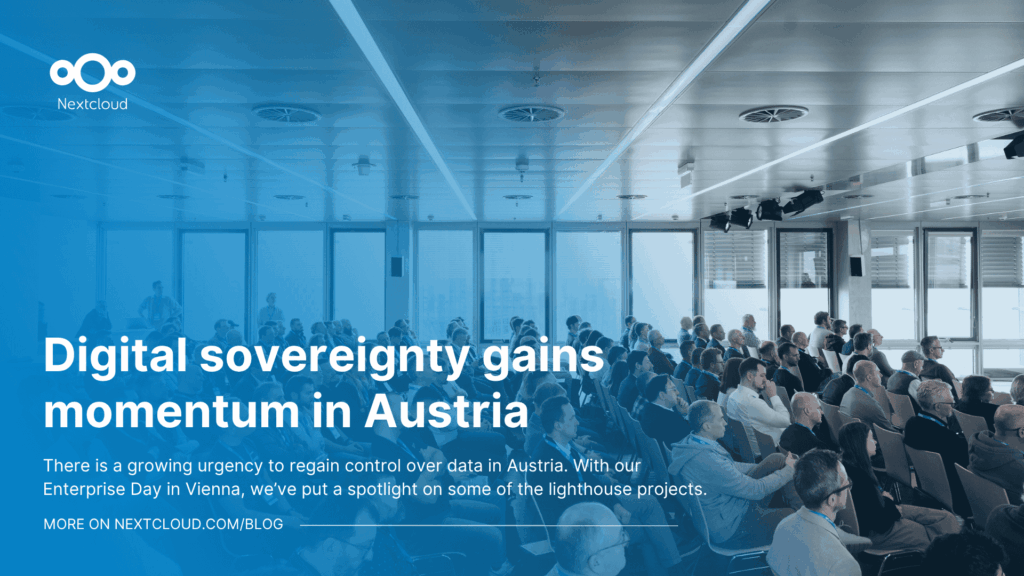
From government institutions to research organisations and private companies: There is a growing urgency to regain control over data, infrastructure and digital collaboration. Austria is actively shaping this movement with great lighthouse projects.
Nous enregistrons certains cookies pour compter les visiteurs et faciliter l'utilisation du site. Ces données ne quittent pas notre serveur et ne sont pas destinées à vous suivre personnellement ! Consultez notre politique de confidentialité pour plus d'informations Personnaliser
Les cookies utilisés pour enregistrer les données saisies dans les formulaires, telles que le nom, l'adresse électronique, le numéro de téléphone et la langue préférée.
Nom du cookie :nc_form_fields
Description du cookie :Mémorise les données saisies dans les formulaires pour une prochaine visite (nom, adresse électronique, numéro de téléphone et langue préférée).
Expiration du cookie :30 jours
Consentement
Nom du cookie :nc_utm_parameters
Description du cookie :We use cookies to store UTM parameters from your visit so we can understand how you arrived at our website.
Les cookies statistiques collectent des informations de manière anonyme et nous aident à comprendre comment nos visiteurs utilisent notre site web. Nous utilisons la solution open source de mesure de statistiques web Matomo
Service:Matomo
Description du cookie :
_pk_ses*: Compte la première visite de l'utilisateur
_pk_id*: Aide à ne pas compter deux fois les visites.
mtm_cookie_consent: Se souvient que l'utilisateur a donné son accord pour le stockage et l'utilisation de cookies.
Expiration du cookie :_pk_ses*: 30 minutes
_pk_id*: 13 mois
mtm_cookie_consent: 30 jours