About Sorbonne University
Sorbonne University is a French university located in Paris, France. In 2018, the universities of Paris-Sorbonne (Paris-IV), now the Faculty of Arts, and Pierre-et-Marie-Curie (Paris-VI) now the Faculty of Science and Medicine were merged into the Sorbonne we know today.
Sorbonne University is one of the successors of the University of Paris founded in 1896. It is organized into three faculties spread across 26 sites mainly in the Latin Quarter (Quartier Latin) and there’s even a campus in Abu Dhabi.
In 2019, Sorbonne University had 55,600 students including 10,200 international students and 6,700 researchers.
As part of its digitalization policy, Sorbonne University provides its users with personal cloud storage based on open source products hosted on its own infrastructure.
This project was dubbed ‘DropSU’ and was initiated at the end of 2019 as part of a digital policy plan. The project is rooted in the notion that Sorbonne University’s staff (15,000 employees) needed a way to store and share their documents online similar to other file sync and share services.
Requirements
- Offer an alternative service as opposed to Google and Microsoft suites
- Providing a sovereign cloud solution for their researchers, students and staff
- To be able to share, store and edit documents online, from any location
- Maintaining sovereignty of their data and user accounts
- Implementing an open source architecture managed by their IT teams
- To offer a chartered solution in the University’s colors which is easy to use
Moving to Nextcloud: Pros and cons of implementing DropSU
Sorbonne University’s users including researchers, students and staff were often accustomed to using services from Google, Amazon and Microsoft to share their data and documents for personal use.
Therefore, before introducing Nextcloud, they needed to define key pros and cons about implementing a new solution and how their users would react and process the change.
Pros:
- Data is locally hosted and thus protected by local data protection rules.
- There are controlled restricted access options to the data because of the confidentiality of research work.
- Nextcloud Hub was evaluated to be intuitive especially for new users as it provided quick and easy management of documents.
- Nextcloud Hub can be used from anywhere, without a VPN or internal network.
- Nextcloud Hub allows easy sharing to colleagues from other universities without the need for a Sorbonne University account.
Cons:
- Users are accustomed to using alternative solutions and need time and assistance to learn the new solution.
- IT staff needs to ensure the availability and operation of the service and this requires staff to be trained properly.
- Training staff is a financial cost for the University.
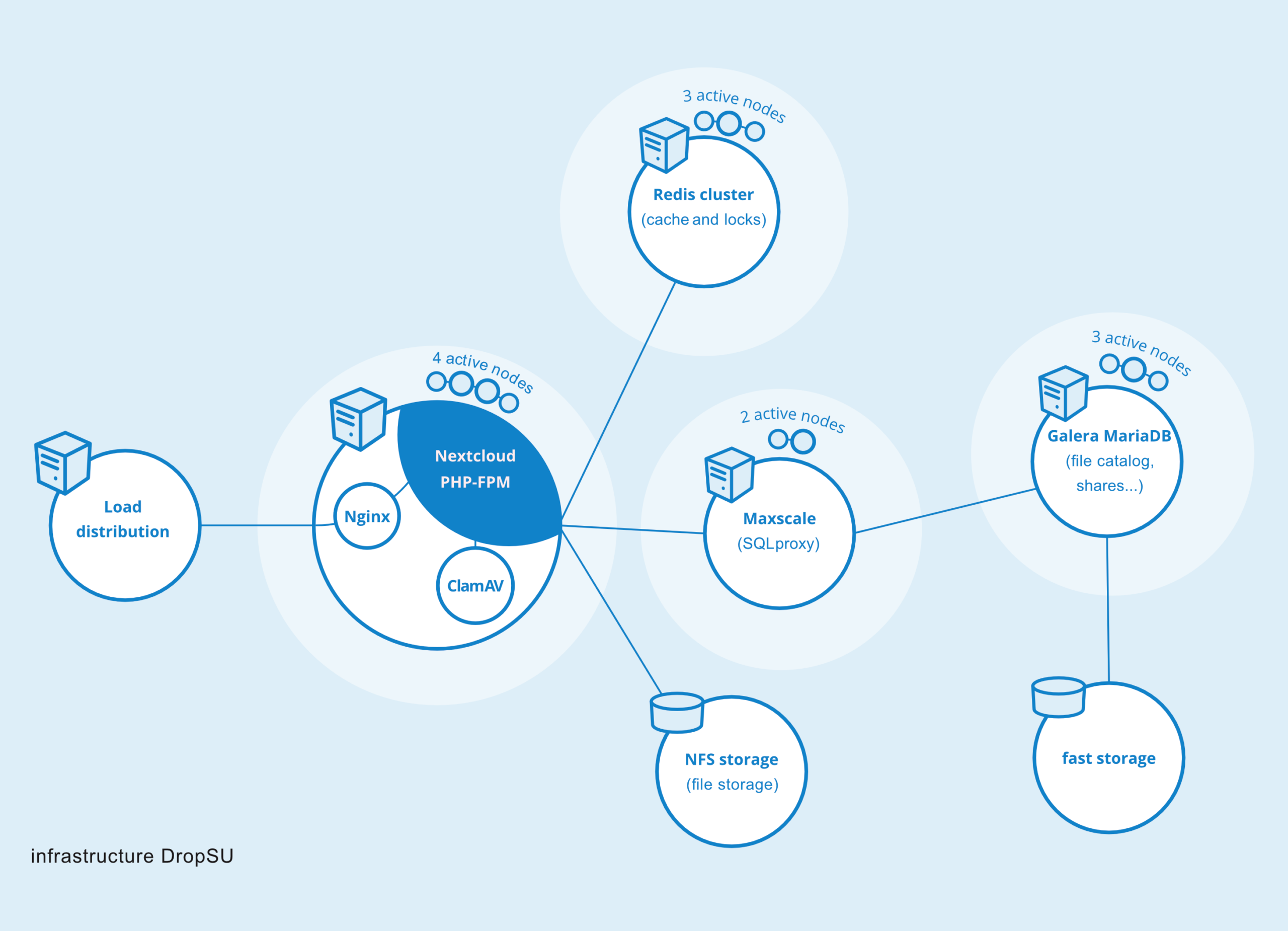
The following technologies are used for Nextcloud Hub (DropSU) at Sorbonne University.
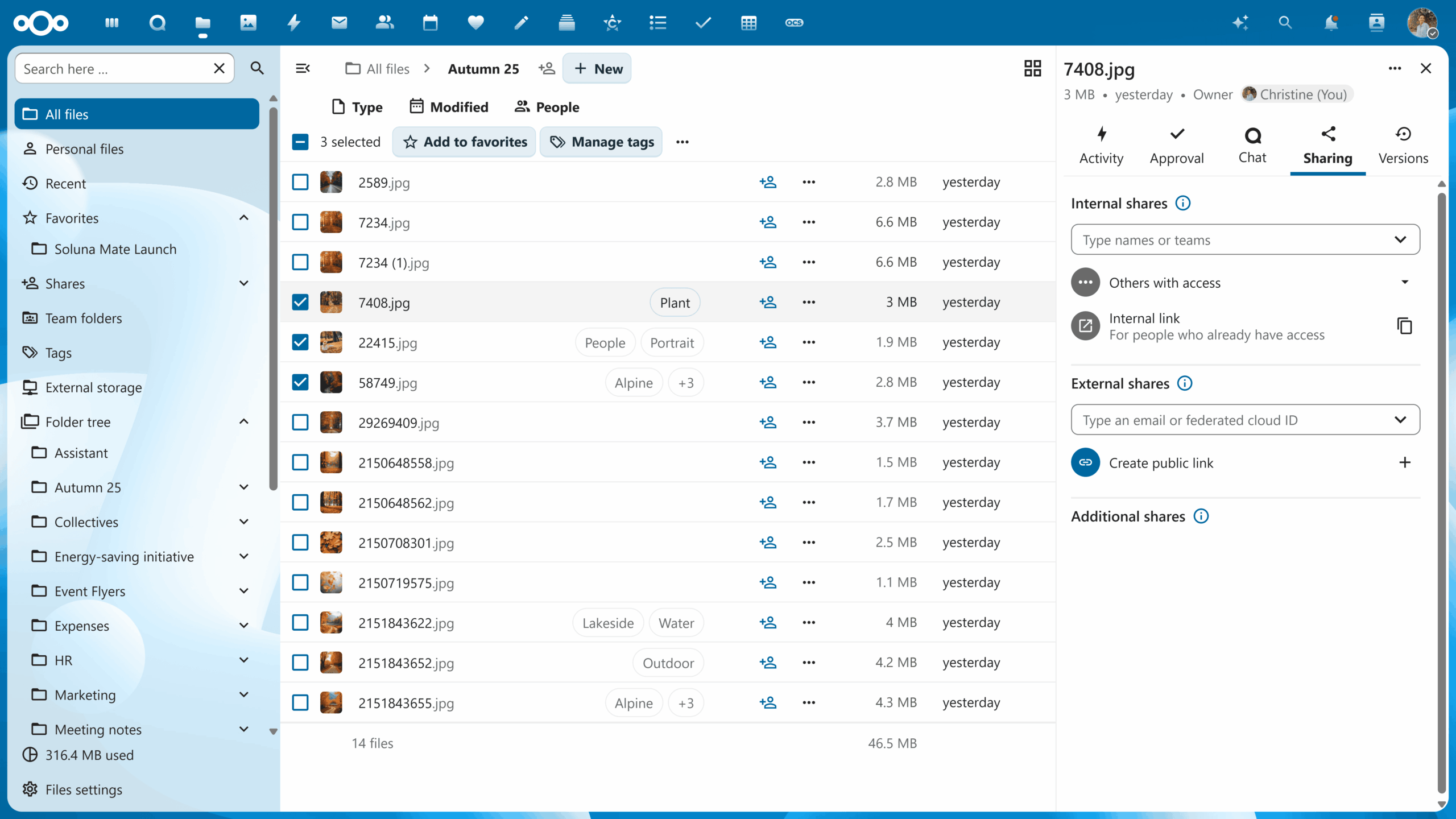
At the application level, Nextcloud Hub is used for storage and document sharing. Within Nextcloud Hub, extendible menus provide Nextcloud apps and collaborative plugins integrated with OnlyOffice to enable collaborative document editing.
At the middleware and database layer it runs Redis, Galera, RabbitMQ and Postgres. The infrastructure level consists of 12 production servers, 4 application servers for load balancing (for Nextcloud), a Galera cluster with 3 databases, 3 Redis databases (for Nextcloud) and 2 MaxScale SQL proxies combined with a cluster of OnlyOffice in active/passive mode on 2 application servers.
There is also a tight integration with directory services (LDAP) and authentication services (SSO viaLemonLDAP/SAML) for account provisioning and authentication management.
The project was a success and within two years Nextcloud Hub (DropSU) reached several thousand active accounts for the University staff alone and the service stored 40TB of data.
Overall, Nextcloud was able to achieve all of Sorbonne’s requirements including providing an easy-to-use digital platform, satisfying their data sovereignty policy and curating an open source technical architecture.
The technical architecture was set up with the help of Arawa, a Gold Partner of Nextcloud. Arawa also assists the University with the maintenance and support of Nextcloud Hub.
Looking forward, the University of Sorbonne aims to:
- Implement an object-oriented secondary storage which includes the migration of the current NAS storage to a S3 mode.
- Open up the service to its 55,000 students. Nextcloud Hub (DropSU) will include on-demand and process-based account provisioning to manage the number of licences used and to optimize the volume of accounts and data.
- Use additional Nextcloud apps to provide more collaborative capabilities to users like: Contacts, Deck (Kanban), Notes, and more.
- Establish a deeper integration with users’ emails or project management.
- Enable higher storage quotas.